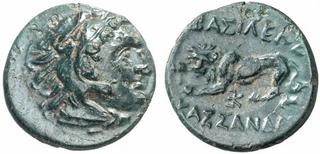
File:Kassander316BC.jpg · Wikimedia Commons · See Wikimedia Commons
Cassander
Sign in to saveCassander (; ; 355 BC – 297 BC) was king of the Ancient Greek kingdom of Macedonia from 305 BC until 297 BC, and de facto ruler of southern Greece from 317 BC until his death.
Key facts
- Royalty.name
- Cassander
- Royalty.image
- Kassander316BC.jpg
- Royalty.caption
- Bronze coin of Cassander. The reverse depicts a lion and an inscription in Ancient Greek reading "ΒΑΣΙΛΕΩΣ ΚΑΣΣΑΝΔΡΟΥ", [of] King Cassander.
- Royalty.succession
- King of Macedonia
- Royalty.reign
- 305 – 297 BC
- Royalty.predecessor
- Alexander IV
- Royalty.successor
- Philip IV
- Royalty.house
- Antipatrid dynasty
- Royalty.spouse
- Thessalonike of Macedon
- Royalty.father
- Antipater
- Royalty.birth_date
- 355 BC
- Royalty.death_date
- 297 BC (aged 58)
- Royalty.death_place
- Pella
- Royalty.religion
- Ancient Greek Religion
via Wikipedia infobox
Wikidata facts
- Instance of
- human
- Gender
- male
- Place of death
- Macedonia
- Spouse
- Thessalonike of Macedon
- Father
- Antipater
- Sibling
- Pleistarchus
- Occupation
- regent
- Position held
- king of Macedonia
- Languages spoken
- Ancient Greek
- Family
- Antipatrid dynasty
- Noble title
- king
- Image
- Coin of Cassander.jpg
Show 5 more facts
- Commons category
- Cassander
- date of death
- 0296-00-00
- date of birth
- 0355-00-00
- described by source
- Pauly–Wissowa
- cause of death
- edema
Sources (3)
via Wikidata · CC0
~10 min read
Encyclopedic overview
5 sectionsContents
- Early history
- Rule of Macedon
- Legacy
- Notes
- References
Cassander (; ; 355 BC – 297 BC) was king of the Ancient Greek kingdom of Macedonia from 305 BC until 297 BC, and de facto ruler of southern Greece from 317 BC until his death.
A son of Antipater and a contemporary of Alexander the Great, Cassander was one of the Diadochi who warred over Alexander's empire following the latter's death in 323 BC. Cassander later seized power by having Alexander's son and heir Alexander IV murdered. While governing Macedonia from 317 BC until 297 BC, Cassander focused on strengthening the northern borders and economic development, while founding or restoring several cities (including Thessalonica, Cassandreia, and Thebes); though his ruthlessness in dealing with political enemies influences assessments of his rule.
Excerpted from Wikipedia’s “Cassander” article, available under the CC BY-SA 4.0 licence.