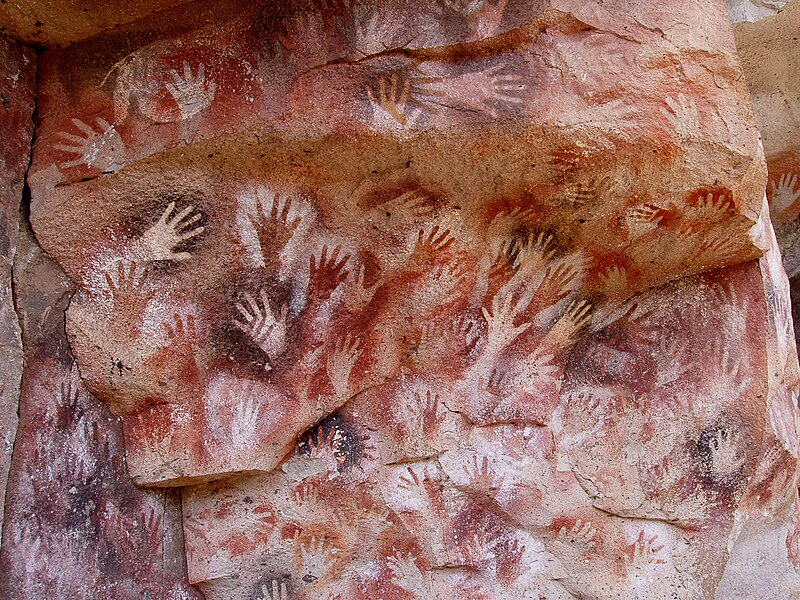
File:SantaCruz-CuevaManos-P2210651b.jpg · Wikimedia Commons · See Wikimedia Commons
cave painting
Sign in to savepaintings found on cave walls and ceilings
Cave paintings are artworks created by ancient people on the walls and ceilings of caves, typically depicting animals and human figures. They matter because they represent some of the earliest known examples of human artistic expression and provide insight into the lives, beliefs, and capabilities of prehistoric peoples.
AI-generated from the Wikipedia summary — may contain errors.
Wikidata facts
- Subclass of
- rock art
- Image
- Rhinos Chauvet Cave.jpg
Show 3 more facts
- Commons category
- Cave paintings
- topic's main category
- Category:Cave paintings
- earliest date
- 38000-00-0
via Wikidata · CC0
~33 min read
Encyclopedic overview
Cueva de las Manos, Perito Moreno, Argentina. The art in the cave is dated between 7,300 BC and 700 AD; stenciled, mostly left hands are shown. In archaeology, cave paintings are a type of parietal art (which category also includes petroglyphs, or engravings), found on the wall or ceilings of caves. The term usually implies prehistoric origin. Several groups of scientists suggest that the oldest of such paintings were created not by Homo sapiens, but by Denisovans and Neanderthals.
Discussion around prehistoric art is important in understanding the history of Homo sapiens and how human beings have come to have unique abstract thoughts. Some point to these prehistoric paintings as possible examples of creativity, spirituality, and sentimental thinking in prehistoric humans.
Excerpted from Wikipedia’s “cave painting” article, available under the CC BY-SA 4.0 licence.
Gallery (12)
Available in 61 languages
- Español
- Français
- Deutsch
- 中文
- 日本語
- Русский
- Português
- Italiano
- العربية
- हिन्दी
- Afrikaans
- Albanian
- Armenian
- Azerbaijani
- Bahasa Indonesia
- Bangla
- Basque
- Belarusian
Show 42 more
- Czech
- Danish
- Esperanto
- Estonian
- Georgian
- Greek
- Hausa
- Hebrew
- Hungarian
- Icelandic
- Ido
- Limburgish
- Lithuanian
- Macedonian
- Malay
- Marathi
- Minangkabau
- Nederlands
- Newari
- Norwegian
- Norwegian Nynorsk
- Occitan
- Papiamento
- Polski
- Romanian
- Serbian
- simple
- Sinhala
- Slovak
- Slovenian
- Svenska
- Tamil
- Telugu
- Tiếng Việt
- Türkçe
- Ukrainian
- Urdu
- Venetian
- Veps
- Western Frisian
- فارسی
- 한국어
via Wikidata sitelinks · CC0