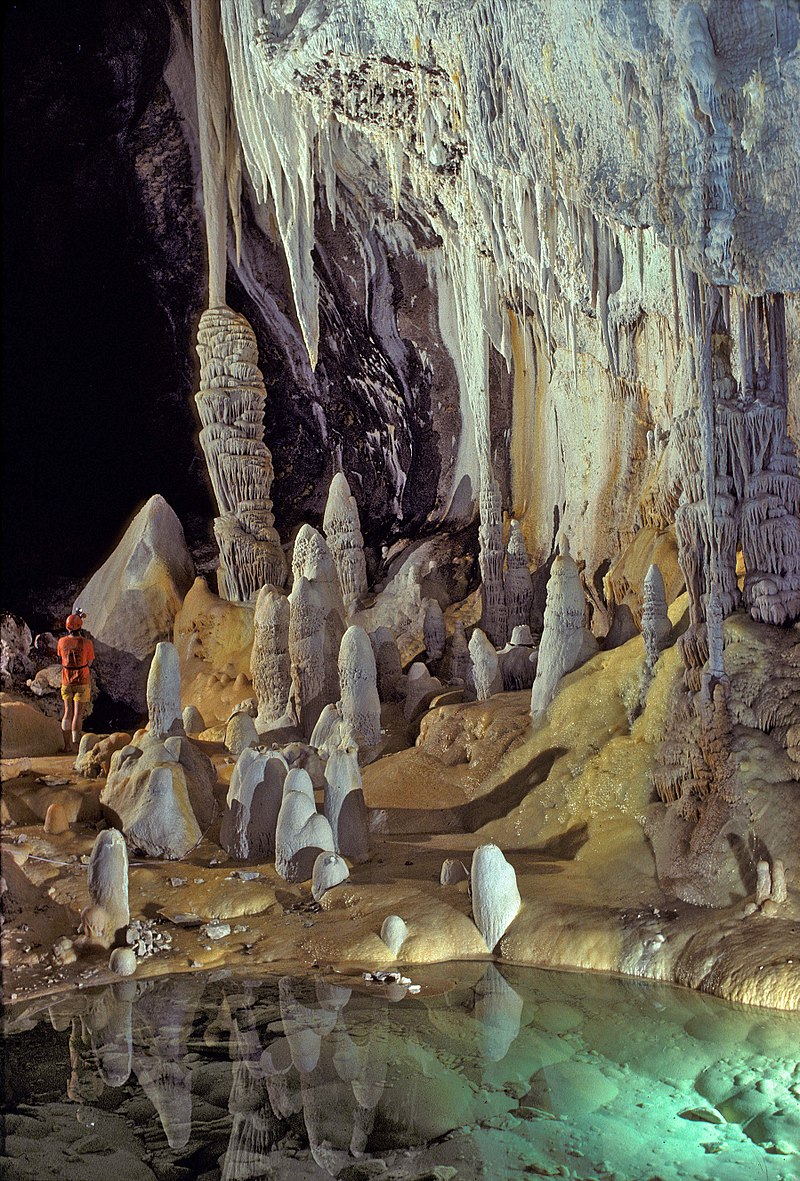
File:Lechuguilla_Cave_Pearlsian_Gulf.jpg · Wikimedia Commons · See Wikimedia Commons
caverna
Sign in to saveAlso known as cavern
cavidade natural rochosa com dimensões que permitam acesso a seres humanos
A cave is a natural underground hollow or chamber formed in rock, such as the Lechuguilla Cave shown in New Mexico. Caves matter because they serve as important geological features, provide habitats for unique wildlife, and offer opportunities for scientific study and exploration.
AI-generated from the Wikipedia summary — may contain errors.
Research
14,895 papers- Cave Microbes as a Potential Source of Drugs Development in the Modern Era.ReviewMicrobial ecology · 2022Zada S, Sajjad W, Rafiq M et al.DOI: 10.1007/s00248-021-01889-3
- Revisiting the cave-dwelling sand flies (Diptera, Psychodidae, Phlebotominae) from Brazil: Diversity and potential role in the transmission of Leishmania Ross, 1903 (Kinetoplastida: Trypanosomatidae).Medical and veterinary entomology · 2022Dutra-Rêgo F, Freire ML, Carvalho GML et al.DOI: 10.1111/mve.12578
- Bubble-induced cave collapse.PloS one · 2015Girihagama L, Nof D, Hancock CDOI: 10.1371/journal.pone.0122349
- Cave Thiovulum (Candidatus Thiovulum stygium) differs metabolically and genomically from marine species.The ISME journal · 2023Bizic M, Brad T, Ionescu D et al.DOI: 10.1038/s41396-022-01350-4
- Cave microorganisms: hidden players in global greenhouse gas cycling and climate regulation.ReviewCurrent opinion in microbiology · 2026Martin-Pozas T, Cuezva S, Fernandez-Cortes A et al.DOI: 10.1016/j.mib.2026.102707
- The ticking clock in the dark: Review of biological rhythms in cave invertebrates.ReviewChronobiology international · 2024de Souza PE, Souza-Silva M, Ferreira RLDOI: 10.1080/07420528.2024.2348010
- Cave beetle lineages gained genes before going down under: An example of repeated genomic exaptation?Journal of experimental zoology. Part B, Molecular and developmental evolution · 2024Friedrich MDOI: 10.1002/jez.b.23245
- Gut microbiota reflect adaptation of cave-dwelling tadpoles to resource scarcity.The ISME journal · 2024Zhu W, Chang L, Shi S et al.DOI: 10.1093/ismejo/wrad009
via PubMed
Wikidata facts
- Image
- Lechuguilla Cave Pearlsian Gulf.jpg
Show 8 more facts
- OpenStreetMap tag
- natural=cave_entrance
- Commons category
- Caves
- topic's main category
- Category:Caves
- equivalent class
- dbpedia.org/ontology/Cave
- Commons gallery
- Cave
- has list
- list of caves
- on focus list of Wikimedia project
- Wikipedia:Vital articles/Level/4
- exact match
- purl.obolibrary.org/obo/ENVO_00000067
Sources (7)
via Wikidata · CC0
Article · Português
Caverna, gruta ou furna é toda cavidade natural rochosa com dimensões que permitam acesso a seres humanos. Podem ter desenvolvimento horizontal ou vertical em forma de galerias e salões. Ocorrem com maior frequência em terrenos formados por rochas sedimentares, mas também em rochas ígneas e metamórficas, além de geleiras e recifes de coral. São originárias de uma série de processos geológicos que podem envolver uma combinação de transformações químicas, tectônicas, biológicas e atmosféricas. Devido às condições ambientais exclusivas das cavernas, esse ecossistema apresenta uma fauna especializada para viver em ambientes escuros e sem vegetação nativa. Outros animais, como os morcegos, podem transitar entre seu interior e exterior. As cavernas também foram utilizadas, em idades remotas, como ambiente seguro e moradia para o homem primitivo, fato comprovado pela imensa variedade de evidências arqueológicas e pela arte rupestre. Em alguns casos essas cavidades também podem ser chamadas de tocas, lapas ou abismos. Os termos relativos a caverna geralmente utilizam a raiz espeleo-, derivada do latim spelaeum, do grego σπήλαιον, "caverna", da mesma raiz da palavra "espelunca". As cavernas são estudadas pela espeleologia, uma ciência multidisciplinar que envolve diversos ramos do conhecimento, como a geologia, hidrologia, biologia, paleontologia e arqueologia. Além da importância científica, a exploração de cavernas representa um grande papel no turismo de aventura (ou ecoturismo), sendo uma parte importante da economia das regiões em que ocorrem.
Abstract from DBpedia / Wikipedia · CC BY-SA
Gallery (44)
Available in 125 languages
- Español
- Français
- Deutsch
- 中文
- 日本語
- Русский
- Português
- Italiano
- العربية
- हिन्दी
- Afrikaans
- Albanian
- Albanian
- Amharic
- ami
- Aragonese
- Armenian
- Asturian
Show 106 more
- Aymara
- azb
- Azerbaijani
- Bahasa Indonesia
- Balinese
- Bangla
- Banjar
- Bashkir
- Basque
- bat_smg
- Belarusian
- Bikol
- Bosnian
- Bulgarian
- Burmese
- Catalan
- Central Kurdish
- Cherokee
- Chuvash
- Croatian
- Czech
- Danish
- Egyptian Arabic
- Esperanto
- Estonian
- Faroese
- Fijian
- Filipino
- Finnish
- Galician
- Georgian
- Greek
- Guarani
- Gujarati
- Haitian Creole
- Hebrew
- Hungarian
- Icelandic
- Ido
- Interlingua
- Inuktitut
- Irish
- Javanese
- Kannada
- Kashmiri
- Kazakh
- Kyrgyz
- Latin
- Latvian
- Limburgish
- Lingala
- Lithuanian
- Macedonian
- Malay
- Malayalam
- Manx
- Marathi
- Mari
- Mingrelian
- Nederlands
- Nepali
- Newari
- Norwegian
- Norwegian Nynorsk
- Occitan
- Polski
- Punjabi
- Quechua
- roa_rup
- Romanian
- Scots
- Scottish Gaelic
- Serbian
- Serbian (Latin)
- Shona
- Sicilian
- simple
- Slovak
- Slovenian
- Southern Sotho
- Sundanese
- Svenska
- Swahili
- Tajik
- Tamil
- Tatar
- Telugu
- Tiếng Việt
- Türkçe
- Ukrainian
- Urdu
- Uzbek
- Venetian
- Walloon
- Waray
- Welsh
- Western Frisian
- Western Panjabi
- Wu Chinese
- Yiddish
- zh_classical
- zh_yue
- Zhuang
- فارسی
- ไทย
- 한국어
via Wikidata sitelinks · CC0