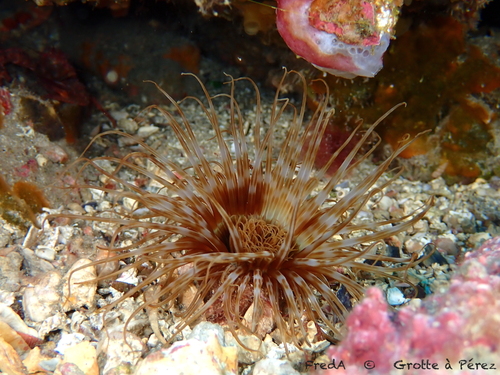
(c) Frédéric ANDRE, some rights reserved (CC BY-NC), uploaded by Frédéric ANDRE · cc-by-nc
Cerianthus
Sign in to saveCerianthus is a genus of tube-dwelling anemones in the family Cerianthidae. Members of the genus are found worldwide. They are predators, scavengers and omnivores.
Species
ceriantharian anemones
GENUS
- KingdomAnimalia
- PhylumCnidaria
- ClassAnthozoa
- OrderCeriantharia
- FamilyCerianthidae
via GBIF
Museum specimens
- Specimen records
- 110
- With media
- 22
- Family
- Cerianthidae
- Collections
- YPM, USNM, SIO, CAS, MCZ, CMN
- Recorded in
- United States, Saudi Arabia, Pakistan, Belize, Philippines, Tonga, Malaysia, Palmyra Atoll
Wikidata facts
- Instance of
- taxon
- Parent taxon
- Cerianthidae
- Image
- Cerianthus membranaceus Spallanzani, 1784.jpg
Show 4 more facts
- taxon name
- Cerianthus
- taxon rank
- genus
- Commons category
- Cerianthus
- topic's main category
- Category:Cerianthus
Sources (1)
via Wikidata · CC0
~2 min read
Encyclopedic overview
3 sectionsContents
- Characteristics
- Species
- References
Cerianthus is a genus of tube-dwelling anemones in the family Cerianthidae. Members of the genus are found worldwide. They are predators, scavengers and omnivores.
==Characteristics== Members of this genus do not have a pedal disc with which to hold themselves in position. Instead they live semi-buried in soft substrate surrounded by a parchment-like tube which they secrete. This surrounds the whole anemone up to its crown of tentacles. Sand grains, debris and shell fragments usually stick to the outer side of the tube. When it is disturbed, the anemone retracts swiftly back into the tube. Some of the larger species can have a column of up to in length. The longitudinal muscles in the trunk are powerful but the transverse ones are weak. The outer ring of tentacles are long and tapering. The tube is flexible and the anemone can extend its tentacles a surprisingly long way. The inner ring of tentacles surrounds the central mouth and assists in pushing food inside.
Excerpted from Wikipedia’s “Cerianthus” article, available under the CC BY-SA 4.0 licence.