
OverviewAI-generated
Chad, officially the Republic of Chad, is a landlocked sovereign state in Africa. Its capital is N'Djamena. The country shares borders with Cameroon, Libya, Niger, and Nigeria. It is a member of the United Nations, African Union, World Trade Organization, and Organisation of Islamic Cooperation. The name Chad is derived from Lake Chad.
The official languages are French and Arabic. The currency is the Central African CFA franc. The head of state includes Idriss Déby and Mahamat Déby, while the head of government is Albert Pahimi Padacké and Idriss Déby. The national anthem is La Tchadienne. The top-level Internet domain is .td. The telephone country code is 235.
Chad has a population of 19,340,757 and covers an area of 1,284,000. The highest point is Emi Koussi. The country contains administrative entities such as Bahr el Gazel, Batha Region, Borkou, and Chari-Baguirmi Region. It is located at coordinates 15.466667, 19.4.
Synthesized by Vinony from 67 facts across 9 sources: Wikidata, REST Countries, Open Meteo, Openweathermap, World Bank, OpenStreetMap, PubMed, Vinony graph, Geo. Generated from structured data (not the Wikipedia text) and checked against those facts — may still contain errors.
In the Vinony graph
Ciad is indexed among the 215 entries in Vinony's Countries collection.
Vinony's link graph records 7,745 inbound references to Ciad, and connects out to African Union, Sahel and traditional African religion.
The entry is geolocated on the map in city, across 60 mapped points.
It sits within the topics 1960 establishments in Africa, 1960 establishments in Chad and Chad.
Weather now
cached 8h ago7-day forecast
via Open-Meteo
Country
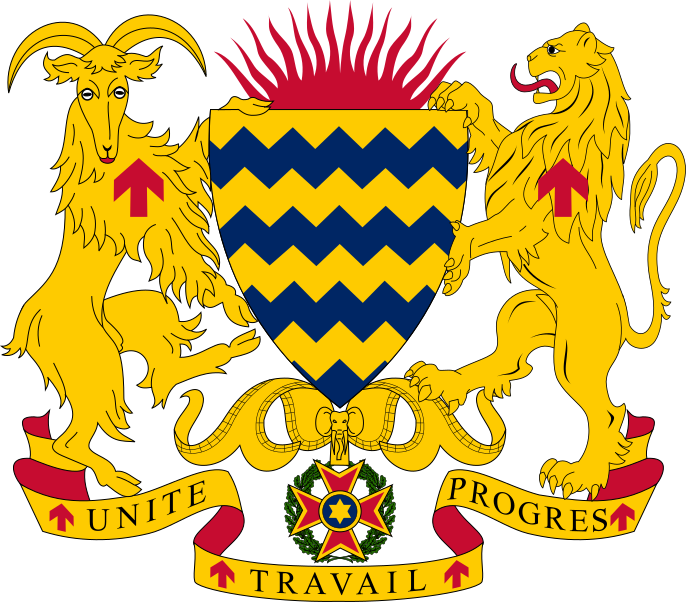
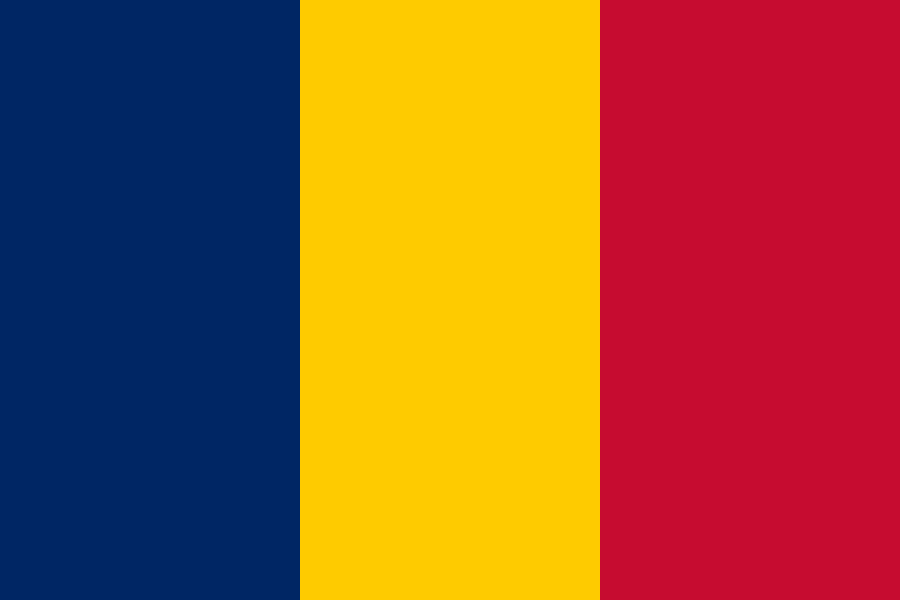
- Capital
- N'Djamena
- Population
- 19,340,757
- Region
- Africa · Middle Africa
- Demonym
- Chadian
- Currencies
- XAF (Fr)
- Languages
- Arabic, French
- Calling code
- +235
- Drives on
- Right
- Gini
- 43.3 (2011)
- FIFA code
- CHA
- TLD
- .td
- Timezones
- UTC+01:00
- Borders
- CMR, CAF, LBY, NER, NGA, SDN
via REST Countries
Indicators · World Bank
- GDP
- $19.5B(2024)
- Population
- 20,299,123(2024)
- Life expectancy
- 55.2 yrs(2024)
- Unemployment
- 1.1 %(2025)
- Urban population
- 26.9 %(2024)
- Internet users
- 12.6 %(2024)
- Forest area
- 3.2 %(2023)
- Renewable energy
- 70 %(2022)
via World Bank Open Data · CC BY 4.0
Wikipedia views (30d)
86,804 totalvia Wikimedia Pageviews API
Key facts
- Country.calling_code
- +235
- Country.cctld
- .td
- Country.conventional_long_name
- Republic of Chad
- Country.common_name
- Chad
- Country.image_flag
- Flag of Chad.svg
- Country.image_coat
- Coat of arms of Chad.svg
- Country.symbol_type
- Coat of arms
- Country.national_anthem
- File:La Tchadienne (instrumental).ogg
- Country.capital
- N'Djamena
- Country.largest_city
- capital
- Country.religion_year
- 2020
- Country.demonym
- Chadian
- Country.government_type
- Unitary semi-presidential republic under a hereditary dictatorship
- Country.leader_title1
- President
- Country.leader_name1
- Mahamat Déby
- Country.leader_title2
- Prime Minister
- Country.leader_name2
- Allamaye Halina
- Country.legislature
- Bicameral parliament
via Wikipedia infobox
Research
4,262 papers- Epilepsy in CHAD: Realities, constraints, and prospects.ReviewEpilepsia open · 2024Sakadi F, Christian MN, Lamine TM et al.DOI: 10.1002/epi4.13087
- Chad eliminates gambiense sleeping sickness.The Lancet. Infectious diseases · 2024Boisson-Walsh ADOI: 10.1016/S1473-3099(24)00524-3
- Chad.Department of State publication. Background notes series · 1988United States. Department of State. Bureau of Public Affairs
- Chad 2014-15.Studies in family planning · 2016DOI: 10.1111/sifp.12003
- Women's autonomy and fertility in Chad.African journal of reproductive health · 2023Tagang G, Rwenge JMDOI: 10.29063/ajrh2023/v27i11.8
- [Chad].Jeune Afrique (Paris, France : 1980) · 1996
- Gini index decomposition by deprivation in multidimensional poverty: evidence from Chad.ReviewGaceta sanitaria · 2023Demsou TDOI: 10.1016/j.gaceta.2023.102299
- Chad.Department of State publication. Background notes series · 1992United States. Department of State. Bureau of Public Affairs. Office of Public Communication
via PubMed
Wikidata facts
- Instance of
- country
- Named after
- Lake Chad
- Official name
- Republic of Chad
- Demonym
- Seadach
- Country
- Chad
- Contains
- Borkou
- Continent
- Africa
- Capital
- N'Djamena
- Official language
- Arabic
- Currency
- Central African CFA franc
- Population
- 19319064
- Area
- 1284000.0
- Body of water
- Lake Chad
- Head of government
- Idriss Déby
- Head of state
- Mahamat Déby
- Legislature
- National Assembly
- Anthem
- La Tchadienne
- Shares border with
- League of Arab States
- Highest point
- Emi Koussi
- Life expectancy
- 52.903
- Nominal GDP
- 12704149842
- Unemployment rate
- 7
- Calling code
- +235
- Licence plate code
- TD
Show 58 more facts
- Electrical plug type
- Europlug
- Mains voltage
- 220
- Motto
- Unitat, treball, progrès
- Flag
- flag of Chad
- Coat of arms
- coat of arms of Chad
- top-level Internet domain
- .td
- Commons category
- Chad
- topic's main category
- Category:Chad
- category for people who died here
- Category:Death in Chad
- category for people born here
- Category:Births in Chad
- category for films shot at this location
- Category:Films shot in Chad
- category of associated people
- Category:Chadian people
- diplomatic relation
- North Korea
- topic's main Wikimedia portal
- Portal:Chad
- Commons gallery
- Tchad
- lowest point
- Bodélé Depression
- mobile country code
- 622
- driving side
- right
- geography of topic
- Geography of Chad
- history of topic
- history of Chad
- marriageable age
- 15
- Human Development Index
- 0.394
- office held by head of government
- President of Chad
- number of out-of-school children
- 1727279
- office held by head of state
- President of Chad
- located in/on physical feature
- Central Africa
- total fertility rate
- 6.156
- maritime identification digits
- 670
- inception
- 1960-08-11
- Unicode character
- 🇹🇩
- language used
- Marfa
- suicide rate
- 8.0
- culture
- culture of Chad
- VAT rate
- 18
- twinned administrative body
- Aisai
- BTI Status Index
- 3.07
- BTI Governance Index
- 2.55
- economy of topic
- economy of Chad
- demographics of topic
- demographics of Chad
- different from
- Tchad
- madhhab
- Malikism
- Democracy Index
- 1.55
- P11012
- Encyclopædia Britannica
- central bank
- Bank of Central African States
- hashtag
- Chad
- on focus list of Wikimedia project
- Wikipedia:Vital articles/Level/4
- Gini coefficient
- 37.5
- Happy Planet Index score
- 30.4
- Inequality-adjusted Human Development Index
- 0.251
- P12749
- River Wandle
- birth rate
- 43.184
- male population
- 8896002
- death rate
- 12.157
- rural population
- 13458554
- female population
- 8827313
- urban population
- 4264761
- native label
- جُمْهُورِيَّة تشاد
Sources (15)
via Wikidata · CC0
Travel guide
Get around
In N'Djamena there are both vehicle taxis and motorcycle taxis. In some major towns, such as Moundou and Sarh, there might be only "clandos" - motorcycle taxis - or rikshas (more towards the east of the country) for getting around town.
In October 2018, a domestic Chadian airline was launched, Tchadia Air. It was placed into liquidation in 2022. Charter flights exist to Zakouma NP and Faya-Largeau Airport (for Ennedi), and are used by the more upmarket tours around Chad.
See
Chad is the quintessential destination to experience the Sahara desert: its ecosystem, but also its past and present forms of human habitation. The Ennedi Massif is a picturesque sandstone bulwark in the middle of the Sahara, which was formed by erosion from wind and temperature. The area is also known for its rock paintings. The Guelta d'Archei is one of the rare pockets of water in the Ennedi, inhabited by the West African crocodile and frequented by camel caravans. The Lakes of Ounianga are a group of 18 ancient lakes with a unique hydrological system. Both the Ennedi Massif and the Lakes of Ounianga are UNESCO World Heritage Sites.
Since the takeover by the NGO African Parks in 2010, has developed itself into a prime destination for safari connoisseurs. Poaching has been virtually eliminated and wildlife numbers are thriving. Part of the Sudan-Guinea Savannah vegetation zone, Zakouma’s floodplains, rivers, marshes and pans are a sanctuary for West and Central African wildlife. After reintroduction of the Black Rhino in 2018, it also is a ‘Big Five Park’.
Football is the most popular sport in Chad with Les Sao being the international tournament. The Chadian national team have never qualified in the World Cup or the African Cup of Nations. However, home matches are only played at the Idriss Mahamat Ouya Stadium.
Other sites of interest: - the largest oasis in northern Chad. Tibesti Mountains - a mountain range in the far north, with the volcano of Emi Koussi and the dom…
Do
Gerewol is a week-long festival, held yearly in late September in the southwest of Chad. The men of the nomadic Woodabe tribe, herding their cattle around Cameroon, Chad, Niger and Nigeria, congregate to dress up and dance in order to attract a new wife. The festival locations are impossible to find independently, so as a foreigner without links to the community the only way to experience it will be as part of an organized small group tour.thumb|Inside the crater of Emi Koussi.Festival of Nomadic Cultures
National Museum N’Djamena
Eat
Meat dishes are very popular in Chad, and foreigners speak highly of the meat. Grilled lamb and camel meat are common and tasty and can be found all over the country. In N’Djamena and southern parts of the country fish is also quite common and very tasty. “La bouille” is a very common Chadian almost liquid porridge made from millet, peanut butter and lemons that is served as breakfast. “La boule” is a fufu-like millet/sorghum or corn based food served with different sauces and serves as the daily food of most Chadians.
Food is usually eaten without utensils, and hand sanitizer may be a good precaution. Muslims find it offensive to eat with the left hand. If eating with or being served by Muslims in Chad, eat with your right hand only.
Follow common health travel guidelines concerning raw fruit and cooking requirements to avoid disease. During Ramadan most restaurants in the northern and central parts of Chad are closed and eating and drinking in public is not accepted.
Drink
In general, do not drink unfiltered water in Chad. Typhoid and other disease carriers are often present in unfiltered water. Bottled water should be safe, but make sure the bottle is properly sealed, as some street vendors will take old bottles and refill them with unfiltered water.
Soft drinks are popular in Chad and are generally safe to drink. Coca-Cola, Sprite, Fanta and Top (a fruity soft drink) are the most popular.
Hot drinks should usually be safe to drink since the water has been boiled. Tea, coffee, and hot milk are very popular.
Chad is a secular country, but the north and center are predominantly Muslim. It is therefore sometimes difficult (and not well regarded) to find and consume alcohol outside of the cities. It's no problem in the south and in N'Djamena.
Sleep
thumb|Women's house. Years ago few hotels existed in Chad, but now N'Djamena hosts a myriad of almost affordable options plus the Radisson Blu Hotel.
Outside of the capital few hotels or accommodation options exist – in the desert these are non-existent. In many other part of the country hotel rooms might be basic and not very clean. Often international NGOs or churches offer affordable and relatively clean housing and might therefore be the better option. Prices range around 10000CFA per night.
Zakouma NP has 2 safari lodges: the expensive Tinga Camp and the uber-expensive Camp Nomade (by invitation only).
Stay safe
There continues to be potential for instability in Chad, particularly in its border regions and in the run-up to and during major political events. The Lake Chad region (threat of Boko Haram jihadists) and the other border areas are considered the most dangerous due to potential for armed conflict and minefields.
N'Djamena is relatively safe, although one should be wary of petty street crime and corrupt police/officials who will strictly enforce the 'no photography'-rule.
Most border crossings are extremely difficult (Sudan and Libya not being viable options) although the border crossings with Niger and Cameroon are relatively painless.
Floodings are another risk factor: during the rainy season (roughly June - September) heavy rain on the dry ground repeatedly leads to flooding and landslides and as a result to damage to infrastructure such as roads and bridges, and even loss of lives.
Stay healthy
Officially, Chad has the worst tap water quality in the world. Drink water brands you recognize from stores. Eat at restaurants recommended to you by friends and locals you trust. Eat food that has been freshly prepared and cooked well. If you are eating local dishes, make sure the food was freshly prepared, cooked well, and still warm from the grill or cooking pot. Wash your hands often.
Ensure your vaccinations are up to date before visiting Chad. Proof of Yellow fever and Covid vaccinations are mandatory to enter the country.
The country is in the African Meningitis Belt. Malaria is the country's deadliest disease. The capital N'Djamena and the South in general lie in the high risk zone for mosquitos. The drier northern region (including Ennedi) sees fewer of them, though they may occur in oases such as Ounianga.
Respect
There are 200 distinct ethnic groups. In the north and center: Arabs, Gorane (Toubou, Daza, Kreda), Zaghawa, Kanembou, Ouaddai, Baguirmi, Hadjerai, Fulbe, Kotoko, Hausa, Boulala, and Maba, most of whom are Muslim; in the south: Sara (Ngambaye, Mbaye, Goulaye), Moundang, Moussei, Massa, most of whom are Christian or animist; about 1,000 French citizens live in Chad.
Do not discuss the Chadian-Libyan conflict; Chadians living in Libya have been tortured and murdered.
As in other Sahel countries, natives are reluctant to be photographed, so always ask. Also there is a general ban on photography for anything that might be of any military or governmental importance.
Connect
The rate of internet use is low – 10% of the population as of 2020 but steadily increasing. Mobile telecommunication is the easiest way to connect while travelling. You can buy SIM cards of one of the bigger telecommunication enterprises (Airtel & Moov) almost everywhere on the streets. Recharging Minutes to call or MB for internet connection is pretty simple and the way to go, since there is not many places that offer stable Wifi connections.
3G/4G coverage is limited to N'Djamena and a few other large towns. Receiving data outside of N'Djamena is only possible with a Chadian SIM and just now and then in the bigger towns (and outside of peak hours). 2G coverage is much more extensive.
A number of eSIM providers have products for Chad. Look at Airalo, easySim, Holafly and others. These are usually data only but you can buy before arrival and be up and running as soon as you arrive. Make sure your phone is eSIM compatible.
Social media sites including Facebook, Twitter, and WhatsApp have been intermittently blocked since March 2018 and then are only accessible via VPN.
Travel guide from Wikivoyage (CC BY-SA 4.0)
Article · Italiano
Il Ciad (AFI: /ˈʧad/; in arabo: تشاد, Tšād; in francese: Tchad), ufficialmente Repubblica del Ciad, è uno Stato dell'Africa centrale che confina a nord con la Libia, a est con il Sudan, a sudovest col Camerun e la Nigeria, a ovest col Niger e a sud con la Repubblica Centrafricana. Ha una superficie di 1 284 000 km² e una popolazione di 11 412 107 abitanti per una densità di 8,9 ab/km². Il Ciad è costituito da diverse regioni climatiche: una zona desertica a nord, un'arida cintura saheliana al centro, mentre il sud è caratterizzato da una più fertile savana sudanese. Il lago Ciad, da cui il paese prende il nome, è la seconda zona umida più grande dell'Africa. La capitale N'Djamena è anche la città più estesa e popolosa del paese. Le lingue ufficiali del Ciad sono l'arabo e il francese. Sono presenti oltre 200 diversi gruppi etnici e linguistici. Islam (52%) e cristianesimo (44%) sono le religioni più diffuse e praticate. Le popolazioni umane iniziarono a stanziarsi in gran numero nel bacino del Ciad a partire dal VII millennio a.C. Entro la fine del I millennio d.C., la striscia saheliana del Ciad ha visto l'ascesa e la caduta di una serie di stati e imperi, ciascuno concentrato sul controllo delle rotte commerciali trans-sahariane che passavano attraverso la regione. La Francia conquistò il territorio nel 1920 e lo incorporò come parte dell'Africa equatoriale francese. Nel 1960, il Ciad ottenne l'indipendenza sotto la guida di François Tombalbaye. Il risentimento verso le sue politiche nel nord a maggioranza musulmana culminò in una lunga guerra civile iniziata nel 1965. Nel 1979 i ribelli conquistarono la capitale e misero fine all'egemonia del Sud; tuttavia i comandanti ribelli iniziarono a combattere tra loro finché Hissène Habré non sconfisse i suoi rivali. Nel 1978 la Libia invase il paese, portando a un conflitto che si interruppe solo nel 1987 con un intervento militare francese (operazione Épervier). Hissène Habré fu a sua volta rovesciato nel 1990 dal suo generale Idriss Déby. Con il sostegno francese, nel 1991 fu avviata una modernizzazione dell'esercito nazionale del Ciad. Dal 2003 la crisi del Darfur nel confinante Sudan portò a una destabilizzazione anche del Ciad, nazione già molto povera che dovette compiere enormi sforzi per accogliere centinaia di migliaia di rifugiati sudanesi. Durante la presidenza di Idriss Déby, il cui governo era descritto come autoritario, il potere rimase saldamente nelle mani del Movimento patriottico di salvezza, nonostante la presenza formale di una pluralità di partiti politici all'Assemblea nazionale del Ciad. Il presidente Déby fu ucciso dai ribelli del Front pour l'alternance et la concorde au Tchad (FACT) nell'aprile 2021: in seguito a tale evento, il consiglio militare di transizione guidato da suo figlio Mahamat Déby assunse il controllo del governo e il nuovo leader sciolse l'Assemblea. Il Ciad rimane un paese tormentato dalla violenza politica e dai ricorrenti tentativi di colpo di Stato. È uno dei paesi meno sviluppati, classificato tra i più bassi in termini di Indice di sviluppo umano. Il Ciad è uno dei paesi più poveri e corrotti del mondo; la maggior parte dei suoi abitanti è costituita da pastori e agricoltori di sussistenza. Dal 2003 il petrolio greggio costituisce la principale fonte di guadagni del paese in termini di esportazioni, soppiantando l'industria tradizionale del cotone. Il Ciad ha una scarsa reputazione in termini di tutela dei diritti umani, con frequenti abusi quali incarcerazioni arbitrarie, esecuzioni extragiudiziali e limiti alle libertà civili da parte delle forze di sicurezza e delle milizie armate.
Abstract from DBpedia / Wikipedia · CC BY-SA
Gallery (59)
On the map
60 mapped locations
Available in 259 languages
- Español
- Français
- Deutsch
- 中文
- 日本語
- Русский
- Português
- Italiano
- العربية
- हिन्दी
- Abkhazian
- Achinese
- Adyghe
- Afrikaans
- Albanian
- Albanian
- Amharic
- ami
Show 240 more
- Angika
- Aragonese
- Aramaic
- Armenian
- Arpitan
- Assamese
- Asturian
- azb
- Azerbaijani
- Bahasa Indonesia
- Balinese
- Bambara
- Bangla
- Banjar
- Bashkir
- Basque
- bat_smg
- Bavarian
- be_x_old
- Belarusian
- Betawi
- Bhojpuri
- Bikol
- Bishnupriya
- Bislama
- Bosnian
- Breton
- Bulgarian
- Buriat
- Burmese
- Catalan
- cbk_zam
- cdo
- Cebuano
- Central Kurdish
- Chechen
- Cherokee
- Chuvash
- Cornish
- Corsican
- Crimean Tatar
- Croatian
- Czech
- dag
- Danish
- Dinka
- Divehi
- dty
- Egyptian Arabic
- Esperanto
- Estonian
- Ewe
- Extremaduran
- Faroese
- Fiji Hindi
- Filipino
- Finnish
- fiu_vro
- Frafra
- Fula
- Gagauz
- Galician
- Ganda
- gcr
- Georgian
- Gilaki
- gpe
- Greek
- Guarani
- Gujarati
- Haitian Creole
- Hakka Chinese
- Hausa
- Hebrew
- Hungarian
- hyw
- Icelandic
- Ido
- Igbo
- Iloko
- Inari Sami
- Interlingua
- Interlingue
- Irish
- Jamaican Creole English
- Javanese
- Kabyle
- Kannada
- Kanuri
- Kara-Kalpak
- Karachay-Balkar
- Kashubian
- Kazakh
- kbp
- kge
- Khmer
- Kikuyu
- Kinyarwanda
- Kongo
- Kotava
- Kurdish
- Kyrgyz
- Ladino
- Lao
- Latin
- Latvian
- Ligurian
- Limburgish
- Lingala
- Lingua Franca Nova
- Lithuanian
- lld
- Lojban
- Lombard
- Low German
- Lower Sorbian
- Luxembourgish
- Macedonian
- Madurese
- Malagasy
- Malay
- Malayalam
- Maltese
- Manipuri
- Manx
- Māori
- map_bms
- Marathi
- Mazanderani
- Minangkabau
- Mingrelian
- Mirandese
- Moksha
- Mongolian
- Moroccan Arabic
- Navajo
- nds_nl
- Nederlands
- Nepali
- Newari
- Nigerian Pidgin
- Northern Frisian
- Northern Sami
- Northern Sotho
- Norwegian
- Norwegian Nynorsk
- Novial
- Obolo
- Occitan
- Old English
- olo
- Oromo
- Ossetic
- Pampanga
- Pangasinan
- Papiamento
- Pashto
- Piedmontese
- Polski
- Punjabi
- Quechua
- rki
- Romanian
- Romansh
- Rusyn
- Samoan
- Sango
- Sanskrit
- Santali
- Sardinian
- Saterland Frisian
- Scots
- Scottish Gaelic
- Serbian
- Serbian (Latin)
- Shan
- Shona
- Sicilian
- Silesian
- simple
- Sindhi
- Sinhala
- Slovak
- Slovenian
- Somali
- Southern Sotho
- Standard Moroccan Tamazight
- Sundanese
- Svenska
- Swahili
- Swati
- szy
- Tachelhit
- Tajik
- Talysh
- Tamil
- Taroko
- Tatar
- tay
- Telugu
- Tetum
- Tibetan
- Tiếng Việt
- Toki Pona
- Tsonga
- Tumbuka
- Türkçe
- Turkmen
- Tyap
- Udmurt
- Ukrainian
- Upper Sorbian
- Urdu
- Uyghur
- Uzbek
- Venetian
- Veps
- Volapük
- Walloon
- Waray
- Welsh
- West Flemish
- Western Frisian
- Western Mari
- Western Panjabi
- Wolof
- Wu Chinese
- Yakut
- Yiddish
- Yoruba
- Zaza
- Zeelandic
- zh_classical
- zh_min_nan
- zh_yue
- Zhuang
- Zulu
- فارسی
- ไทย
- 한국어
via Wikidata sitelinks · CC0