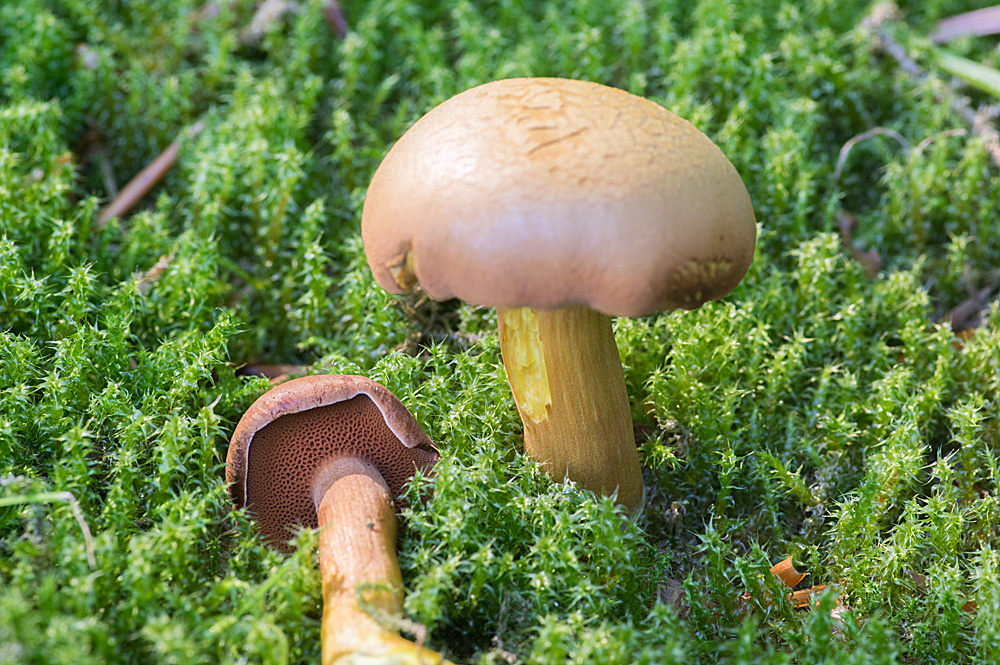
Image from GBIF · CC BY
OverviewAI-generated
*Chalciporus piperatus* is a species of fungus classified within the kingdom Fungi, phylum Basidiomycota, class Agaricomycetes, order Boletales, and family Boletaceae. The taxon belongs to the genus *Chalciporus* and was described by Bataille, with the author citation (Bull.) Bataille. It produces a brown spore print. Common names for this organism include cap tyllog poeth, Peperboleet, hřib peprný, and äikätatti.
Records of *Chalciporus piperatus* are held by institutions including UFRGS, NY, DBG, MICH, and DUKE. Specimens have been documented in Brasil, the United States, New Zealand, Australia, and the United Kingdom. The species has 28,209 occurrence records and 788 individual records, which include 317 media files.
Synthesized by Vinony from 24 facts across 5 sources: Wikidata, GBIF, Gbif Occ, iDigBio, Vinony graph. Generated from structured data (not the Wikipedia text) and checked against those facts — may still contain errors.
Species
SPECIES
- KingdomFungi
- PhylumBasidiomycota
- ClassAgaricomycetes
- OrderBoletales
- FamilyBoletaceae
via GBIF
Museum specimens
- Specimen records
- 788
- With media
- 317
- Family
- Boletaceae
- Collections
- UFRGS, NY, DBG, MICH, DUKE, UTC
- Recorded in
- Brasil, United States, New Zealand, Australia, United Kingdom, Canada
Wikidata facts
- Instance of
- taxon
- Parent taxon
- Chalciporus
- Image
- 2012-08-05 Chalciporus piperatus (Bull.) Bataille 265048.jpg
Show 8 more facts
via Wikidata · CC0
~10 min read
Encyclopedic overview
Chalciporus piperatus, commonly known as the peppery bolete, is a species of fungus in the family Boletaceae. Described by Pierre Bulliard in 1790 as Boletus piperatus, it is only distantly related to other members of the genus Boletus and was reclassified as Chalciporus piperatus by Frédéric Bataille in 1908. The genus Chalciporus was an early branching lineage in the Boletaceae and appears to be related to boletes with parasitic properties.
A small bolete, the fruit body has a 1.6–9 cm (5⁄8–3+1⁄2 in) orange-fawn cap with small cinnamon to brown pores underneath. The stipe is 4–9.5 cm (1+5⁄8–3+3⁄4 in) long and 0.6–1.2 cm (1⁄4–1⁄2 in). The flesh has a very peppery taste. The rare variety hypochryseus, found only in Europe, has yellow pores and tubes. The species is found in mixed woodland in Europe and North America. It has been recorded under introduced trees in Brazil, and has become naturalised in Tasmania and spread under native Nothofagus cunninghamii trees. Previously thought to be ectomycorrhizal (a symbiotic relationship that occurs between a fungus and the roots of various plant species), C. piperatus is now suspected of being parasitic on Amanita muscaria.
Excerpted from Wikipedia’s “Chalciporus piperatus” article, available under the CC BY-SA 4.0 licence.