
Cover via Open Library · Open Library
Book · Open Library
- Author
- Edmond Rostand
- First published
- 1910
- Editions
- 37
- Subjects
- Birds, Drama, Roosters, DRAMA POETICO FRANCES, Stage-setting and scenery, Theaters, Theater, Costume
via Open Library
Described at
Chantecler, a Barnyard Fantasy | MCNY Blog: New York Stories
While digitizing the vast collection of over 30,000 photographs that make up the theatre production files at the Museum of the City of New York, a project generously funded by the Institute for Museum and Library Services, there oftentimes come to light incredible images that are unusual and dream-like, seemingly attached to a time and space very…
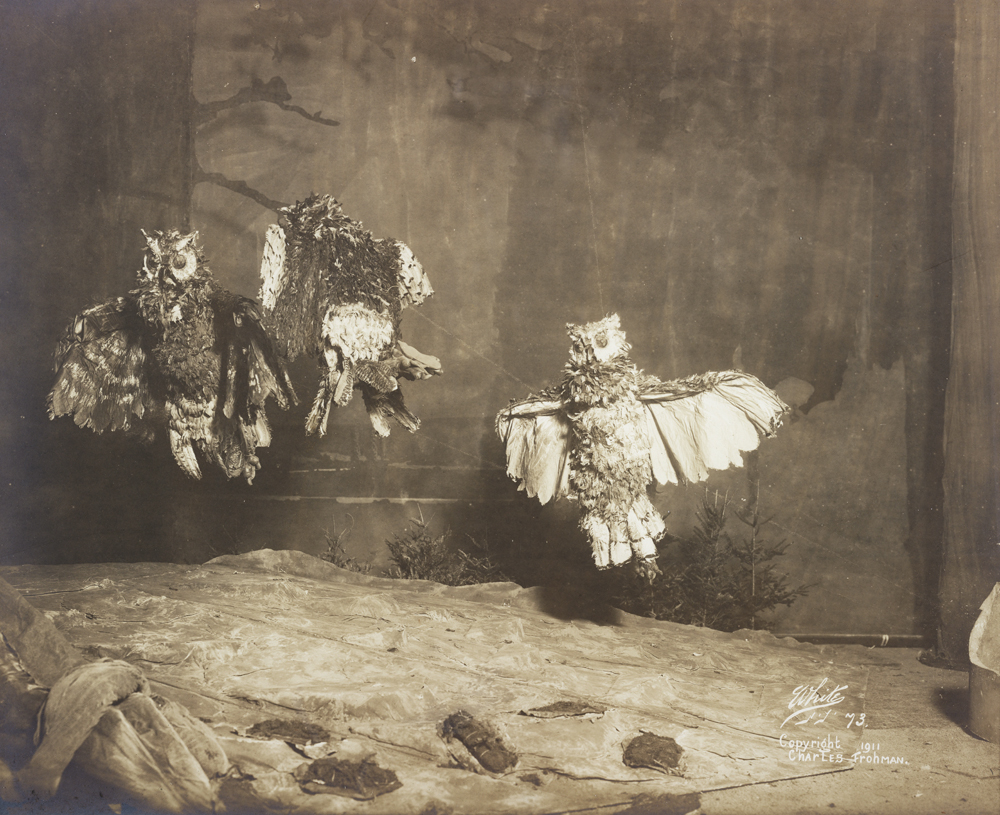
blog.mcny.org →“Chantecler” theater still, 1911. From the Theater Collection. Museum of the City of New York, 48.367.65 . While digitizing the vast collection of over 30,000 photographs that make up the theatre production files at the Museum of the City of New York, a project generously funded by the Institute for Museum and Library Services , there oftentimes come to light incredible images that are unusual and dream-like, seemingly attached to a time and space very distant from a typical 21st century production. One example is the photographs by White Studios of the 1911 Broadway production of Chantecler, a Verse Play in Four Acts, by French poet and dramatist Edmond Rostand, adapted by Louis N. Parker. Rostrand had dealt with 10 years of writer’s block before writing the script and the production was particularly contentious: the public was shocked that such an elaborate production featured chickens; the original Paris production was postponed due to a great flood; and the American version was surrounded in controversy over the casting of a woman (Maude Adams ) as the male protagonist. The plot centers around the existential struggle of the rooster Chantecler (meaning ‘clear singing’), who is convinced that his crowing is solely responsible for the sun rising. There is much conflict among the barnyard animals: jealousy, deception, denial of the possibility Chantecler could emit a call so beautiful it could command daylight. Chantecler defends his belief in his life-summoning art, even placing its importance above the affections of a beautiful young pheasant (who eventually learns to accept his dedication to deliver the dawn after he nearly gives his life for it). Although it is revealed that the sun does rise regardless, Chantecler maintains his conviction that it is his duty to signal the new day to every creature and to call attention to the radiant rays of light that shield the farm’s inhabitants from birds that prey in the darkness. “Chantecler” theater still, 1911. From the Theater Collection. Museum of the City of New York, 48.367.73 . Although peculiar in its approach and aesthetic, Chantecler was unanimously heralded as a great work of philosophy and artistic accomplishment. Most of the tickets were sold in advance, due to the public anticipation as to whether Maude Adams could take on such a symbolic masculine role. The casting was seen as a publicity stunt by legendary producer Charles Frohman , who preferred Adams in gender-atypical roles, previously casting her in 1905 as Peter Pan. Chantecler premiered at the Knickerbocker Theater (Broadway and 38th Street), January 23, 1911. “The demand for seats was unprecedented. A line began to form at four o’clock in the afternoon preceding the day the sale opened. Within twenty-four hours after the window was raised at the box-office as high as $200 was offered in vain for a seat on the opening night.” (1) The play ran four months with nearly 100 performances, and subsequently toured more than 60 cities. Maude Adams in the title role of “Chantecler”, 1911. From the Theater Collection. Museum of the City of New York, 48.367.52 . “Chantecler” theater still, 1911. From the Theater Collection. Museum of the City of New York, 48.367.58 . “Chantecler” theater still, 1911. From the Theater Collection. Museum of the City of New York, 48.367.60 . Upon observing the bewildering beauty of the production photos, it should be no surprise that producer Frohman assembled a production design team of extraordinary ingenuity. Documents from the stage manager’s manual depict the cutting edge technology used to engineer the production. Remember, electric (tungsten) stage lights had only recently been invented! Stage equipment for “Chantecler”, 1911. From the Theater Collection. Museum of the City of New York, 48.367.77 . Much of Chantecler’s stagecraft was developed by J.M. Hewlett, A.T. Hewlett, and Charles Basing under the direction of W.H. Gilmore. J.M. Hewlett (formally of McKim, Mead & White
Excerpt from a page describing this subject · 17,433 chars · not written by Vinony
Wikidata facts
- Instance of
- literary work
- Author
- Edmond Rostand
- Country of origin
- France
- Image
- M.Blayney & M.Adams.jpg
Show 5 more facts
- Commons category
- Chantecler (play)
- language of work or name
- French
- form of creative work
- play
- inception
- 1911-01-03
- described at URL
- blog.mcny.org/2014/07/29/chantecler-a-barnyard-fantasy
Sources (1)
via Wikidata · CC0