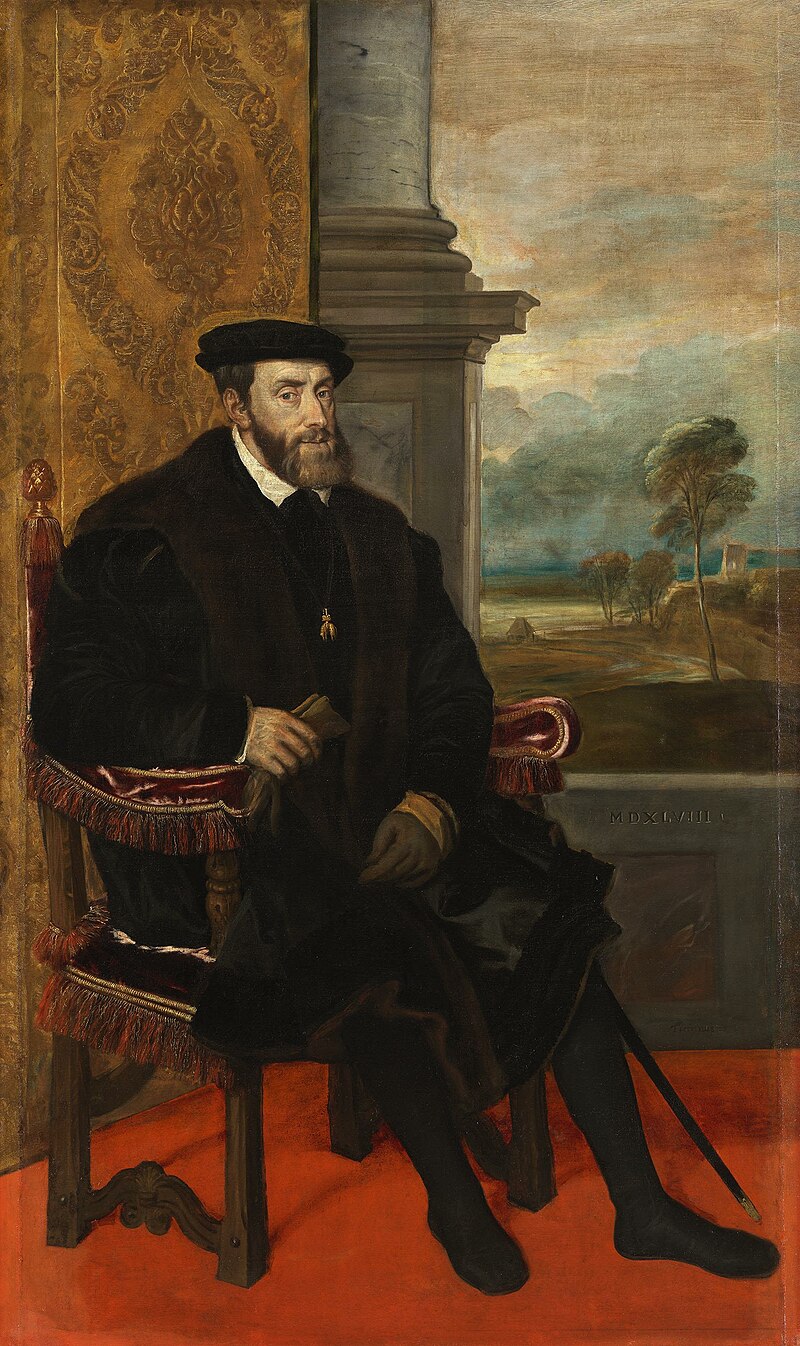
File:Portrait_of_Charles_V,_Holy_Roman_Emperor,_seated_(1500–1558),_formerly_attributed_to_Titian_(Alte_Pinakothek,_Munich).jpg · Wikimedia Commons · See Wikimedia Commons
Charles V
Sign in to saveAlso known as Karl V., Holy Roman Emperor Charles V, King Carlos I, King Charles I, Emperor Charles V, Charles I of Spain, Don Carlos, King Charles
Holy Roman Emperor from 1519 to 1556 (1500–1558)
Charles V was a powerful European ruler who served as Holy Roman Emperor from 1519 until his retirement in 1556, overseeing vast territories across Europe and the Americas during a period of major religious and political upheaval. His reign mattered because his decisions shaped the religious conflicts of his time, including the Protestant Reformation, and his empire's size and influence made him one of the most consequential figures of the 16th century.
AI-generated from the Wikipedia summary — may contain errors.
Wikidata facts
- Instance of
- human
- Given name
- Charles
- Gender
- male
- Citizenship
- Holy Roman Empire
- Place of birth
- Ghent
- Place of death
- Monastery of Yuste
- Spouse
- Isabella of Portugal
- Father
- Philip I of Castile
- Mother
- Juana I of Castile
- Occupation
- monarch
- Languages spoken
- Latin
- Native language
- French
- Religion
- Catholic Church
- Participant in
- Diet of Worms
- Family
- House of Habsburg
- Field of work
- politics
- Image
- Denkmal Karl V.jpg
- Significant event
- coronation of the Holy Roman Emperor
Show 24 more facts
- name in native language
- Charles de Habsbourg
- described by source
- New International Encyclopedia
- different from
- Charles V of France
- Commons gallery
- Carolus V, Imperator Romanus Sacer
- Commons category
- Charles V, Holy Roman Emperor
- date of birth
- 1500-02-24
- date of death
- 1558-09-21
- topic's main category
- Category:Charles V, Holy Roman Emperor
- cause of death
- malaria
- relative
- Mary of Burgundy
- manner of death
- natural causes
- unmarried partner
- Germaine of Foix
- writing language
- French
- P8168
- Meissa
- start of work period
- 1515-01-01
- end of work period
- 1558-01-01
- significant person
- Pietro Bembo
- Commons Creator page
- Charles Quint
- on focus list of Wikimedia project
- Wikipedia:Vital articles/Level/4
- P12749
- Wilhelm Külz
- has works in the collection
- Biblioteca Virtual Miguel de Cervantes
- P13311
- 1851
via Wikidata · CC0
~40 min read
Encyclopedic overview
Charles V (24 February 1500 – 21 September 1558) was Holy Roman Emperor and Archduke of Austria from 1519 to 1556, King of Spain (as Charles I) from 1516 to 1556, King of Sicily and Naples from 1516 to 1554, and also Lord of the Netherlands and titular Duke of Burgundy (as Charles II) from 1506 to 1555. He was heir to and then head of the rising House of Habsburg. His dominions in Europe included the Holy Roman Empire, extending from Germany to northern Italy with rule over the Austrian hereditary lands and Burgundian Low Countries, and Spain with its possessions of the southern Italian kingdoms of Sicily, Naples, and Sardinia. In the Americas, he oversaw the continuation of Spanish colonisation and a short-lived German colonisation. The personal union of the European and American territories he ruled was the first collection of realms labelled "the empire on which the sun never sets".
Charles was born in Flanders to Habsburg Archduke Philip the Handsome, son of Maximilian I, Holy Roman Emperor and Mary of Burgundy, and Joanna of Castile, younger child of Isabella I of Castile and Ferdinand II of Aragon, the Catholic Monarchs of Spain. Heir of his grandparents, Charles inherited his family's dominions at a young age. After his father's death in 1506, he inherited the Habsburg Netherlands in the Low Countries. In 1516, he became King of Spain as co-monarch of Castile and Aragon with his mother. Spain's possessions included the Castilian colonies of the Spanish West Indies and the Spanish Main, as well as Naples, Sicily and Sardinia. At the death of his paternal grandfather Maximilian in 1519, he inherited the Austrian hereditary lands and was elected as Holy Roman Emperor. He adopted the Imperial name of Charles V as his main title, and styled himself as a new Charlemagne.
Excerpted from Wikipedia’s “Charles V” article, available under the CC BY-SA 4.0 licence.
Gallery (12)
Available in 105 languages
- Español
- Français
- Deutsch
- 中文
- 日本語
- Русский
- Português
- Italiano
- العربية
- हिन्दी
- Afrikaans
- Albanian
- Albanian
- Aragonese
- Armenian
- Asturian
- azb
- Azerbaijani
Show 86 more
- Bahasa Indonesia
- Bangla
- Basque
- be_x_old
- Belarusian
- Bosnian
- Breton
- Bulgarian
- Catalan
- Central Kurdish
- Croatian
- Czech
- Danish
- Egyptian Arabic
- Esperanto
- Estonian
- Extremaduran
- Filipino
- Finnish
- fiu_vro
- Galician
- Georgian
- Greek
- Haitian Creole
- Hebrew
- Hungarian
- Icelandic
- Ido
- Interlingua
- Irish
- kbp
- Latin
- Latvian
- Ligurian
- Lingua Franca Nova
- Lithuanian
- Low German
- Luxembourgish
- Macedonian
- Malagasy
- Malay
- Marathi
- Mingrelian
- Mirandese
- Mongolian
- nds_nl
- Nederlands
- Norwegian
- Norwegian Nynorsk
- Occitan
- Pashto
- Piedmontese
- Polski
- ppl
- Quechua
- Romanian
- Scots
- Scottish Gaelic
- Serbian
- Serbian (Latin)
- Sicilian
- simple
- Slovak
- Slovenian
- Svenska
- Tamil
- Tiếng Việt
- Türkçe
- Ukrainian
- Urdu
- Uzbek
- Venetian
- Walloon
- Waray
- Welsh
- West Flemish
- Western Frisian
- Western Panjabi
- Wu Chinese
- Zeelandic
- zh_classical
- zh_min_nan
- zh_yue
- فارسی
- ไทย
- 한국어
via Wikidata sitelinks · CC0