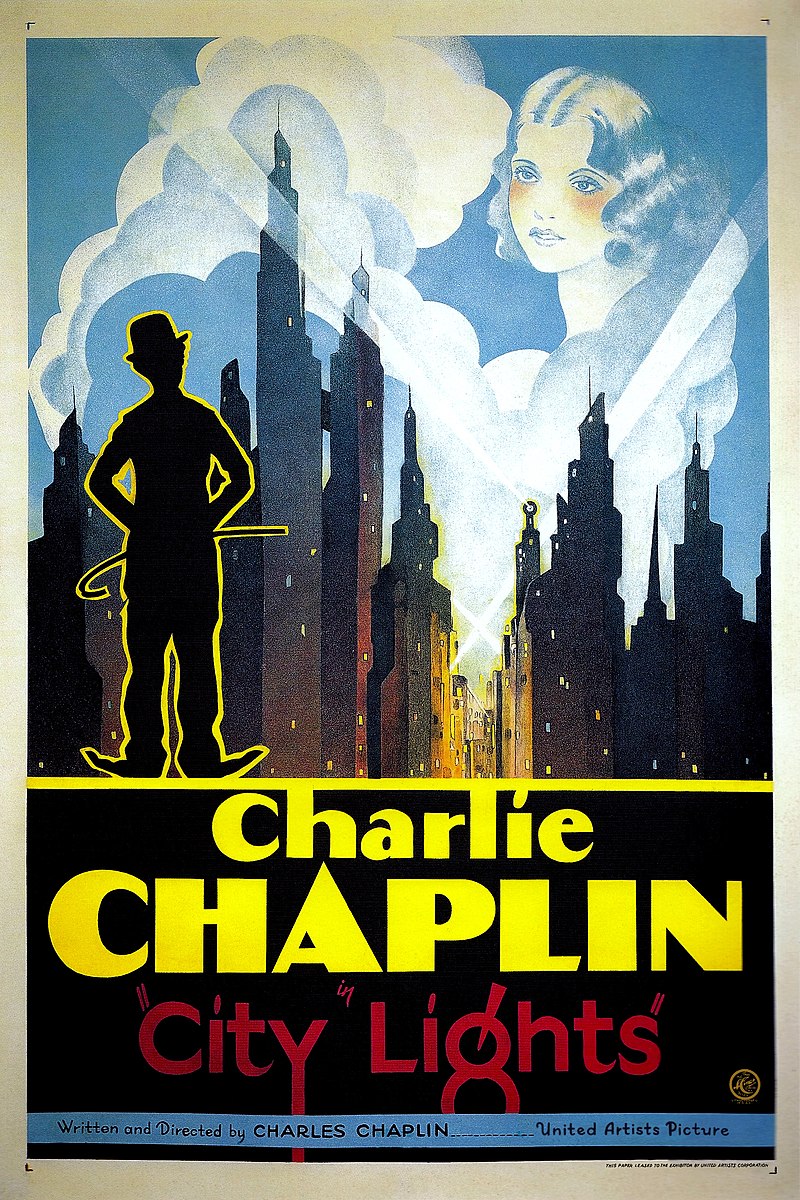
File:City_Lights_(1931_theatrical_poster_-_retouched).jpg · Wikimedia Commons · See Wikimedia Commons
City Lights
Sign in to save1931 film directed by Charlie Chaplin
OverviewAI-generated
City Lights is a 1931 American comedy drama and tragicomedy film written, directed, produced, edited, and composed by Charlie Chaplin. The cast includes Chaplin, Harry Myers, Henry Bergman, and Virginia Cherrill. Roland Totheroh served as the director of photography, while Charles D. Hall was the production designer. The film is in English and is associated with the Pre-Code Hollywood movement.
Produced by United Artists and Charles Chaplin Productions, the movie has a runtime of 87 minutes. It was distributed by United Artists and Netflix. The production had a budget of 1,500,000 and generated box office revenue of 5,000,000.
City Lights received a rating of G and was recognized with the National Board of Review: Top Ten Films award. It has received 6 total awards. Critical reception includes an IMDb rating of 8.5 based on 216,642 votes, a Metascore of 99, and a Rotten Tomatoes rating of 95%. The film is referenced by 314 other encyclopedia articles.
Synthesized by Vinony from 47 facts across 5 sources: Wikidata, TMDb, IMDb, OMDb, Vinony graph. Generated from structured data (not the Wikipedia text) and checked against those facts — may still contain errors.
Film · TMDB
8.3A tramp falls in love with a beautiful blind flower girl. His on-and-off friendship with a wealthy man allows him to be the girl's benefactor and suitor.
Cast
- Charlie Chaplin as A Tramp
- Virginia Cherrill as A Blind Girl
- Florence Lee as Her Grandmother
- Harry Myers as An Eccentric Millionaire
- Al Ernest Garcia as His Butler
- Hank Mann as A Prizefighter
Themes
- blindness and impaired vision
- eye operation
- operation
- love of one's life
- suicide attempt
- flower shop
- flower girl
- tramp
- love
- black and white
This product uses the TMDB API but is not endorsed or certified by TMDB.
Ratings
IMDb
8.5/10
215,345 votes
Rotten Tomatoes
95%
Metacritic
99/100
- Year
- 1931
- Runtime
- 87 min
- Genres
- Comedy, Drama, Romance
- Rated
- G
- Awards
- 6 wins total
via OMDb · IMDb
Wikidata facts
- Instance of
- film
- Part of
- National Film Registry
- Genre
- tragicomedy
- Country of origin
- United States
- Movement
- Pre-Code Hollywood
- Director
- Charlie Chaplin
- Screenwriter
- Charlie Chaplin
- Cast member
- Florence Lee
- Composer
- Charlie Chaplin
- Producer
- Charlie Chaplin
- Production company
- United Artists
- Duration
- 87
- FilmAffinity ID
- 750301
- Distribution format
- video on demand
- Image
- City Lights (1931 theatrical poster - retouched).jpg
Show 12 more facts
- Commons category
- City Lights
- publication date
- 1931-00-00
- film editor
- Charlie Chaplin
- title
- City Lights
- production designer
- Charles D. Hall
- distributed by
- Netflix
- capital cost
- 1500000
- box office
- 5000000
- different from
- City Lights
- color
- black-and-white
- assessment
- Bechdel test
- review score
- 8.5/10
Sources (10)
via Wikidata · CC0
~28 min read
Encyclopedic overview
City Lights is a 1931 American synchronized sound romantic comedy-drama film written, produced, directed by, and starring Charlie Chaplin. While the film has no audible dialog, it was released with a synchronized musical score with sound effects. The story follows the misadventures of Chaplin's Tramp as he falls in love with a blind woman (Virginia Cherrill) and develops a turbulent friendship with an alcoholic millionaire (Harry Myers).
Although talking pictures (or films with recorded dialogue) were on the rise when Chaplin started developing the script in 1928, he decided to continue working without dialogue only incorporating sound with the use of a synchronized musical score with sound effects. Filming started in December 1928 and ended in September 1930. City Lights marked the first time Chaplin composed the film score to one of his productions and it was written in six weeks with Arthur Johnston. The main theme, used as a leitmotif for the blind flower girl, is the song "La Violetera" ("Who'll Buy my Violets") from Spanish composer José Padilla. Chaplin lost a lawsuit to Padilla for not crediting him.
Excerpted from Wikipedia’s “City Lights” article, available under the CC BY-SA 4.0 licence.