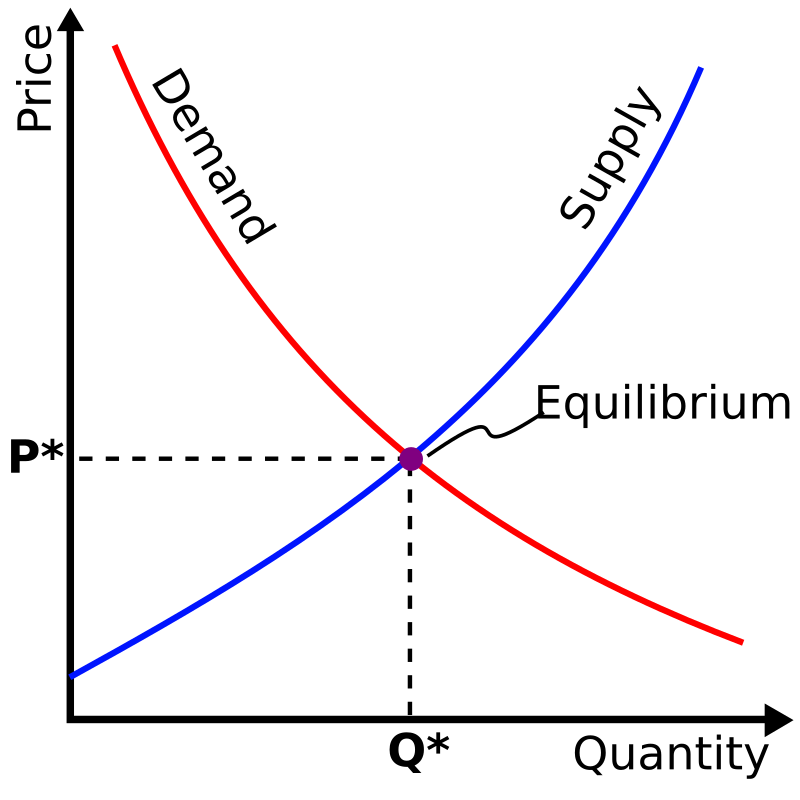
File:Supply-demand-equilibrium.svg · Wikimedia Commons · See Wikimedia Commons
I appreciate your request, but I cannot provide an accurate 2-sentence overview of classical economics based solely on the context "economic thought" you've provided. That phrase is too broad and doesn't contain specific information about classical economics itself—its key ideas, theorists, principles, or historical significance. To write an accurate overview, I would need context that actually discusses classical economics specifically (such as information about Adam Smith, the invisible hand, labor theory of value, or the historical period of classical economic thought). Without that, I'd be inventing facts rather than basing my answer only on provided context, which violates your instruction. If you can provide more detailed context about classical economics, I'd be happy to create the overview you're looking for.
AI-generated from the Wikipedia summary — may contain errors.
Wikidata facts
- Subclass of
- political economics
Show 4 more facts
- topic has template
- Template:Classical economists
- topic's main category
- Category:Classical economics
- named by
- Karl Marx
- Stack Exchange tag
- economics.stackexchange.com/tags/classical-economics
via Wikidata · CC0
~20 min read
Encyclopedic overview
Classical economics, also known as the classical school of economics, or classical political economy, is a school of thought in political economy that flourished, primarily in Britain, in the late 18th and early-to-mid 19th century. It includes both the Smithian and Ricardian schools. Its main thinkers are held to be Adam Smith, Jean-Baptiste Say, David Ricardo, Thomas Robert Malthus, and John Stuart Mill. These economists produced a theory of market economies as largely self-regulating systems, governed by natural laws of production and exchange (famously captured by Adam Smith's metaphor of the invisible hand).
Adam Smith's The Wealth of Nations in 1776 is usually considered to mark the beginning of classical economics. The fundamental message in Smith's book was that the wealth of any nation was determined not by the gold in the monarch's coffers, but by its national income. This income was in turn based on the labor of its inhabitants, organized efficiently by the division of labour and the use of accumulated capital, which became one of classical economics' central concepts.
Excerpted from Wikipedia’s “classical economics” article, available under the CC BY-SA 4.0 licence.