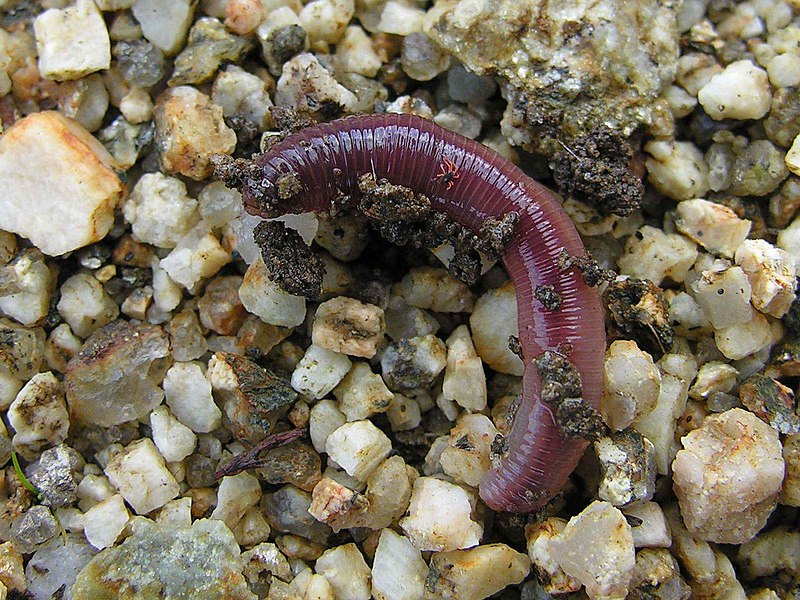
File:Earthworm_Miñoca_060106GFDL.jpg · Wikimedia Commons · See Wikimedia Commons
Clitellata
Sign in to saveThe Clitellata are a class of annelid worms, characterized by having a clitellum – the 'collar' that forms a reproductive cocoon during part of their life cycles. The clitellates comprise around 8,000 species. Unlike the class of Polychaeta, they do not have parapodia and their heads are less developed.
OverviewAI-generated
Clitellata is a class within the phylum Annelida and the kingdom Animalia. It falls under the parent taxon Sedentaria. The taxon was described by Michaelsen in 1919 and holds an accepted status. Its common name is clitellata, and it is also referred to as sedlaši.
Organisms in this class inhabit marine, brackish, and freshwater environments. Records of Clitellata are held by institutions including FMNH, AUM, CAS, and SIO, primarily in the United States. These collections include 2,051 records and 58 media items. A total of 1,959,713 occurrences have been documented for this taxon.
Synthesized by Vinony from 25 facts across 6 sources: Wikidata, GBIF, Gbif Occ, WoRMS, iDigBio, Vinony graph. Generated from structured data (not the Wikipedia text) and checked against those facts — may still contain errors.
Species
clitellata
CLASS
- KingdomAnimalia
- PhylumAnnelida
- ClassClitellata
亞綱 原環蟲綱 Acanthobdellida 蛭蚓纲 Branchiobdellae 蛭亞綱 Hirudinea 寡毛亞綱 Oligochaeta 環帶綱(Clitellata),是环节动物门下的一个纲,在系統演化上爲一個單系群,包括蛭(螞蟥,含水蛭、旱蛭)和寡毛類(如蚯蚓)等。牠們的特色是身體上有一節像是「衣領」一樣的環帶,在生育時會產生卵繭。環帶綱大約有8000多個品種。 與多毛綱(Polychaeta)不同的是:牠們的頭部(圍口節)沒有疣足(parapodia),而且發展比較簡單。 目录 1 習性 2 繁殖 3 分類 4 參考 5 外部連結 習性 大多數環帶綱的生物可在陸地上及水裡生活。 繁殖 所有環帶綱動物都是雌雄同體的。在繁殖期間,環帶綱動物會分泌一種會硬化的表層。牠會從這表層向後爬走,並將受精卵或同時間將卵子及精子留在這表層內,此表層會形成一個卵繭。受精卵會在沒有幼蟲的階段進而生長。[1] 分類 原環蟲綱(Acanthobdellida) 蛭蚓纲(Branchiobdellae) 蛭亞綱(Hirudinea) 寡毛亞綱(Oligochaeta):例如:蚯蚓(不論是水生還是陸生的)。 參考 ^ Reichardt, Anna Katharina. Systematische Zoologie. 2006: 63, 67–68. 外部連結 维基共享资源中相关的多媒体资源:环带纲 Brief description An introductory key to revised earthworm family classification[永久失效連結] A Series of Searchable Texts on Earthworm Biodiversity, Ecology and Systematics from Various Regions of the World 取自“https://zh.wikipedia.org/w/index.php?title=环带纲&oldid=47798624” 分类: 环节动物门 環帶綱 隐藏分类: 本地相关图片与维基数据不同 含有拉丁語的條目 自2018年1月带有失效链接的条目 条目有永久失效的外部链接
via GBIF
Museum specimens
- Specimen records
- 2,051
- With media
- 58
- Collections
- FMNH, AUM, CAS, SIO
- Recorded in
- United States
Wikidata facts
- Instance of
- taxon
- Parent taxon
- Sedentaria
- Image
- Regenwurm1.jpg
Show 5 more facts
- taxon rank
- class
- taxon name
- Clitellata
- Commons category
- Clitellata
- topic's main category
- Category:Clitellata
- taxon common name
- sedlaši
Sources (2)
via Wikidata · CC0
~6 min read
Encyclopedic overview
7 sectionsContents
- Characteristics
- Distribution and habitat
- Reproduction
- Systematics
- Footnotes
- References
- External links
The Clitellata are a class of annelid worms, characterized by having a clitellum – the 'collar' that forms a reproductive cocoon during part of their life cycles. The clitellates comprise around 8,000 species. Unlike the class of Polychaeta, they do not have parapodia and their heads are less developed.
==Characteristics== Clitellate annelids are segmented worms characterised by the clitellum or girdle which is located near the head end of mature individuals. The mouth is on the ventral surface and is overhung by the prostomium (proboscis). The brain is not located in the head but in one of the body segments. The clitellum is formed by a modification of several segments, and either includes the female gonopores or is located just behind them. During copulation, this glandular tissue secretes mucus that keeps the paired individuals together while they exchange sperm. Afterwards it secretes material that forms a cocoon that encircles the animal's body and encloses the eggs and sperm. The animal works this cocoon forward and over its head end, whereupon the ends of the cocoon become sealed, with fertilisation and development taking place inside.
Excerpted from Wikipedia’s “Clitellata” article, available under the CC BY-SA 4.0 licence.