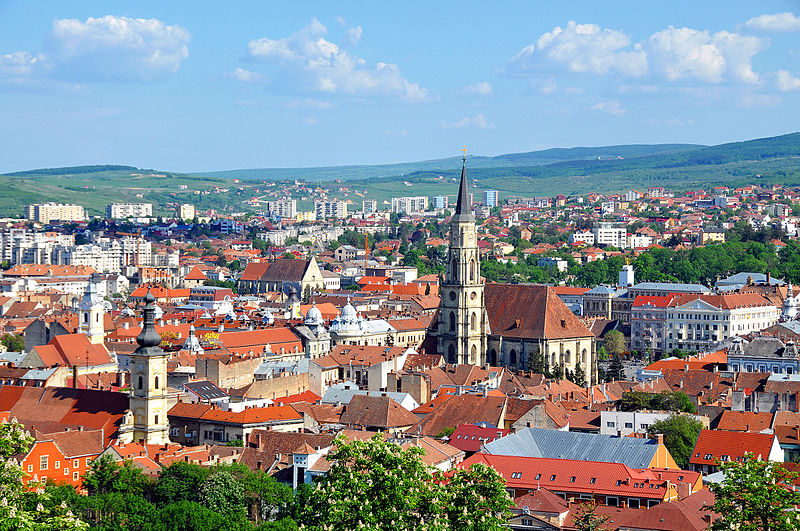
File:Romania-2382_-_View_from_Hotel_(7794313314).jpg · Wikimedia Commons · See Wikimedia Commons
Cluj-Napoca
Sign in to saveAlso known as Kolozsvár, Klausenburg, Cluj, Claudiopolis, Kolozsvar, Kluyzenburg, Napoca, Kluž
Cluj-Napoca ( , ), or simply Cluj ( ; ), is a city in northwestern Romania. It is the second-most populous city in the country and the seat of Cluj County. Geographically, it is roughly equidistant from Bucharest (), Budapest () and Belgrade (). Located in the Someșul Mic river valley, the city is considered the unofficial capital of the historical province of Transylvania. For some decades prior to the Austro-Hungarian Compromise of 1867, it was the official capital of the Grand Principality of Transylvania.
Cluj-Napoca is the second-largest city in Romania, located in the northwestern region in the Someșul Mic river valley and serving as the administrative center of Cluj County. The city is considered the unofficial capital of the historical province of Transylvania and holds significant regional importance as a major cultural and economic hub in southeastern Europe.
AI-generated from the Wikipedia summary — may contain errors.
Key facts
- Settlement.subdivision_type
- Country
- Settlement.subdivision_name
- Romania
- Settlement.timezone
- EET
- Settlement.utc_offset
- +2
- Settlement.timezone_DST
- EEST
- Settlement.utc_offset_DST
- +3
- Settlement.mapframe
- yes
- Settlement.pushpin_map
- Romania#Europe
- Settlement.pushpin_mapsize
- 250
- Settlement.pushpin_map_caption
- Location within Romania
- Settlement.image_shield
- RO CJ Cluj-Napoca CoA.png
- Settlement.nickname
- Treasure City(;)
- Settlement.official_name
- Cluj-Napoca
- Settlement.subdivision_type1
- County
- Settlement.subdivision_name1
- Cluj County
- Settlement.subdivision_type2
- Status
- Settlement.subdivision_name2
- County seat
- Settlement.settlement_type
- County Seat and Municipality
via Wikipedia infobox
Wikidata facts
- Instance of
- municipality
- Official name
- Коложвар
- Country
- Kingdom of Hungary
- Located in
- Cluj County
- Population
- 13928
- Area
- 179.5
- Elevation
- 356
- Time zone
- UTC+03:00
- Head of government
- Gheorghe Funar
- Official website
- primariaclujnapoca.ro
- Image
- CJROCluj-Napoca 19.jpg
- Dialing code
- 364
- Licence plate code
- CJ-N
Show 20 more facts
- category of associated people
- Category:People from Cluj-Napoca
- Commons gallery
- Cluj-Napoca
- postal code
- 400001–400930
- twinned administrative body
- Municipio Chacao
- Commons category
- Cluj-Napoca
- topic's main category
- Category:Cluj-Napoca
- category for people born here
- Category:Births in Cluj-Napoca
- category for people who died here
- Category:Deaths in Cluj-Napoca
- inception
- 1213-00-00
- native label
- Клаузенбург
- short name
- Cluj
- P6482
- Cluj-Napoca
- P8168
- Varnamkhast
- phone number
- +40-264596030
- street address
- Str. Moților nr.3, 400001, Cluj-Napoca, Cluj
- population by native language
- 33851
- P12749
- Arkhangelsk
- email address
- mailto:[email protected]
- historical region
- Transylvania
- number of viewers/listeners
- 425946
Sources (13)
via Wikidata · CC0
~83 min read
Encyclopedic overview
50 sectionsContents
- Etymology
- Napoca
- Cluj
- Current official name
- Nickname
- History
- Roman Empire
- Middle Ages
- 16th–18th centuries
- 19th century
- 20th century
- 1989 revolution and after
- Geography
- Surroundings
- Climate
- Law and government
- Administration
- Justice system
- Crime
- Demographics
- Hungarian community
- Economy
- Tourism
- Arts and culture
- Landmarks
- Visual arts
- Performing arts
- Music and nightlife
- Traditional culture
- Cultural events and festivals
- Architecture
- Historical architecture
- Modern and Communist architecture
- Contemporary architecture
- Transport
- Road
- Air
- Rail
- Public transport
- Trams
- Metro
- Culture and media
- Education
- Sports
- Twin towns – sister cities
- Footnotes
- See also
- Notes
- References
- External links
Cluj-Napoca ( , ), or simply Cluj ( ; ), is a city in northwestern Romania. It is the second-most populous city in the country and the seat of Cluj County. Geographically, it is roughly equidistant from Bucharest (), Budapest () and Belgrade (). Located in the Someșul Mic river valley, the city is considered the unofficial capital of the historical province of Transylvania. For some decades prior to the Austro-Hungarian Compromise of 1867, it was the official capital of the Grand Principality of Transylvania.
, 286,598 inhabitants lived in the city. The Cluj-Napoca metropolitan area had a population of 411,379 people, while the population of the peri-urban area is approximately 420,000. According to a 2007 estimate, the city hosted an average population of over 20,000 students and other non-residents each year from 2004 to 2007. The city spreads out from St. Michael's Church in Unirii Square, built in the 14th century and named after the Archangel Michael, Cluj's patron saint. The municipality covers an area of .
Excerpted from Wikipedia’s “Cluj-Napoca” article, available under the CC BY-SA 4.0 licence.
Gallery (52)
On the map
3 mapped locations
Available in 107 languages
- Español
- Français
- Deutsch
- 中文
- 日本語
- Русский
- Português
- Italiano
- العربية
- Achinese
- Albanian
- Aragonese
- Armenian
- Asturian
- azb
- Azerbaijani
- Bahasa Indonesia
- Bangla
Show 88 more
- Banjar
- Bashkir
- Basque
- be_x_old
- Belarusian
- Breton
- Bulgarian
- Catalan
- Cebuano
- Chechen
- Croatian
- Czech
- Danish
- Egyptian Arabic
- Esperanto
- Estonian
- Extremaduran
- Finnish
- Galician
- Georgian
- Greek
- Guarani
- Hebrew
- Hungarian
- hyw
- Icelandic
- Ido
- Interlingue
- Irish
- Javanese
- Ladino
- Latin
- Latvian
- Limburgish
- Lithuanian
- Lombard
- Luxembourgish
- Macedonian
- Malay
- Maltese
- Marathi
- Minangkabau
- Mingrelian
- Moksha
- Mongolian
- Moroccan Arabic
- Nederlands
- Northern Frisian
- Norwegian
- Norwegian Nynorsk
- nrm
- Occitan
- Old English
- Ossetic
- Pashto
- Piedmontese
- Polski
- roa_rup
- Romanian
- Scots
- Scottish Gaelic
- Serbian
- Serbian (Latin)
- Silesian
- simple
- Slovak
- Slovenian
- Svenska
- Tajik
- Tatar
- Tiếng Việt
- Türkçe
- Tyap
- Ukrainian
- Urdu
- Uyghur
- Uzbek
- Veps
- Volapük
- Waray
- Welsh
- Western Panjabi
- Wu Chinese
- Yiddish
- zh_yue
- فارسی
- ไทย
- 한국어
via Wikidata sitelinks · CC0