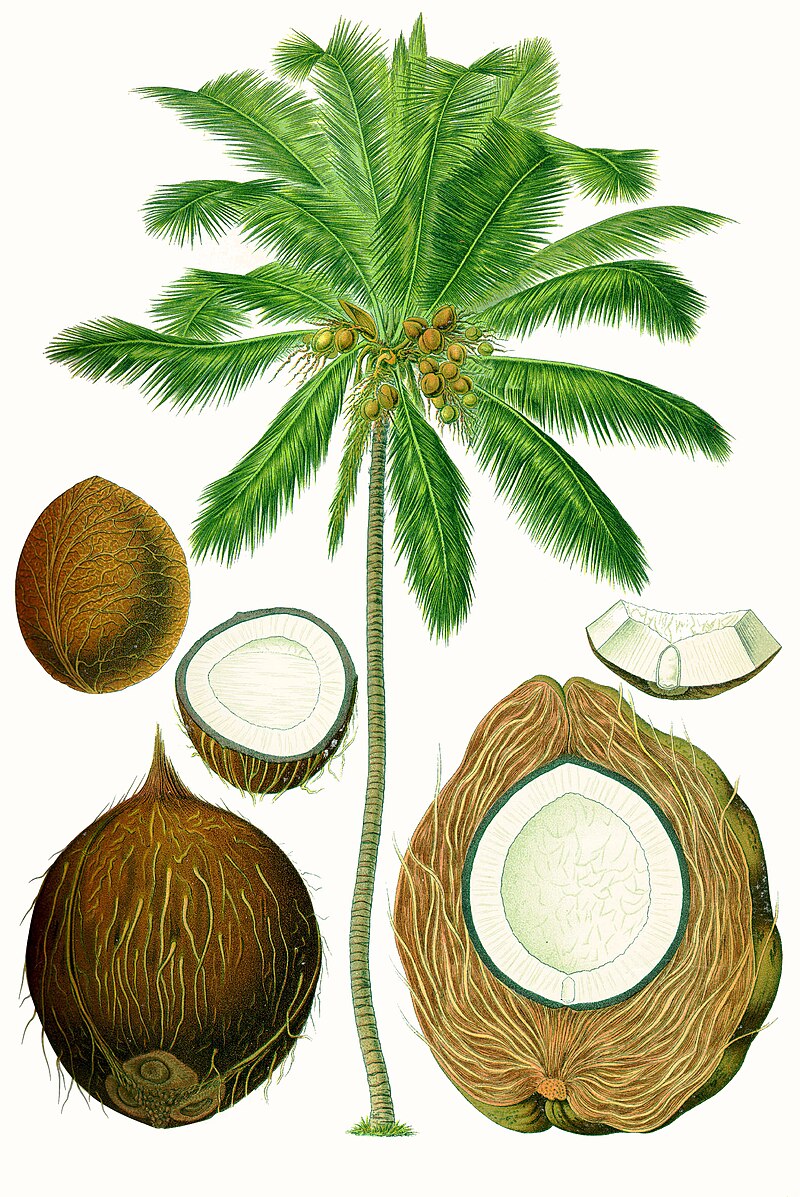
File:Cocos_nucifera_-_Köhler–s_Medizinal-Pflanzen-187.jpg · Wikimedia Commons · See Wikimedia Commons
Cocos nucifera
Sign in to saveAlso known as coconut palm, coconut tree, coconut, cocoanut, coconut palm tree
The coconut (Cocos nucifera) is a member of the palm family (Arecaceae) and the only living species of the genus Cocos. The term "coconut" (or the archaic "cocoanut") can denote the whole coconut palm tree or the large hard fruit. Originally native to Central Indo-Pacific, they are ubiquitous in coastal tropical regions.
OverviewAI-generated
Cocos nucifera, commonly known as the coconut palm, is a species within the family Arecaceae. It belongs to the kingdom Plantae and the genus Cocos. The taxon is classified as a useful plant and is the source of coconut, coconut water, coconut timber, and coconut sugar. Its fruit is a drupe. The organism has various uses, including as a medicinal plant, for wood, and in afforestation.
The species is found in Fujian, the Tibet Autonomous Region, Guangdong, and Gabon. It inhabits marine, brackish, and freshwater environments. The taxon has been described in sources such as the Armenian Soviet Encyclopedia, Brockhaus and Efron Encyclopedic Dictionary, Gujin Tushu Jicheng, and the Encyclopædia Britannica 11th edition. It is also referenced by 4,064 other encyclopedia articles.
Synthesized by Vinony from 61 facts across 8 sources: Wikidata, GBIF, Gbif Occ, Plants of the World, Openfoodfacts, WoRMS, iDigBio, Vinony graph. Generated from structured data (not the Wikipedia text) and checked against those facts — may still contain errors.
Species
coconut palm
Cocos nucifera
SPECIES
- KingdomPlantae
- PhylumTracheophyta
- ClassLiliopsida
- OrderArecales
- FamilyArecaceae
本条目需要补充更多来源。(2009年10月27日) 请协助添加多方面可靠来源以改善这篇条目,无法查证的内容可能會因為异议提出而移除。 椰子每100 g(3.5 oz)食物營養值 熱量 354 kJ(85 kcal) 糖类 12.76 g 糖 10.1 g膳食纖維 1.3 g 脂肪 0.13 g 飽和脂肪 0.021 g單元不飽和脂肪 0.005 g多元不飽和脂肪 0.037 g 蛋白質 0.27 g 色氨酸 0.001 g蘇氨酸 0.006 g異亮氨酸 0.006 g亮氨酸 0.014 g賴氨酸 0.013 g蛋氨酸 0.001 g胱氨酸 0.001 g苯丙氨酸 0.007 g酪氨酸 0.001 g纈氨酸 0.012 g精氨酸 0.006 g組氨酸 0.005 g丙氨酸 0.012 g天冬氨酸 0.074 g穀氨酸 0.026 g甘氨酸 0.009 g脯氨酸 0.006 g絲氨酸 0.011 g 維生素維生素A equiv.β-胡萝卜素 葉黃素與玉米黃素 (0%) 2 μg (0%)17 μg 18 μg 硫胺(維生素B1) (2%) 0.019 mg核黃素(維生素B2) (2%) 0.028 mg菸鹼酸(維生素B3) (1%) 0.091 mg泛酸(維生素B5) (1%) 0.071 mg吡哆醇(維生素B6) (3%) 0.037 mg葉酸(維生素B9) (0%) 0 μg維生素B12 (0%) 0 μg膽鹼 (1%) 3.4 mg維生素C (5%) 4 mg維生素D (0%) 0 IU維生素E (0%) 0.05 mg維生素K (1%) 0.6 μg 膳食礦物質鈣 (1%) 5 mg鐵 (1%) 0.07 mg鎂 (1%) 4 mg錳 (2%) 0.038 mg磷 (2%) 11 mg鉀 (2%) 90 mg鈉 (0%) 0 mg鋅 (1%) 0.05 mg 其他成分水 86.67 g 單位 μg = 微克 · mg = 毫克 IU = 藥學国际單位 參照美國標準的相對百分比成人每日的膳食營養素參考攝取量(英语:Dietary Reference Intakes)(RDI)來源:(英文)美國農業部營養数据库 椰(学名:Cocos nucifera)是棕榈科椰属的唯一种大型植物,椰子是椰树的果实,是一种在热带地区很普及的果实。椰子树的普及也在于其果实椰子可以在海中随风浪漂流上千公里后落地生根在离母树非常远的地方。一般商业卖出来的椰子在收割时还是绿色的,未成熟的果实,它有点三角形状,足球大小。在泰国南部人们也利用训练好的猕猴来採摘椰子。而在中国的海南岛,人们宣称爬椰子树最快的人在海南文昌市的东郊椰林[2]。 一般在原产地以外出售的“椰子”实际上是椰子的棕色的核,也叫作「椰仁」,是椰子的种子。在这个核外面实际上还有一层很厚的纤维质和一个硬的、绿色的果皮壳层。为
via GBIF · Kew POWO
Museum specimens
- Specimen records
- 844
- With media
- 457
- Family
- Arecaceae
- Collections
- ECOSUR, CICY, UACH, CIBYC-UAEM, INECOL, UJAT
- Recorded in
- Mexico
Nutrition · Open Food Facts
Typical values per 100 g · averaged across 6 products
- Energy
- 364 kcal
- Fat
- 33.5 g
- — of which saturates
- 29 g
- Carbohydrates
- 7.4 g
- — of which sugars
- 6 g
- Fibre
- 16 g
- Protein
- 3.7 g
- Salt
- 0.04 g
via Open Food Facts · ODbL
Wikidata facts
- Instance of
- taxon
- Subclass of
- useful plant
- Parent taxon
- Cocos
- Image
- 1859-Martinique.web.jpg
- Has use
- essential oil
Show 15 more facts
- taxon rank
- species
- taxon name
- Cocos nucifera
- Commons category
- Cocos nucifera
- this taxon is source of
- coconut milk
- Commons gallery
- Cocos nucifera
- taxon common name
- ololani
- has fruit type
- drupe
- start time
- 55000000-0
- on focus list of Wikimedia project
- Wikipedia:Vital articles/Level/4
- short name
- C. nucifera
- Flora of the Hawaiian Islands URL
- naturalhistory2.si.edu/botany/hawaiianflora/speciesdescr.cfm?genus=Cocos&species=nucifera
- taxon author citation
- L.
- taxon range
- Gabon
- external data available at URL
- www.gbif.org/dataset/31dc1507-a6e1-4233-a8df-c7a78596a7e4
Sources (6)
via Wikidata · CC0
~38 min read
Encyclopedic overview
33 sectionsContents
- Description
- Inflorescence
- Fruit
- Roots
- Taxonomy
- Taxonomic history
- Etymology
- Origins
- Fossil history
- Phylogeny
- Human dispersal
- Domestication
- Distribution and habitat
- Cultivation
- Pests and diseases
- Cultivars
- Breeding
- Harvesting
- Production
- Health concerns
- Cardiovascular disease
- Uses
- Nutrition
- Culinary
- Oil
- Non-food uses
- In culture
- Myths and legends
- Early history
- See also
- References
- Sources
- External links
The coconut (Cocos nucifera) is a member of the palm family (Arecaceae) and the only living species of the genus Cocos. The term "coconut" (or the archaic "cocoanut") can denote the whole coconut palm tree or the large hard fruit. Originally native to Central Indo-Pacific, they are ubiquitous in coastal tropical regions.
The coconut tree provides food, fuel, cosmetics, folk medicine and building materials. The inner flesh of the mature fruit forms a regular part of the diets of many people in the tropics and subtropics. Coconut endosperm contains a large quantity of a liquid, "coconut water". Mature coconuts can be processed for oil and coconut milk from the flesh, charcoal from the hard shell, and coir from the fibrous husk. Dried coconut flesh is called copra, and the oil and milk derived from it are commonly used in cooking and in soaps and cosmetics. Sweet coconut sap can be made into drinks or fermented into palm wine or coconut vinegar. The hard shells, fibrous husks and long pinnate leaves are used to make a products for furnishing and decoration.
Excerpted from Wikipedia’s “Cocos nucifera” article, available under the CC BY-SA 4.0 licence.
Gallery (37)
Available in 151 languages
- Español
- Français
- Deutsch
- 中文
- 日本語
- Русский
- Português
- Italiano
- العربية
- हिन्दी
- Achinese
- Afrikaans
- Akan
- Amharic
- Aragonese
- Armenian
- Asturian
- azb
Show 132 more
- Azerbaijani
- Bahasa Indonesia
- Balinese
- Bangla
- Banjar
- Basque
- Belarusian
- Bhojpuri
- Bikol
- Bislama
- Bulgarian
- Burmese
- Catalan
- cdo
- Cebuano
- Central Dusun
- Central Kurdish
- Chuvash
- Crimean Tatar
- Croatian
- Czech
- dag
- Danish
- Divehi
- Egyptian Arabic
- Esperanto
- Estonian
- Fijian
- Filipino
- Finnish
- Galician
- Georgian
- Gorontalo
- Greek
- Gujarati
- Haitian Creole
- Hakka Chinese
- Hausa
- Hebrew
- Hungarian
- hyw
- Iban
- Icelandic
- Ido
- Irish
- Javanese
- Kannada
- Kashmiri
- Kazakh
- kge
- Khmer
- Kurdish
- Latin
- Latvian
- lbe
- Lingala
- Lithuanian
- Luxembourgish
- Macedonian
- Madurese
- Maithili
- Malagasy
- Malay
- Malayalam
- Manipuri
- Manx
- Māori
- Marathi
- Minangkabau
- Mirandese
- mnw
- Mongolian
- Navajo
- Nederlands
- Nepali
- Nias
- Northern Frisian
- Norwegian
- Norwegian Nynorsk
- Odia
- Ossetic
- Pampanga
- Pashto
- Polski
- Punjabi
- Quechua
- Romanian
- Sanskrit
- Scots
- Serbian
- Serbian (Latin)
- simple
- Sindhi
- Sinhala
- Slovak
- Slovenian
- Somali
- Sundanese
- Svenska
- Swahili
- syl
- szy
- Tahitian
- Tamil
- tdd
- Telugu
- Tibetan
- Tiếng Việt
- Tok Pisin
- Tongan
- Tulu
- Türkçe
- Turkmen
- Tyap
- Ukrainian
- Upper Sorbian
- Urdu
- Waray
- Wayuu
- Welsh
- Western Panjabi
- Wolof
- Wu Chinese
- Yiddish
- Yoruba
- zh_classical
- zh_min_nan
- zh_yue
- Zulu
- فارسی
- ไทย
- 한국어
via Wikidata sitelinks · CC0