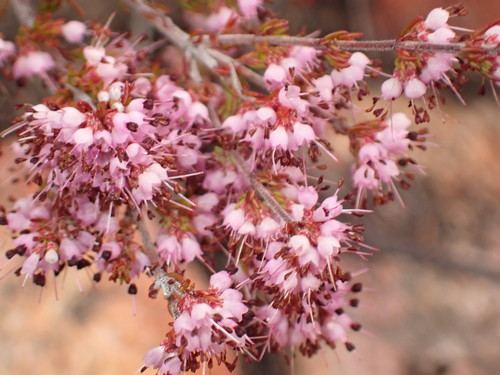
(c) Karol Cameron, some rights reserved (CC BY-NC), uploaded by Karol Cameron · cc-by-nc
Codonanthe
Sign in to saveCodonanthe is a genus of mainly epiphytic plants in the family Gesneriaceae, endemic to the Atlantic Forest of Brazil. The botanical name comes from the Ancient Greek for 'bellflower'. They have white or pale pink flowers and somewhat fleshy leaves. In 2013, the genus was reduced in size when more than half of the species were transferred to Codonanthopsis. They can be grown as houseplants, particularly in hanging baskets. Artificial crosses with Nematanthus hybrids have produced the hybrid genus '× Codonatanthus'''''.
Species
Rednut Heath
GENUS
- KingdomPlantae
- PhylumTracheophyta
- ClassMagnoliopsida
- OrderLamiales
- FamilyGesneriaceae
via GBIF · Kew POWO
Museum specimens
- Specimen records
- 262
- With media
- 53
- Family
- Gesneriaceae
- Collections
- CICY, IBUNAM, NY, INSTITUTO NACIONAL DE PESQUISAS DA AMAZÔNIA (INPA)
- Recorded in
- Mexico, Guatemala, Ecuador, Brazil, Brasil, Panama
Wikidata facts
- Instance of
- taxon
- Image
- Codonanthecarnosa.JPG
Show 7 more facts
- taxon name
- Codonanthe
- taxon rank
- genus
- Commons category
- Codonanthe
- topic's main category
- Category:Codonanthe
- has fruit type
- capsule
- taxon common name
- 玉唇花属
Sources (1)
via Wikidata · CC0
~4 min read
Encyclopedic overview
6 sectionsContents
- Description
- Taxonomy
- Species
- Distribution and habitat
- Cultivation
- References
Codonanthe is a genus of mainly epiphytic plants in the family Gesneriaceae, endemic to the Atlantic Forest of Brazil. The botanical name comes from the Ancient Greek for 'bellflower'. They have white or pale pink flowers and somewhat fleshy leaves. In 2013, the genus was reduced in size when more than half of the species were transferred to Codonanthopsis. They can be grown as houseplants, particularly in hanging baskets. Artificial crosses with Nematanthus hybrids have produced the hybrid genus '× Codonatanthus'''.
==Description== Codonanthe species are subshrubs, generally growing as epiphytes, occasionally on rocks. Unlike Codonanthopsis species, they never grow in ant gardens. They have stems with few branches, which may be upright, creeping or hanging, and often produce roots along their length (adventitious roots). The leaves have a short or very short petiole (stalk), and are fleshy, with either smooth or hairy surfaces. The flowers, produced in the upper leaf axils, on pedicels up to long, are either solitary or in groups of a few together, rarely in the form of a cyme. The five petals are fused at the base with spreading, rounded tips, overall either funnel-shaped or expanded towards the base (ventricose). The flowers are white or pale pink, sometimes with yellow or maroon markings, particularly inside the throat. The four stamens remain within the flowers, and have paired anthers joined by a wide connective. The fruit is a yellowish to dark orange berry with seeds that are long.
Excerpted from Wikipedia’s “Codonanthe” article, available under the CC BY-SA 4.0 licence.