File:Collared_flycatcher_(Ficedula_albicollis).jpg · Wikimedia Commons · See Wikimedia Commons
The Collared Flycatcher is a small songbird found across Europe and western Asia that catches insects in flight. It is scientifically important as a subject for studying bird migration, evolution, and how species adapt to environmental changes.
AI-generated from the Wikipedia summary — may contain errors.
Species
Least Concernvia IUCN
Wikidata facts
Show 12 more facts
- taxon rank
- species
- IUCN conservation status
- Least Concern
- taxon name
- Ficedula albicollis
- Commons category
- Ficedula albicollis
- Commons gallery
- Ficedula albicollis
- taxon common name
- mosqueru collariegu
- litter size
- 5.9
- egg incubation period
- 13
- sequenced genome URL
- www.ensembl.org/Ficedula_albicollis
- short name
- F. albicollis
- taxon range
- Africa
- taxon author citation
- (Temminck, 1815)
Sources (8)
via Wikidata · CC0
~4 min read
Encyclopedic overview
The collared flycatcher (Ficedula albicollis) is a small passerine bird in the Old World flycatcher family, one of the four species of Western Palearctic black-and-white flycatchers. It breeds in southeast Europe (isolated populations are present in the islands of Gotland and Öland in the Baltic Sea, Sweden) and Eastern France to the Balkan Peninsula and Ukraine and is migratory, wintering in Sub-Saharan Africa. It is a rare vagrant in western Europe.
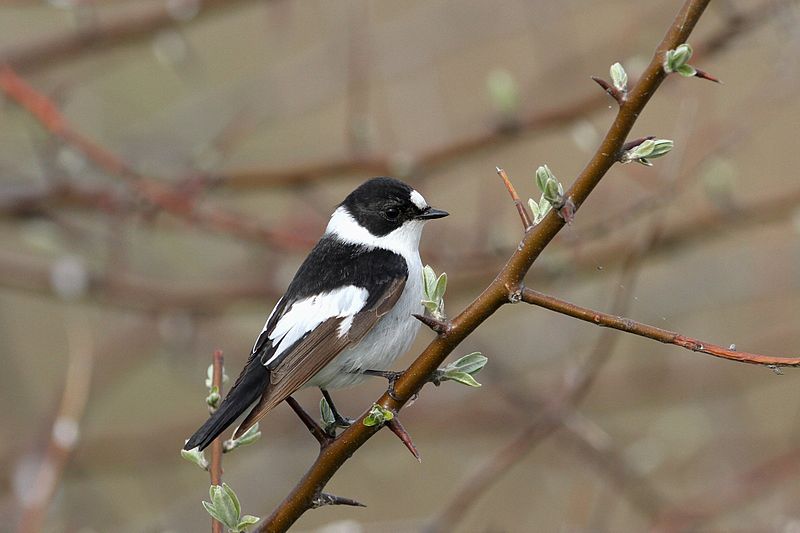
This is a 12–13.5 cm long bird. The breeding male is mainly black above and white below, with a white collar, large white wing patch, black tail (although some males have white tail sides) and a large white forehead patch. It has a pale rump. The bill is black and has the broad but pointed shape typical of aerial insectivores. As well as taking insects in flight, this species hunts caterpillars amongst the oak foliage, and will take berries.
Excerpted from Wikipedia’s “Collared Flycatcher” article, available under the CC BY-SA 4.0 licence.