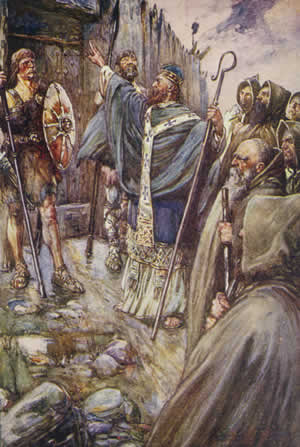
File:Columba_at_Bridei's_fort.jpg · Wikimedia Commons · See Wikimedia Commons
Columba
Sign in to saveAlso known as St. Columba, Saint Columba, St Columba, Colmcille, Colum Cille
Columba () or Colmcille (7 December 521 – 9 June 597 AD) was an Irish abbot and missionary evangelist credited with spreading Christianity in what is today Scotland at the start of the Hiberno-Scottish mission. He founded the important abbey on Iona, which became a dominant religious and political institution in the region for centuries. He is the patron saint of Derry. He was highly regarded by both the Gaels of Dál Riata and the Picts, and is remembered today as a Catholic saint and one of the Twelve Apostles of Ireland.
Columba was an Irish abbot and missionary who lived from 521 to 597 AD and played a key role in spreading Christianity to Scotland, founding the influential abbey on Iona that became a major religious and political center for centuries. He is venerated today as a Catholic saint and patron saint of Derry, and is remembered as one of the most important figures in early Christian history in the British Isles.
AI-generated from the Wikipedia summary — may contain errors.
Key facts
- Saint.honorific_prefix
- Saint
- Saint.name
- Columba
- Saint.image
- Columba at Bridei's fort.jpg
- Saint.caption
- Saint Columba, Apostle to the Picts
- Saint.titles
- Apostle of the Picts
- Saint.birth_date
- 7 December 521 AD
- Saint.birth_place
- Gartan, Tyrconnell, Gaelic Ireland
- Saint.death_date
- 9 June 597 AD (aged 75)
- Saint.death_place
- Iona, Dál Riata
- Saint.feast_day
- 9 June
- Saint.venerated_in
- Catholic ChurchEastern Orthodox ChurchAnglicanism Lutheranism
- Saint.major_shrine
- Iona, Scotland
- Saint.attributes
- Monk's robes, Celtic tonsure and crosier
- Saint.patronage
- Derry, floods, bookbinders, poets, Ireland and Scotland
via Wikipedia infobox
Wikidata facts
- Instance of
- human
- Gender
- male
- Citizenship
- Gaelic Ireland
- Place of birth
- County Donegal
- Place of death
- Iona
- Occupation
- missionary
- Position held
- abbot
- Languages spoken
- Latin
- Religion
- Christianity
- Notable work
- Cathach of St. Columba
- Student of
- Finnian of Clonard
- Field of work
- Christianity
- Conflict
- Battle of Cúl Dreimhne
- Image
- Stained Glass Window in St Margaret's Chapel.jpg
- Residence
- County Donegal
Show 14 more facts
- Commons category
- Saint Columba
- date of birth
- 0521-12-07
- date of death
- 0597-06-09
- canonization status
- saint
- Commons gallery
- Columba
- member of
- Twelve Apostles of Ireland
- place of burial
- Iona
- feast day
- June 9
- writing language
- Latin
- name in native language
- Columba
- nickname
- Apôtre des Scots
- on focus list of Wikimedia project
- Wikipedia:Vital articles/Level/4
- different from
- Columbanus
- P12749
- Rue
via Wikidata · CC0
~19 min read
Encyclopedic overview
15 sectionsContents
- Early life in Ireland
- Scotland
- Legacy
- Ireland
- Scotland
- Poetry
- Other
- Primary sources
- See also
- References
- Notes
- Citations
- Sources
- Further reading
- External links
Columba () or Colmcille (7 December 521 – 9 June 597 AD) was an Irish abbot and missionary evangelist credited with spreading Christianity in what is today Scotland at the start of the Hiberno-Scottish mission. He founded the important abbey on Iona, which became a dominant religious and political institution in the region for centuries. He is the patron saint of Derry. He was highly regarded by both the Gaels of Dál Riata and the Picts, and is remembered today as a Catholic saint and one of the Twelve Apostles of Ireland.
Columba studied under some of Ireland's most prominent church figures and founded several monasteries in the country. Around 563 AD he and his twelve companions crossed to Dunaverty near Southend, Argyll, in Kintyre before settling in Iona in Scotland, then part of the Ulster kingdom of Dál Riata, where they founded a new abbey as a base for spreading Christianity among the pagan Northern Pictish kingdoms. He remained active in Irish politics, though he spent most of the remainder of his life in Scotland. Three surviving early-medieval Latin hymns are attributed to him.
Excerpted from Wikipedia’s “Columba” article, available under the CC BY-SA 4.0 licence.