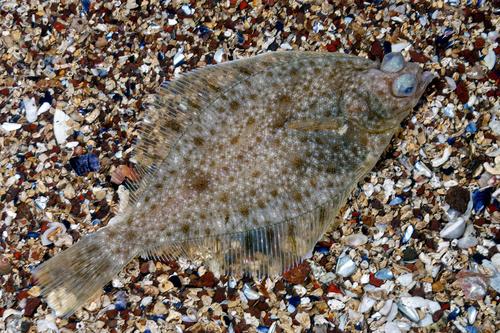
(c) Jim Greenfield, all rights reserved, uploaded by Jim Greenfield
OverviewAI-generated
The common dab, scientifically named *Limanda limanda*, is a species of fish within the family Pleuronectidae. It belongs to the order Pleuronectiformes, class Teleostei, and phylum Chordata. The species was described by Linnaeus in 1758 and is currently accepted as a valid taxon. Other common names for this organism include Sand Dab, Jelinenn, platýs limanda, Ising, and Kliesche.
This marine species is classified as Least Concern on the IUCN Red List, a status assigned in 2014. The common dab is also categorized as a type of seafood and fish as food.
Synthesized by Vinony from 27 facts across 5 sources: Wikidata, iNaturalist, WoRMS, IUCN Red List, Vinony graph. Generated from structured data (not the Wikipedia text) and checked against those facts — may still contain errors.
Species
Least Concerncommon dab
Species
- PhylumChordata
- ClassTeleostei
- OrderPleuronectiformes
- FamilyPleuronectidae
via IUCN
Wikidata facts
Show 7 more facts
- taxon rank
- species
- taxon name
- Limanda limanda
- Commons category
- Limanda limanda
- IUCN conservation status
- Least Concern
- Commons gallery
- Limanda limanda
- taxon common name
- hietakampela
- short name
- L. limanda
Sources (3)
via Wikidata · CC0
~3 min read
Encyclopedic overview
The common dab (Limanda limanda) is an edible flatfish of the family Pleuronectidae. It is a demersal fish native to shallow seas around Northern Europe, in particular the North Sea, where it lives on sandy bottoms down to depths of about 100 metres (330 ft). It can reach 40 centimetres (16 in) in length and can weigh up to 1 kilogram (2.2 lb), though most specimens grow no longer than 20 centimetres (7.9 in).
Taxonomy and nomenclature
Excerpted from Wikipedia’s “common dab” article, available under the CC BY-SA 4.0 licence.