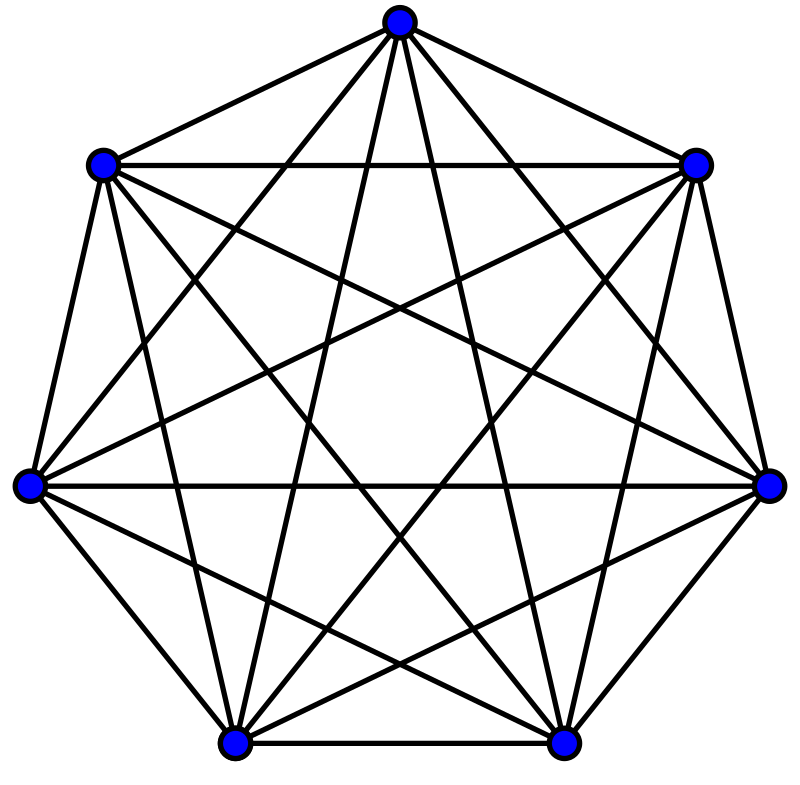
File:Complete_graph_K7.svg · Wikimedia Commons · See Wikimedia Commons
graphe complet
Sign in to saveAlso known as complete digraph, complete graphs, complete digraphs, 2K1-free graph
type de graphe
Key facts
- Vertices
- n
- Edges
- n ( n − 1 ) 2 {\displaystyle \textstyle {\frac {n(n-1)}{2}}}
- Radius
- { 0 n ≤ 1 1 otherwise {\displaystyle \left\{{\begin{array}{ll}0&n\leq 1\\1&{\text{otherwise}}\end{array}}\right.}
- Diameter
- { 0 n ≤ 1 1 otherwise {\displaystyle \left\{{\begin{array}{ll}0&n\leq 1\\1&{\text{otherwise}}\end{array}}\right.}
- Girth
- { ∞ n ≤ 2 3 otherwise {\displaystyle \left\{{\begin{array}{ll}\infty &n\leq 2\\3&{\text{otherwise}}\end{array}}\right.}
- Automorphisms
- n ! ( S n )
- Chromatic number
- n
- Chromatic index
- n if n is odd n − 1 if n is even
- Spectrum
- { ∅ n = 0 { 0 1 } n = 1 { ( n − 1 ) 1 , − 1 n − 1 } otherwise {\displaystyle \left\{{\begin{array}{lll}\emptyset &n=0\\\left\{0^{1}\right\}&n=1\\\left\{(n-1)^{1},-1^{n-1}\right\}&{\text{otherwise}}\end{array}}\right.}
- Properties
- ( n − 1) -regular Symmetric graph Vertex-transitive Edge-transitive Strongly regular Integral
- Notation
- K n
via Wikipedia infobox
Wikidata facts
- Subclass of
- Moore graph
- Image
- Complete graph example.svg
Show 6 more facts
- maintained by WikiProject
- WikiProject Mathematics
- Commons category
- Complete graphs
- graph diameter
- 1
- graph radius
- 1
- studied by
- graph theory
- opposite of
- edgeless graph
Sources (2)
via Wikidata · CC0
Article · Français
En théorie des graphes, un graphe complet est un graphe simple dont tous les sommets sont adjacents deux à deux, c'est-à-dire que tout couple de sommets disjoints est relié par une arête. Si le graphe est orienté, on dit qu'il est complet si chaque paire de sommets est reliée par exactement deux arcs (un dans chaque sens).
Abstract from DBpedia / Wikipedia · CC BY-SA