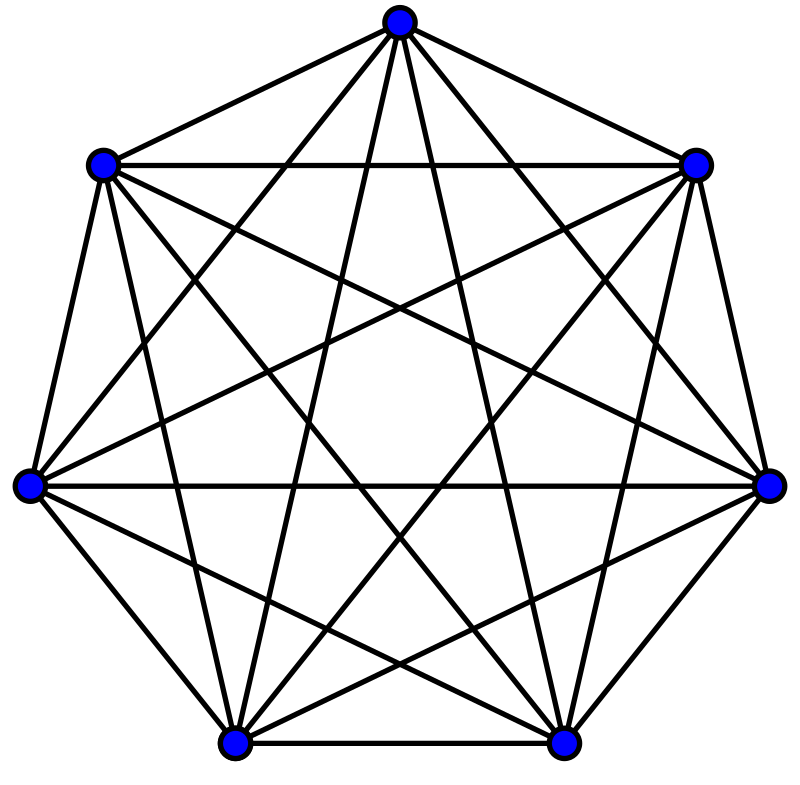
File:Complete_graph_K7.svg · Wikimedia Commons · See Wikimedia Commons
complete graph
Sign in to saveAlso known as complete digraph, complete graphs, complete digraphs, 2K1-free graph
simple undirected graph in which every pair of distinct vertices is connected by a unique edge
Key facts
- Vertices
- n
- Edges
- n ( n − 1 ) 2 {\displaystyle \textstyle {\frac {n(n-1)}{2}}}
- Radius
- { 0 n ≤ 1 1 otherwise {\displaystyle \left\{{\begin{array}{ll}0&n\leq 1\\1&{\text{otherwise}}\end{array}}\right.}
- Diameter
- { 0 n ≤ 1 1 otherwise {\displaystyle \left\{{\begin{array}{ll}0&n\leq 1\\1&{\text{otherwise}}\end{array}}\right.}
- Girth
- { ∞ n ≤ 2 3 otherwise {\displaystyle \left\{{\begin{array}{ll}\infty &n\leq 2\\3&{\text{otherwise}}\end{array}}\right.}
- Automorphisms
- n ! ( S n )
- Chromatic number
- n
- Chromatic index
- n if n is odd n − 1 if n is even
- Spectrum
- { ∅ n = 0 { 0 1 } n = 1 { ( n − 1 ) 1 , − 1 n − 1 } otherwise {\displaystyle \left\{{\begin{array}{lll}\emptyset &n=0\\\left\{0^{1}\right\}&n=1\\\left\{(n-1)^{1},-1^{n-1}\right\}&{\text{otherwise}}\end{array}}\right.}
- Properties
- ( n − 1) -regular Symmetric graph Vertex-transitive Edge-transitive Strongly regular Integral
- Notation
- K n
via Wikipedia infobox
Wikidata facts
- Subclass of
- Moore graph
- Image
- Complete graph example.svg
Show 6 more facts
- maintained by WikiProject
- WikiProject Mathematics
- Commons category
- Complete graphs
- graph diameter
- 1
- graph radius
- 1
- studied by
- graph theory
- opposite of
- edgeless graph
Sources (2)
via Wikidata · CC0
~5 min read
Encyclopedic overview
In the mathematical field of graph theory, a complete graph is a simple undirected graph in which every pair of distinct vertices is connected by a unique edge. A complete digraph is a directed graph in which every pair of distinct vertices is connected by a pair of unique edges (one in each direction).
Graph theory itself is typically dated as beginning with Leonhard Euler's 1736 work on the Seven Bridges of Königsberg. However, drawings of complete graphs, with their vertices placed on the points of a regular polygon, had already appeared in the 13th century, in the work of Ramon Llull. Such a drawing is sometimes referred to as a mystic rose.
Excerpted from Wikipedia’s “complete graph” article, available under the CC BY-SA 4.0 licence.