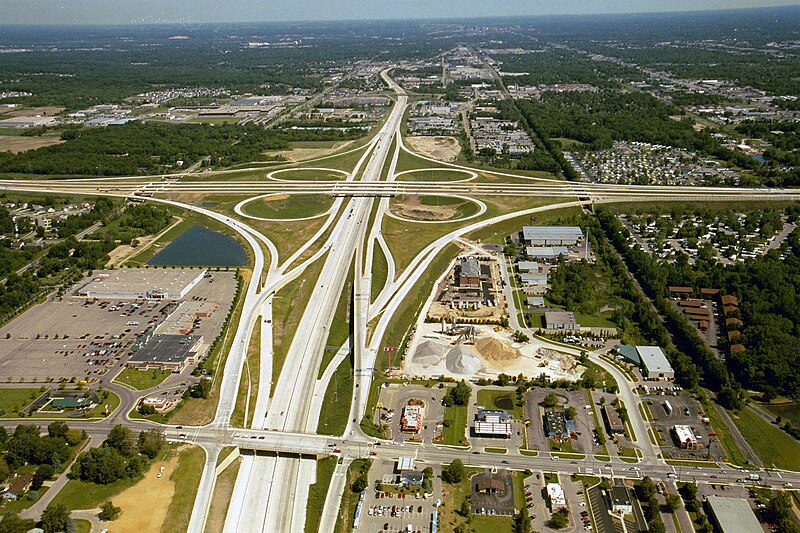
File:US_131,_M-6,_68th_St_interchange.jpg · Wikimedia Commons · See Wikimedia Commons
controlled-access highway
Sign in to saveAlso known as motorway, freeway, autobahn, expressway, highway, arterial highway
highway designed exclusively for high-speed vehicular traffic, with all traffic flow and ingress/egress regulated
A controlled-access highway is a road designed exclusively for high-speed vehicles, where you can only enter and exit at specific designated points rather than anywhere along the road. This design matters because it keeps traffic moving smoothly and safely by preventing slower vehicles and random access points from interrupting the flow of faster-moving cars.
AI-generated from the Wikipedia summary — may contain errors.
Wikidata facts
- Instance of
- road type
- Subclass of
- highway
- Part of
- limited-access road
- Image
- Garching Bundesautobahn 9.jpg
Show 8 more facts
- topic's main category
- Category:Controlled-access highways
- Unicode character
- 🛣
- OpenStreetMap tag
- access_control=full
- Commons category
- Controlled-access highways
- different from
- national road
- partially coincident with
- trunk road
- on focus list of Wikimedia project
- Wikipedia:Vital articles/Level/4
- has characteristic
- paved road surface
Sources (6)
via Wikidata · CC0
~40 min read
Encyclopedic overview
The cloverleaf interchange between US 131, M-6 and 68th Street in Cutlerville, Michigan, United States, shows many of the features of controlled-access highways: entry and exit ramps, median strips for opposing traffic, no at-grade intersections and no direct access to properties. This sign, or some variation thereof, is used to denote controlled-access highways in many countries. Typical overhead signage on Ontario's King's Highway network featuring an airport pictogram, distances to upcoming interchanges, and lane guidance. These signs have a blue background rather than the usual green to denote the local-express lanes.
A controlled-access highway is a type of highway that has been designed for high-speed vehicular traffic, with all traffic flow—ingress and egress—regulated. Common English terms are freeway, motorway, and expressway. Other similar terms include throughway or thruway and parkway. Some of these may be limited-access highways, although this term can also refer to a class of highways with somewhat less isolation from other traffic.
Excerpted from Wikipedia’s “controlled-access highway” article, available under the CC BY-SA 4.0 licence.
Gallery (12)
Available in 91 languages
- Español
- Français
- Deutsch
- 中文
- 日本語
- Русский
- Português
- Italiano
- العربية
- Albanian
- Albanian
- ami
- Asturian
- Azerbaijani
- Bahasa Indonesia
- Bangla
- Basque
- Belarusian
Show 72 more
- Bosnian
- Bulgarian
- Catalan
- Chuvash
- Croatian
- Czech
- Danish
- eml
- Esperanto
- Estonian
- Extremaduran
- Finnish
- Galician
- Georgian
- Greek
- Hebrew
- Hungarian
- Icelandic
- Ido
- Irish
- Kazakh
- Kyrgyz
- Latin
- Latvian
- Limburgish
- Lithuanian
- Lombard
- Luxembourgish
- Macedonian
- Malay
- Marathi
- Mazanderani
- Moroccan Arabic
- nds_nl
- Neapolitan
- Nederlands
- Newari
- Norwegian
- Norwegian Nynorsk
- nrm
- Occitan
- Piedmontese
- Polski
- roa_tara
- Romanian
- Scots
- Serbian
- Serbian (Latin)
- Silesian
- simple
- Slovak
- Slovenian
- Svenska
- Swahili
- Tiếng Việt
- Ukrainian
- Upper Sorbian
- Urdu
- Uzbek
- Venetian
- Veps
- Walloon
- Welsh
- Western Frisian
- Western Panjabi
- Wu Chinese
- Yiddish
- zh_classical
- zh_yue
- فارسی
- ไทย
- 한국어
via Wikidata sitelinks · CC0