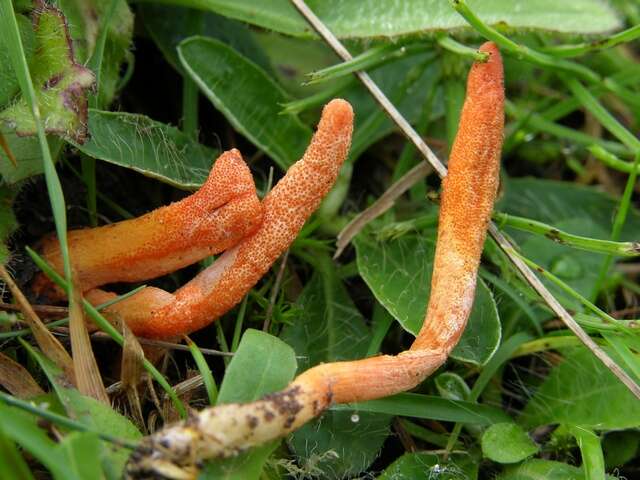
Encyclopedia of Life · EOL (see source)
Cordycipitaceae
Sign in to saveThe Cordycipitaceae are a family of parasitic fungi in the Ascomycota, class Sordariomycetes and order Hypocreales. The family was first published in 1969 by mycologist Hanns Kreisel, but the naming was invalid according to the code of International Code of Nomenclature for algae, fungi, and plants. It was validly published in 2007 as a way to resolve the paraphyly of Clavicipitaceae.
Species
ノムシタケ科
FAMILY
- KingdomFungi
- PhylumAscomycota
- ClassSordariomycetes
- OrderHypocreales
- FamilyCordycipitaceae
ノムシタケ科 サナギタケ(Cordyceps militaris) 分類 界 : 菌界 Fungi 門 : 子嚢菌門 Ascomycota 亜門 : チャワンタケ亜門 Pezizomycotina 綱 : フンタマカビ綱 Sordariomycetes 目 : ボタンタケ目 Hypocreales 科 : ノムシタケ科 Cordycipitaceae 学名 Cordycipitaceae Kreisel ex G.M. Sung et al.[1] 属 ノムシタケ属 Cordyceps など ノムシタケ科はフンタマカビ綱ボタンタケ目に属する菌類の科。昆虫寄生菌が多く含まれており、広義の冬虫夏草として知られているものも多い。 下位分類[編集] 2014年末の時点で編纂されたOutline of Sordariomycetes[2]によると以下の属が含まれる。 Akanthomyces Ascopolyporus Beauveria Cordyceps Gibellula Granulomanus Hyperdermium Isaria Lecanicillium Microhilum Simplicillium Syspastospora Torrubiella 歴史[編集] バッカクキン科は植物病原性や昆虫病原性など多様な糸状菌を含むことで知られてきたが、21世紀になると分子系統解析によってこの科の多系統性が指摘され、2007年にバッカクキン科、ノムシタケ科、オフィオコルジケプス科の3科に分割された。[1]設立当初はCordyceps、Ascopolyporus、Hyperdermium、Torrubiellaの4属から成っていたが、真菌全体の系統関係が見直される中で上記13属が枠組みとして提唱された。[2] 参考文献[編集] ^ a b Sung GH, Hywel-Jones NL, Sung JM, Luangsa-ard JJ, Shrestha B, Spatafora JW (2007). “Phylogenetic classification of Cordyceps and the clavicipitaceous fungi”. Studies in Mycology 57: 5–59. doi:10.3114/sim.2007.57.01. PMC 2104736. PMID 18490993. http://www.pubmedcentral.nih.gov/articlerender.fcgi?tool=pmcentrez&artid=2104736. ^ a b Maharachchikumbura et al. (2015). “Towards a natural classification and backbone
via GBIF
Museum specimens
- Specimen records
- 175
- With media
- 35
- Family
- Cordycipitaceae
- Collections
- TENN-F, LSUM, MIN, CUP, UCSC
- Recorded in
- United States, Brazil, Peru, Puerto Rico
Wikidata facts
- Instance of
- taxon
- Parent taxon
- Hypocreales
- Image
- 2010-08-06 Cordyceps militaris 1.jpg
Show 4 more facts
- taxon name
- Cordycipitaceae
- taxon rank
- family
- topic's main category
- Category:Cordycipitaceae
- Commons category
- Cordycipitaceae
Sources (2)
via Wikidata · CC0
~2 min read
Encyclopedic overview
6 sectionsContents
- Description
- Genera
- ''Parengyodontium album''
- See also
- References
- External links
The Cordycipitaceae are a family of parasitic fungi in the Ascomycota, class Sordariomycetes and order Hypocreales. The family was first published in 1969 by mycologist Hanns Kreisel, but the naming was invalid according to the code of International Code of Nomenclature for algae, fungi, and plants. It was validly published in 2007 as a way to resolve the paraphyly of Clavicipitaceae.
==Description== Cordycipitaceae species have stromata or subicula that are pallid or brightly pigmented and fleshy. Their perithecia are superficial to completely immersed in the substrate, and oriented at right angles to the surface of the stroma. The asci are cylindrical with a thickened ascus tip. Ascospores are usually cylindrical, contain multiple septa, and disarticulate into part-spores or remain intact at maturity.
Excerpted from Wikipedia’s “Cordycipitaceae” article, available under the CC BY-SA 4.0 licence.