File:Corioliskraftanimation.gif · Wikimedia Commons · See Wikimedia Commons
Coriolis force
Sign in to saveAlso known as Coriolis effect
apparent or fictitious force on objects moving within a reference frame that rotates with respect to an inertial frame
The Coriolis force is an apparent force that seems to push moving objects sideways when they travel within a rotating reference frame, such as on Earth's spinning surface. It matters because it affects the paths of weather systems, ocean currents, and long-range projectiles, making it essential for understanding how things move on our rotating planet.
AI-generated from the Wikipedia summary — may contain errors.
Research
611 papers- Virtual Coriolis-Force-Based Mode-Matching Micromachine-Optimized Tuning Fork Gyroscope without a Quadrature-Nulling Loop.Micromachines · 2023Wu Y, Yuan W, Xue Y et al.DOI: 10.3390/mi14091704
- Gradual exposure to Coriolis force induces sensorimotor adaptation with no change in peripersonal space.Scientific reports · 2022Leclere NX, Sarlegna FR, Coello Y et al.DOI: 10.1038/s41598-022-04961-1
- Rapid adaptation to Coriolis force perturbations of voluntary body sway.Journal of neurophysiology · 2019Bakshi A, DiZio P, Lackner JRDOI: 10.1152/jn.00606.2018
- Unidirectional Modes Induced by Nontraditional Coriolis Force in Stratified Fluids.Physical review letters · 2022Perez N, Delplace P, Venaille ADOI: 10.1103/PhysRevLett.128.184501
- Adaptation to Coriolis force perturbations of postural sway requires an asymmetric two-leg model.Journal of neurophysiology · 2019Bakshi A, DiZio P, Lackner JRDOI: 10.1152/jn.00607.2018
- Gravitoinertial force background level affects adaptation to coriolis force perturbations of reaching movements.Journal of neurophysiology · 1998Lackner JR, Dizio P, New Collective AuthorDOI: 10.1152/jn.1998.80.2.546
- Ocular torsion induced by Coriolis stimulation.Auris, nasus, larynx · 2024Aoki N, Yamazaki A, Honda K et al.DOI: 10.1016/j.anl.2024.05.011
- Rapid adaptation to Coriolis force perturbations of arm trajectory.Journal of neurophysiology · 1994Lackner JR, Dizio P, New Collective AuthorDOI: 10.1152/jn.1994.72.1.299
via PubMed
Wikidata facts
- Instance of
- scientific theory
- Subclass of
- physical quantity
- Named after
- Gaspard-Gustave de Coriolis
- Image
- Low pressure system over Iceland.jpg
Show 6 more facts
- discoverer or inventor
- Gaspard-Gustave de Coriolis
- Commons category
- Coriolis force
- Commons gallery
- Coriolis effect
- measurement scale
- newton
- time of discovery or invention
- 1835-00-00
- on focus list of Wikimedia project
- Wikipedia:Vital articles/Level/4
Sources (2)
via Wikidata · CC0
~40 min read
Encyclopedic overview
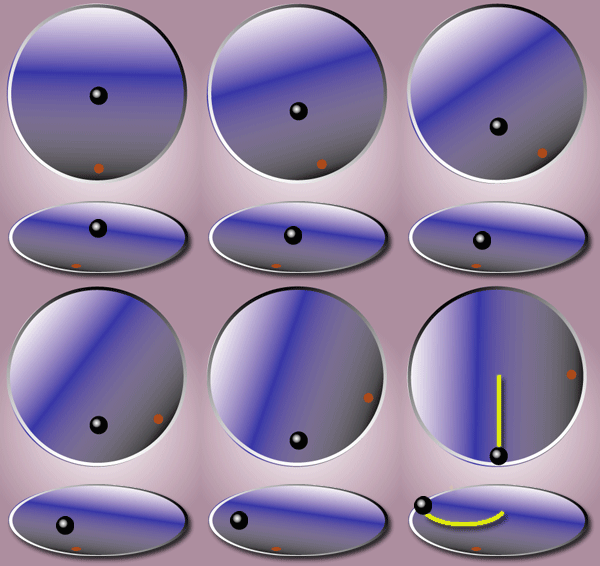
In the inertial frame of reference (upper part of the picture), the black ball moves in a straight line. However, the observer (red dot) who is standing in the rotating/non-inertial frame of reference (lower part of the picture) sees the object as following a curved path due to the Coriolis and centrifugal forces present in this frame. In physics, the Coriolis force is a pseudo-force that acts on objects in motion within a frame of reference that rotates with respect to an inertial frame. In a reference frame with clockwise rotation, the force acts to the left of the motion of the object. In one with anticlockwise (or counterclockwise) rotation, the force acts to the right. Deflection of an object due to the Coriolis force is called the Coriolis effect. Though recognized previously by others, the mathematical expression for the Coriolis force appeared in an 1835 paper by French scientist Gaspard-Gustave de Coriolis, in connection with the theory of water wheels. Early in the 20th century, the term Coriolis force began to be used in connection with meteorology. On Earth, the Coriolis force will affect the movement of air and water over long distance. Because of Earth's rotation, the moving object does not travel in a straight line relative to the Earth's surface but follows a curved path. This deflection, to the right in the Northern Hemisphere and to the left in the Southern Hemisphere, significantly influences large-scale circulation of winds and ocean currents.
Newton's laws of motion describe the motion of an object in an inertial (non-accelerating) frame of reference. When Newton's laws are transformed to a rotating frame of reference, the Coriolis and centrifugal accelerations appear. When applied to objects with masses, the respective forces are proportional to their masses. The magnitude of the Coriolis force is proportional to the rotation rate, and the magnitude of the centrifugal force is proportional to the square of the rotation rate. The Coriolis force acts in a direction perpendicular to two quantities: the angular velocity of the rotating frame relative to the inertial frame and the velocity of the body relative to the rotating frame, and its magnitude is proportional to the object's speed in the rotating frame (more precisely, to the component of its velocity that is perpendicular to the axis of rotation). The centrifugal force acts outwards in the radial direction and is proportional to the distance of the body from the axis of the rotating frame. These additional forces are termed inertial forces, fictitious forces, or pseudo forces. By introducing these fictitious forces to a rotating frame of reference, Newton's laws of motion can be applied to the rotating system as though it were an inertial system; these forces are correction factors that are not required in a non-rotating system.
Excerpted from Wikipedia’s “Coriolis force” article, available under the CC BY-SA 4.0 licence.
Gallery (12)
Available in 78 languages
- Español
- Français
- Deutsch
- 中文
- 日本語
- Русский
- Português
- Italiano
- العربية
- हिन्दी
- Afrikaans
- Albanian
- Armenian
- Asturian
- Azerbaijani
- Bahasa Indonesia
- Bangla
- Basque
Show 59 more
- Belarusian
- Bhojpuri
- Breton
- Bulgarian
- Catalan
- Central Kurdish
- Chuvash
- Croatian
- Czech
- Danish
- Esperanto
- Estonian
- Finnish
- Galician
- Georgian
- Greek
- Haitian Creole
- Hebrew
- Hungarian
- Ido
- Irish
- Kazakh
- Latin
- Latvian
- Lithuanian
- Lombard
- Macedonian
- Malay
- Malayalam
- Nederlands
- Norwegian
- Norwegian Nynorsk
- Occitan
- Papiamento
- Polski
- Romanian
- Scots
- Serbian
- Serbian (Latin)
- Sicilian
- Silesian
- simple
- Slovak
- Slovenian
- Sundanese
- Svenska
- Tamil
- Tatar
- Tiếng Việt
- Türkçe
- Ukrainian
- Urdu
- Uzbek
- Western Frisian
- Wu Chinese
- zh_yue
- فارسی
- ไทย
- 한국어
via Wikidata sitelinks · CC0