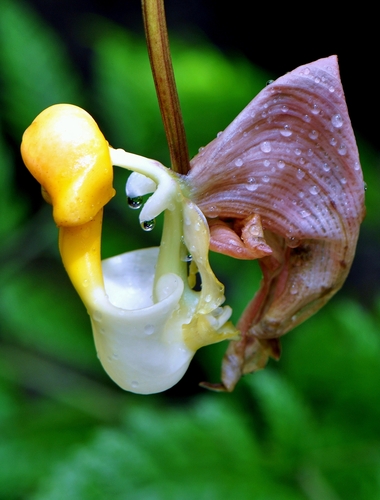
(c) Walter, some rights reserved (CC BY) · cc-by
Coryanthes
Sign in to saveCoryanthes, commonly known as bucket orchids, is a genus of neotropical epiphytic orchids (family Orchidaceae). This genus is abbreviated as Crths in horticultural trade. They are native to South America, Central America, Mexico and Trinidad.
Species
GENUS
- KingdomPlantae
- PhylumTracheophyta
- ClassLiliopsida
- OrderAsparagales
- FamilyOrchidaceae
Coryanthes Hook. 1831. Es un género con 53 especies de orquídeas epífitas simpodiales. Se distribuyen en toda la América tropical. Orquídeas muy complejas que se encuentran en asociación con colonias de hormigas. Índice 1 Descripción 2 Hábitat 3 Taxonomía 4 Especies de Coryanthes 5 Véase también 6 Referencias 7 Bibliografía 8 Enlaces externos Descripción Todas las especies de este género son epífitas con un desarrollo simpodial. Las raíces son aéreas, blancas y muy finas, desarrollándose en densos paquetes. Algunas raíces se desarrollan hacia arriba en vez de colgar hacia abajo. Esta especialización ayuda en la formación de grandes madejas de raíces aéreas. Muchas se encuentran en asociación con las hormigas de nidos. Los pseudobulbos cónicos son acanalados y de unos 8 cm de longitud. Dos hojas alternas se producen en el ápice de cada pseudobulbo. Las hojas son coriáceas y con venas pronunciadas, llegando hasta unos 30 cm de longitud. Las inflorescencias son en racimos desarrollándose desde la base de los pseudobulbos. Los tallos primero crecen hacia arriba, pero pronto se doblan y quedan péndulos. Las numerosas flores son de las más complejas de las orquídeas. Las flores están per
via GBIF · Kew POWO
Museum specimens
- Specimen records
- 27
- With media
- 13
- Family
- Orchidaceae
- Collections
- AMES, F, UESC, MO, SEL, INSTITUTO NACIONAL DE PESQUISAS DA AMAZÔNIA (INPA)
- Recorded in
- Venezuela, Perú, Colombia, Peru, Brasil, Guyana, Panama
Wikidata facts
- Instance of
- taxon
- Parent taxon
- Stanhopeinae
- Image
- Coryanthes verrucolineata Orchi 02.jpg
Show 7 more facts
- taxon name
- Coryanthes
- topic's main category
- Category:Coryanthes
- taxon rank
- genus
- Commons category
- Coryanthes
- Commons gallery
- Coryanthes
- taxon common name
- 吊桶兰属
Sources (1)
via Wikidata · CC0
~4 min read
Encyclopedic overview
6 sectionsContents
- History
- Intergeneric hybrids
- Gallery
- See also
- References
- External links
Coryanthes, commonly known as bucket orchids, is a genus of neotropical epiphytic orchids (family Orchidaceae). This genus is abbreviated as Crths in horticultural trade. They are native to South America, Central America, Mexico and Trinidad.
Bucket orchids are an excellent example of coevolution and mutualism, as the orchids have evolved along with orchid bees (the tribe Euglossini of the family Apidae) and both depend on each other for reproduction. One to three flowers are borne on a pendant stem that comes from the base of the pseudobulbs. The flower secretes a fluid (see Coryanthes alborosea picture) into the flower lip, which is shaped like a bucket. The male orchid bees (not the females) are attracted to the flower by a strong scent from aromatic oils, which they store in specialized spongy pouches inside their swollen hind legs, as they appear to use the scent in their courtship dances in order to attract females. The bees, trying to get the waxy substance containing the scent, sometimes fall to the fluid-filled bucket. As they are trying to escape, they find that there are some small knobs on which they can climb on, while the rest of the lip is lined with smooth, downward-pointing hairs, upon which their claws cannot find a grip. The knobs lead to a spout (see the Coryanthes leucocorys picture), but as the bee is trying to escape, the spout constricts. At that same moment, the small packets containing the pollen of the orchid are pressed against the thorax of the bee. However, the glue on the pollen packets does not set immediately, so the orchid keeps the bee trapped until the glue has set. Once the glue has set, the bee is let free and he can now dry his wings and fly off. This may have taken as long as 45 minutes. Pollination is completed if the bee goes to another Coryanthes flower, where, if the orchid is to be successful at reproducing, the bee again falls into the bucket of another flower of the same species. This time the pollen packets get stuck to the stigma as the bee is escaping, and after a while the orchid will produce a seed pod. According to Anthony Huxley, the fluid produced by the two glands which fill the bucket contain an intoxicating substance. These flowers are among the largest in the Orchid Family. According to Kupper and Linsenmaier some species can be up to wide and top to bottom. C. bruchmuelleri is generally regarded as the largest species, as even the unopened buds can be long by in width.
Excerpted from Wikipedia’s “Coryanthes” article, available under the CC BY-SA 4.0 licence.
Gallery (4)
Available in 20 languages
- Español
- 中文
- Português
- العربية
- Bulgarian
- Catalan
- Cebuano
- Egyptian Arabic
- Komi
- Komi-Permyak
- Lithuanian
- Mari
- Moksha
- Polski
- Svenska
- Tiếng Việt
- Udmurt
- Waray
Show 1 more
via Wikidata sitelinks · CC0