File:MMC_MD_Curriculum.png · Wikimedia Commons · See Wikimedia Commons
curriculum
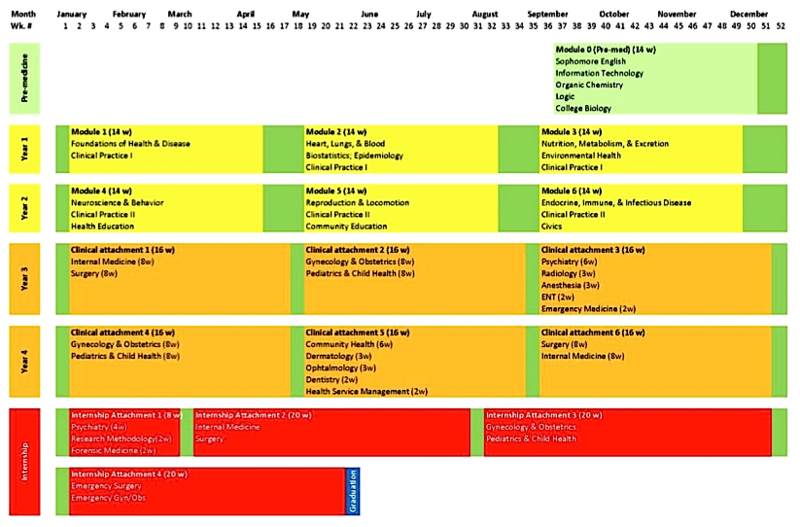
Sign in to savethumb|A 52-week curriculum for a medical school, showing the courses for the different levels In education, a curriculum (; : curriculums or curricula ) is the totality of student experiences that occur in an educational process. The term often refers specifically to a planned sequence of instruction, or to a view of the student's experiences in terms of the educator's or school's instructional goals. A curriculum may incorporate the planned interaction of pupils with instructional content, materials, resources, and processes for evaluating the attainment of educational objectives. Curricula a
A curriculum is the complete set of courses, materials, and learning experiences that a school or educational program provides to students, typically organized in a planned sequence. It matters because it shapes what students learn and how their progress is measured, reflecting the educational goals and objectives that educators want students to achieve.
AI-generated from the Wikipedia summary — may contain errors.
Research
2,254,266 papers- The integrated curriculum in medical education: AMEE Guide No. 96.Medical teacher · 2015Brauer DG, Ferguson KJDOI: 10.3109/0142159X.2014.970998
- The programming curriculum within ISIS.PloS one · 2022Deslandes-Martineau M, Charland P, Lapierre HG et al.DOI: 10.1371/journal.pone.0265721
- Addiction curriculum design for medical students.The clinical teacher · 2022Hostetter K, Thakkar B, Edwards C et al.DOI: 10.1111/tct.13438
- Robotic surgical curriculum for medical students: a scoping review.Journal of robotic surgery · 2025El-Mohamed J, Ahmadipour M, Warrier S et al.DOI: 10.1007/s11701-025-02667-w
- Ophthalmology Residency in the United States: The Case for a National Curriculum.ReviewSeminars in ophthalmology · 2023Bhullar PK, Venkateswaran NDOI: 10.1080/08820538.2022.2152713
- Curriculum reform and trainees' perception of the pharmacy educational environment: a modified DREEM study.The International journal of pharmacy practice · 2023Yeoh TT, Kumwenda B, Chew LDOI: 10.1093/ijpp/riac105
- The Hidden Curriculum of Utilisation of Imaging and Unregulated Digital Resources within Clinical Education.ReviewAdvances in experimental medicine and biology · 2020Matthan J, Finn GMDOI: 10.1007/978-3-030-37639-0_9
- Quality Improvement Curriculum for Intensive Care Unit Upgrades.The western journal of emergency medicine · 2023Bohman SR, Day L, Danko C et al.DOI: 10.5811/westjem.59400
via PubMed
Wikidata facts
Show 5 more facts
- topic's main category
- Category:Curricula
- partially coincident with
- course
- equivalent class
- skos.um.es/unescothes/C00934
- Commons category
- Curricula
- on focus list of Wikimedia project
- Wikipedia:Vital articles/Level/4
via Wikidata · CC0
~33 min read
Encyclopedic overview
28 sectionsContents
- Etymology
- Definitions and interpretations
- Professional interpretations
- Types of curricula
- Historical conception
- Progressivist views
- Primary and secondary education
- Australia
- Canada
- Iran
- South Korea
- Japan
- The Netherlands
- Nigeria
- Russia
- United Kingdom
- England and Wales
- Scotland
- United States
- Higher education
- Core curriculum
- Distribution requirements
- Open curriculum
- Gender inequality in curricula
- See also
- Works cited
- References
- External links
thumb|A 52-week curriculum for a medical school, showing the courses for the different levels In education, a curriculum (; : curriculums or curricula ) is the totality of student experiences that occur in an educational process. The term often refers specifically to a planned sequence of instruction, or to a view of the student's experiences in terms of the educator's or school's instructional goals. A curriculum may incorporate the planned interaction of pupils with instructional content, materials, resources, and processes for evaluating the attainment of educational objectives. Curricula are split into several categories: the explicit, the implicit (including the hidden), the excluded, and the extracurricular.
Curricula may be tightly standardized or may include a high level of instructor or learner autonomy. Many countries have national curricula in primary and secondary education, such as the United Kingdom's National Curriculum.
Excerpted from Wikipedia’s “curriculum” article, available under the CC BY-SA 4.0 licence.