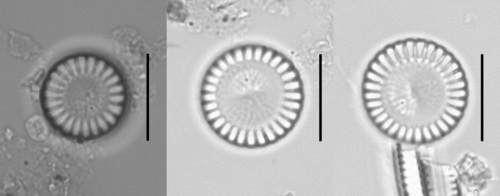
(c) Stephanie Robson, some rights reserved (CC BY-NC), uploaded by Stephanie Robson · cc-by-nc
Cyclotella
Sign in to saveCyclotella is a genus of diatoms often found in oligotrophic environments, both marine and fresh water. It is in the family Stephanodiscaceae and the order Thalassiosirales. The genus was first discovered in the mid-1800s and since then has become an umbrella genus for over 100 different species, the most well-studied and the best known being Cyclotella meneghiniana. Despite being among the most dominant genera in low-productivity environments, it is relatively understudied.
Species
タイコケイソウ/キクロテラ属
GENUS
- KingdomChromista
- PhylumOchrophyta
- ClassBacillariophyceae
- OrderThalassiosirales
- FamilyStephanodiscaceae
via GBIF
Museum specimens
- Specimen records
- 180
- With media
- 19
- Family
- Stephanodiscaceae
- Collections
- CCBA-FMVZ-UADY, UCMP, US
- Recorded in
- Mexico, United States
Wikidata facts
- Instance of
- taxon
- Parent taxon
- Stephanodiscaceae
- Image
- Cyclotellameneghiniana.jpg
Show 4 more facts
- Commons category
- Cyclotella
- taxon rank
- genus
- taxon name
- Cyclotella
Sources (2)
via Wikidata · CC0
~13 min read
Encyclopedic overview
8 sectionsContents
- Etymology
- History
- Habitat and ecology
- Morphology
- Life cycle
- Biochemistry
- Fossil records
- References
Cyclotella is a genus of diatoms often found in oligotrophic environments, both marine and fresh water. It is in the family Stephanodiscaceae and the order Thalassiosirales. The genus was first discovered in the mid-1800s and since then has become an umbrella genus for over 100 different species, the most well-studied and the best known being Cyclotella meneghiniana. Despite being among the most dominant genera in low-productivity environments, it is relatively understudied.
Cyclotella habitat has traditionally been described as low-productivity mesotrophic or oligotrophic freshwater environments. However, it is unclear whether there is an archetypal aquatic setting for this genus as some species are more cosmopolitan, such as C. meneghiniana, which occurs in warm, nutrient-rich environments as well as low-productivity environments.
Excerpted from Wikipedia’s “Cyclotella” article, available under the CC BY-SA 4.0 licence.
Gallery (2)
Available in 7 languages
via Wikidata sitelinks · CC0