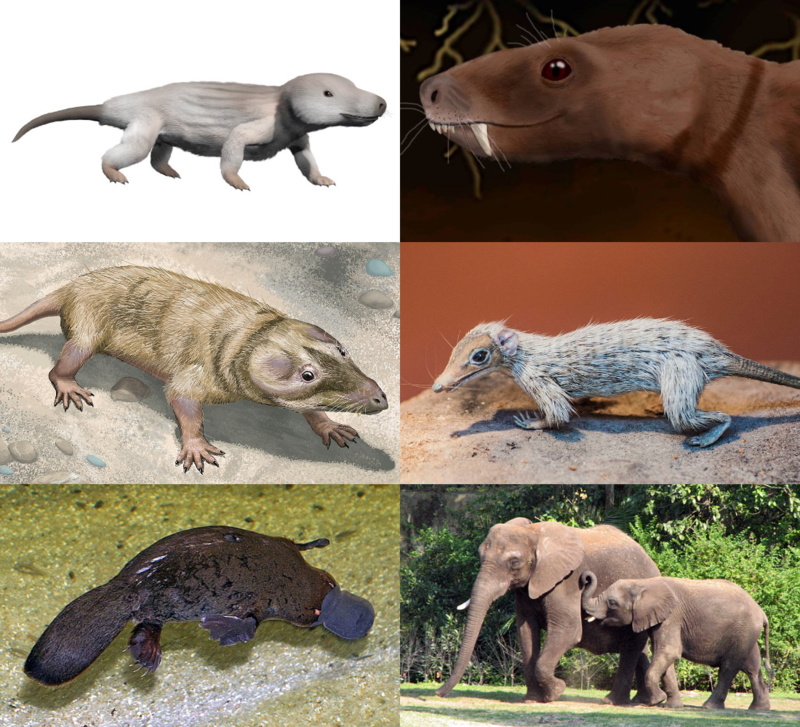
File:Cynodontia2.png · Wikimedia Commons · See Wikimedia Commons
Cynodontia
Sign in to saveAlso known as cynodont
Cynodontia () is a clade of eutheriodont therapsids that first appeared in the Late Permian (approximately 260 mya), and extensively diversified after the Permian–Triassic extinction event. Mammals are cynodonts, as are their extinct ancestors and close relatives (Mammaliaformes), having evolved from advanced probainognathian cynodonts during the Late Triassic.
OverviewAI-generated
Cynodontia is a family within the kingdom Animalia and the phylum Chordata. This taxon has existed since about 260 million years ago.
Records of Cynodontia are held by institutions including NHMUK and NMMNHS. These records originate from South Africa, Zambia, and the United States. The subject is associated with 285 occurrences and 11 records, which include 3 media items.
Synthesized by Vinony from 15 facts across 5 sources: Wikidata, GBIF, Gbif Occ, iDigBio, Vinony graph. Generated from structured data (not the Wikipedia text) and checked against those facts — may still contain errors.
Museum specimens
- Specimen records
- 11
- With media
- 3
- Family
- Cynodontia
- Collections
- NHMUK, NMMNHS
- Recorded in
- South Africa, Zambia, United States
Wikidata facts
- Instance of
- taxon
- Parent taxon
- Eutheriodontia
- Image
- Cynognathus BW.jpg
Show 6 more facts
- temporal range start
- Cisuralian
- taxon common name
- Cynodont
- start time
- 260000000-
- taxon name
- Cynodontia
- Commons category
- Cynodontia
- topic's main category
- Category:Cynodonts
Sources (1)
via Wikidata · CC0
~10 min read
Encyclopedic overview
10 sectionsContents
- Etymology
- Description
- Evolutionary history
- Taxonomy
- Phylogeny
- Distribution
- See also
- References
- Further reading
- External links
Cynodontia () is a clade of eutheriodont therapsids that first appeared in the Late Permian (approximately 260 mya), and extensively diversified after the Permian–Triassic extinction event. Mammals are cynodonts, as are their extinct ancestors and close relatives (Mammaliaformes), having evolved from advanced probainognathian cynodonts during the Late Triassic.
Non-mammalian cynodonts occupied a variety of ecological niches, both as carnivores and as herbivores. Following the emergence of mammals, most other cynodont lines went extinct, with the last known non-mammaliaform cynodont group, the Tritylodontidae, having its youngest records in the Early Cretaceous.
Excerpted from Wikipedia’s “Cynodontia” article, available under the CC BY-SA 4.0 licence.