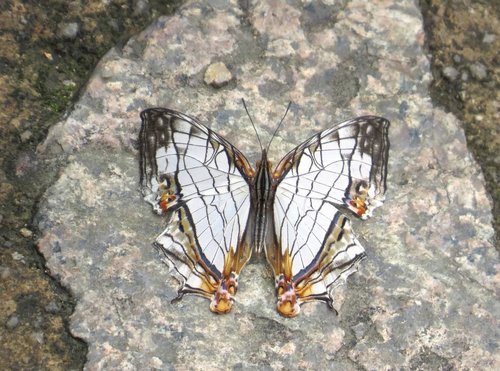
(c) Alan Kwok (King Lun), Ada Tai (Ah Heung) / 阿達蘭 AdAlan, some rights reserved (CC BY-NC), uploaded by Alan Kwok (King Lun), Ada Tai (Ah Heung) / 阿達蘭 AdAlan · cc-by-nc
Cyrestis
Sign in to saveCyrestis is a butterfly genus in the family Nymphalidae. They are known as map butterflies, so named because the wing-markings of some species resemble the lines of latitude and longitude of a world map. Cyrestis is a widespread genus ranging from Africa to parts of the Indomalayan realm and parts of the Australasian realm (New Guinea).
Species
Common Mapwing
GENUS
- KingdomAnimalia
- PhylumArthropoda
- ClassInsecta
- OrderLepidoptera
- FamilyNymphalidae
via GBIF
Museum specimens
- Specimen records
- 94
- With media
- 1
- Family
- Nymphalidae
- Collections
- UMNH, YPM, FMNH, CSIRO
- Recorded in
- Indonesia, India, Papua New Guinea
Wikidata facts
- Instance of
- taxon
- Image
- Cyrestiselegans.jpg
Show 5 more facts
- Commons category
- Cyrestis
- taxon name
- Cyrestis
- taxon rank
- genus
- topic's main category
- Category:Cyrestis
- taxon common name
- 絲蛺蝶屬
Sources (1)
via Wikidata · CC0
~2 min read
Encyclopedic overview
4 sectionsContents
- Description
- Species
- References
- External links
Cyrestis is a butterfly genus in the family Nymphalidae. They are known as map butterflies, so named because the wing-markings of some species resemble the lines of latitude and longitude of a world map. Cyrestis is a widespread genus ranging from Africa to parts of the Indomalayan realm and parts of the Australasian realm (New Guinea).
==Description== The following characteristics apply to all the species of Cyrestis. They are very delicate and strikingly coloured with exceedingly tender and thin, but unusually large wings whose surface is out of all proportion with the slightly-built, slender and delicate body. The eyes are large, prominent and naked; palpi long, pointed, beak-like, slightly curved upwards, resembling those of the genus Libythea. The principal and most striking markings found on both wings in all the species consist in finer or coarser blackish bands running parallel to the body and at right angles to the longitudinal axis of the wings; of these bands always three unite on each wing to form a broader submarginal fascia. In the white-coloured species these bands or streaks are so fine that, in combination with the frequently black veins, they remind one of the meridian lines on a map, which has given rise in British India and the Straits to the popular and expressive name “the Map”.
Excerpted from Wikipedia’s “Cyrestis” article, available under the CC BY-SA 4.0 licence.
Gallery (2)
Available in 13 languages
via Wikidata sitelinks · CC0