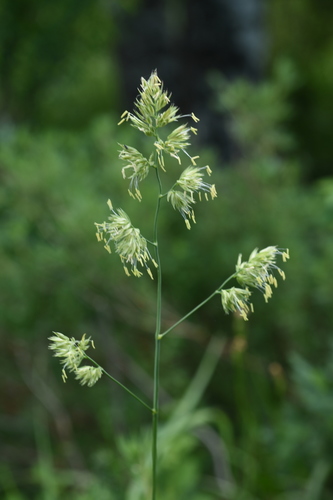
(c) Petr Kosachev, some rights reserved (CC BY-NC), uploaded by Petr Kosachev · cc-by-nc
Dactylis
Sign in to saveAlso known as cocksfoot, cocksfoot grasses, cocks-foot grass, orchard grasses
Dactylis is a genus of Eurasian and North African plants in the bluegrass subfamily within the grass family. Dactylis is native to North Africa, they are found throughout the world, and are an invasive species. They are known in English as '''cock's-foot or cocksfoot grasses, also sometimes as orchard grasses'''.
OverviewAI-generated
Dactylis is a genus of plants in the family Poaceae, commonly known as orchardgrass or Cocksfoot. It belongs to the kingdom Plantae, phylum Tracheophyta, and order Poales. The genus is classified under the subfamily Dactylidinae, with Dactylis glomerata serving as its taxonomic type. Its fruit type is a caryopsis.
The native range of Dactylis includes Afghanistan, Albania, Algeria, Altay, Assam, Austria, the Azores, Baleares, the Baltic States, Belarus, Belgium, and Bulgaria. The taxon is considered accepted in taxonomic records. Various databases document its presence, with occurrence records noted in countries such as Turkey, Portugal, Sweden, the United States, and Denmark.
Synthesized by Vinony from 43 facts across 9 sources: Wikidata, GBIF, PubMed, iNaturalist, Gbif Occ, Plants of the World, WoRMS, iDigBio, Vinony graph. Generated from structured data (not the Wikipedia text) and checked against those facts — may still contain errors.
Species
orchard grass
GENUS
- KingdomPlantae
- PhylumTracheophyta
- ClassLiliopsida
- OrderPoales
- FamilyPoaceae
鸭茅属(学名:Dactylis)是禾本目禾本科下的一个属,为粗壮、多年生草本植物。该属共有约4种,分布于欧亚之温带和北非。[1] 参考文献 ^ 中国种子植物科属词典. 中国数字植物标本馆. (原始内容存档于2012-04-11). 外部链接 維基物種中有關鸭茅属的數據 这是一篇與植物相關的小作品。你可以通过编辑或修订扩充其内容。 查 论 编 取自“https://zh.wikipedia.org/w/index.php?title=鸭茅属&oldid=45919169” 分类: 禾本科 鸭茅属 卡尔·林奈命名的生物分类 隐藏分类: 物种微格式条目 含有拉丁語的條目 WikispeciesLatinName 全部小作品 植物小作品
via GBIF · Kew POWO
Museum specimens
- Specimen records
- 436
- With media
- 249
- Family
- Poaceae
- Collections
- US, NY, NHMUK, MO, UCONN, GH
- Recorded in
- Turkey, Portugal, Sweden, United States, Denmark, South Africa, United Kingdom, Iran
Research
709 papers- Metabolomic Study of Dactylis glomerata Growing on Aeolian Archipelago (Italy).Metabolites · 2022
- Plant-Growth-Promoting Potential of PGPE Isolated from Dactylis glomerata L.Microorganisms · 2022
- Orchard grass or cock's foot, Dactylis glomerata.Annals of allergy, asthma & immunology : official publication of the American College of Allergy, Asthma, & Immunology · 2005
- Metabolomic approach to investigate Dactylis glomerata L. from the VIR collection.Vavilovskii zhurnal genetiki i selektsii · 2023
- Short-Term Exposure of Dactylis glomerata Pollen to Atmospheric Gaseous Pollutants Is Related to an Increase in IgE Binding in Patients with Grass Pollen Allergies.Plants (Basel, Switzerland) · 2022
via PubMed
Wikidata facts
- Instance of
- taxon
- Parent taxon
- Dactylidinae
- Image
- DactylisGlomerata.jpg
Show 8 more facts
- taxon name
- Dactylis
- taxon rank
- genus
- Commons category
- Dactylis
- taxonomic type
- Dactylis glomerata
- topic's main category
- Category:Dactylis
- taxon common name
- 鸭茅属
- has fruit type
- caryopsis
Sources (3)
via Wikidata · CC0
~3 min read
Encyclopedic overview
8 sectionsContents
- Taxonomy
- Accepted species
- Formerly included
- Description
- Ecology
- Cytology
- See also
- References
Dactylis is a genus of Eurasian and North African plants in the bluegrass subfamily within the grass family. Dactylis is native to North Africa, they are found throughout the world, and are an invasive species. They are known in English as '''cock's-foot or cocksfoot grasses, also sometimes as orchard grasses'.
==Taxonomy== The genus has been treated as containing only a single species Dactylis glomerata by many authors, treating variation in the genus at only subspecific rank within D. glomerata, but more recently, there has been a trend to accept two species, while some authors accept even more species in the genus, particularly island endemic species in Macaronesia.
Excerpted from Wikipedia’s “Dactylis” article, available under the CC BY-SA 4.0 licence.