Encyclopedia of Life · EOL (see source)
Dactylopteridae
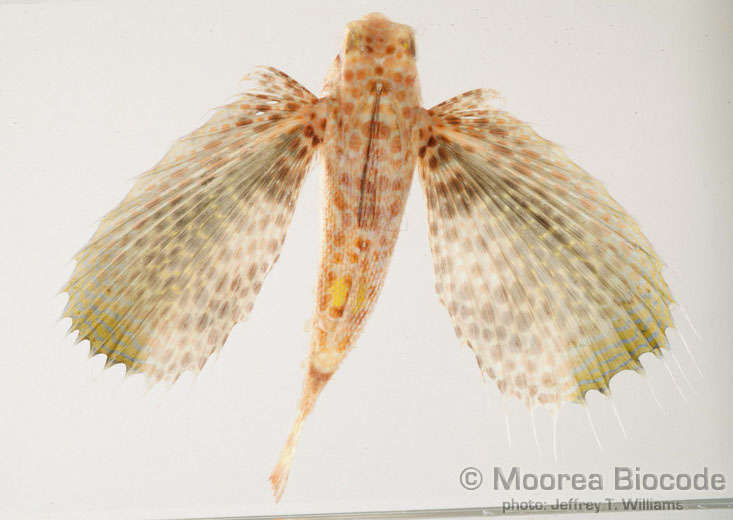
Sign in to saveThe flying gurnards are a family, Dactylopteridae, of marine fish notable for their greatly enlarged pectoral fins. As they cannot literally fly or glide in the air (like flying fish), an alternative name preferred by some authors is helmet gurnards. They have been regarded as the only family in the suborder Dactylopteroidei of the Scorpaeniformes. However, more recent molecular classifications put them in the order Syngnathiformes, in the superfamily Centriscoidea.
Species
flying gurnards
FAMILY
- KingdomAnimalia
- PhylumChordata
- ClassTeleostei
- OrderScorpaeniformes
- FamilyDactylopteridae
飛角魚科是輻鰭魚綱鮋形目的其中一科。
via GBIF
Museum specimens
- Specimen records
- 264
- Family
- Dactylopteridae
- Collections
- USNM, CAS, NMV, MSUM, MNHN, AM
- Recorded in
- United States, Philippines, Australia, Japan, Polynesie, French Polynesia, Vietnam, Canada
Wikidata facts
- Instance of
- taxon
- Image
- Flughahn.jpg
Show 6 more facts
- Commons category
- Dactylopteridae
- taxon rank
- family
- taxon name
- Dactylopteridae
- Code of nomenclature
- International Code of Zoological Nomenclature
- topic's main category
- Category:Dactylopteridae
- taxon common name
- flygeknurrfamilien
Sources (1)
via Wikidata · CC0
~2 min read
Encyclopedic overview
4 sectionsContents
- Taxonomy
- See also
- References
- External links
The flying gurnards are a family, Dactylopteridae, of marine fish notable for their greatly enlarged pectoral fins. As they cannot literally fly or glide in the air (like flying fish), an alternative name preferred by some authors is helmet gurnards. They have been regarded as the only family in the suborder Dactylopteroidei of the Scorpaeniformes. However, more recent molecular classifications put them in the order Syngnathiformes, in the superfamily Centriscoidea.
They have been observed to "walk" along sandy sea floors while looking for crustaceans, other small invertebrates and small fish by using their pelvic fins. Like the true gurnards (sea robins), to which they may be related, they possess a swim bladder with two lobes and a "drumming muscle" that can beat against the swim bladder to produce sounds. They have heavy, protective scales and the undersides of their huge pectoral fins are brightly coloured, perhaps to startle predators.
Excerpted from Wikipedia’s “Dactylopteridae” article, available under the CC BY-SA 4.0 licence.