Described at
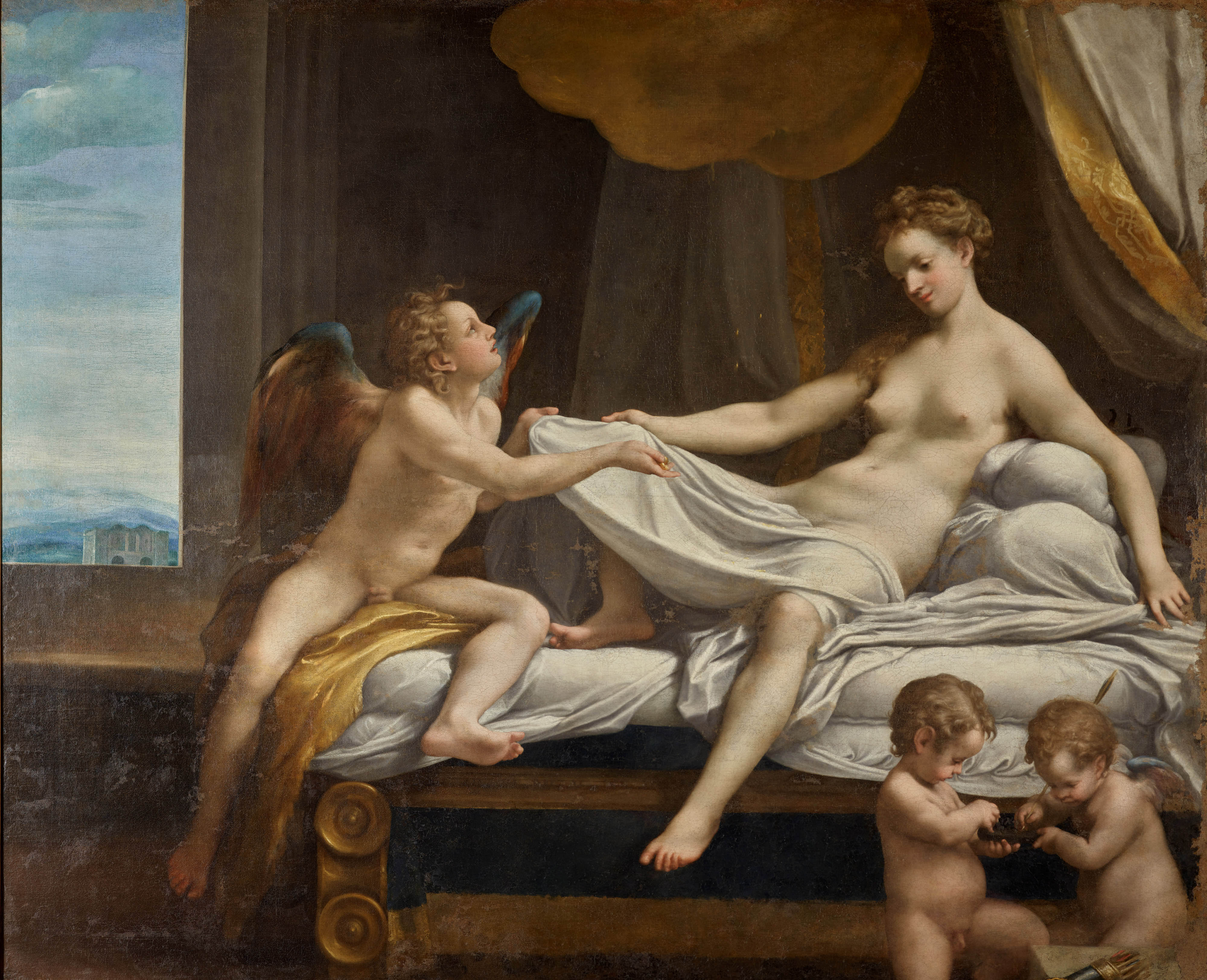
Danae - Allegri Antonio called Correggio
collezionegalleriaborghese.it →Executed in 1530-31, the work formed part of a series of four paintings depicting Jupiter’s loves ( Jupiter and Io , Kunsthistorisches Museum, Vienna, inv. no. GG274; Ganymede Abducted by the Eagle , Kunsthistorisches Museum, Vienna, inv. no. GG276; and Leda and the Swan , Gemäldegalerie, Berlin, inv. no 218). The series represents a refined and sophisticated homage which alludes – through the transformed figure of the father of the gods – to the Emperor himself, given that Charles’s emblem, the eagle, corresponds to the divine attribute. As Verheyen (1966) suggested, however, it is also possible that the duke commissioned the entire cycle for himself, perhaps destined for the ‘Ovid Room’ in the Palazzo Te in Mantua. According to this theory, Federico gave them to Charles only after the latter saw and obtained the first two canvases – Jupiter and Io and Ganymede Abducted by the Eagle – which the duke donated to him with the promise that he would also soon receive the other works. (According to Verheyen, the cycle, which was executed for Federico’s lover Isabella Boschetti, consisted of many other paintings, a theory deduced from the correspondence between the duke and the governor of Parma in 1534.) Whichever hypothesis is correct, it is certain that the painting was given to Charles V, perhaps in 1530 or more likely in November 1532 (Gould 1976). Subsequently, the painting returned to Italy by various possible routes. Here it was seen by Giovanni Paolo Lomazzo in 1584 in the Milanese collection of the sculptor Leone Leoni (Lomazzo 1584). At present, we do not know the details of how Leone’s son Pompeo came into possession of the canvas before sending it to his father in Lombardy. One theory is that he obtained it from the emperor himself; another that he purchased it through Antonio Pérez, secretary of Ruy Gómez de Silva, Prince of Eboli, who in turn could have received it from Philip II, Charles’s son (Delaforce 1982). As the variety of opinions on this complex topic shows (Verheyen 1966; Quintavalle 1970, Gould 1976; Bacchi 1997; Fabiansky 2000; Hoeninger 2001), the ‘transfer’ is still a debated point among critics. The story is further complicated by the nearly contemporary presence of the Danaë in Leoni’s collection in Milan (1584) and Perez’s in Madrid (1585): this dilemma can only be resolved by assuming either that the painting moved from Italy to Spain in a short space of time, or that a copy existed. In any case, a recent study (Rudolf 2002) showed that the Leoni Danaë was sold by him to Rudolf II in Prague in 1601 through the ambassador Hans Khevenhüller, entering into the imperial collections. Here it was indeed mentioned in the inventory of 1621 (Zimmermann 1905, no. 894). Taken to Stockholm by Swedish troops at the end of the Thirty Years’ War (1648), it came into possession of Christina of Sweden, who brought it with her to Rome in 1655. It was indeed seen and praised in her collection by the erudite Giovanni Michele Silos, who was based in the Eternal City in 1673 (Silos 1673, ed. 1979). In 1689, Christina gave the work to Cardinal Decio Azzolini, who bequeathed it to his nephew Pompeo Azzolini. In 1697, the Danaë was sold to Prince Livio Odescalchi. Through Marquis Baldassarre Erba Odescalchi, it came into possession of first Pierre Crozat and then Philippe II, Duke of Orleans (Gould, 1976). In 1780, the work found its way onto the London art market, together with much of the collection of the powerful French prince. In 1816, it passed into the hands of the Duke of Bridgewater, who ceded it to Henry Hope, who in turn sold it to the Parisian antiques dealer Bonnemaison. It was from the last-named figure that Camillo Borghese purchased the work in 1827 for 285 pounds. (Gould 1976). On its journey back to Italy it was intentionally mislabelled: this was the expedient concocted by Evasio Gozzani to avoid paying a burdensome import tax in the Papal States (M. Minozzi in Correggio 2008). Once in Rome, the work wa
Excerpt from a page describing this subject · 24,424 chars · not written by Vinony
Wikidata facts
- Instance of
- painting
- Main subject
- shower of gold
- Depicts
- putto
- Material used
- canvas
- Creator
- Antonio da Correggio
- Collection
- Borghese Collection
- Location
- Galleria Borghese
- Image
- Correggio 008.jpg
- Height
- 158
- Width
- 189
Show 8 more facts
- described at URL
- www.collezionegalleriaborghese.it/opere/danae
- inventory number
- 125
- commissioned by
- Federico II Gonzaga, Duke of Mantua
- Commons category
- Danae by Correggio
- copyright status
- public domain
- inception
- 1530-00-00
- title
- Danae
- depicts Iconclass notation
- 92B1217
via Wikidata · CC0