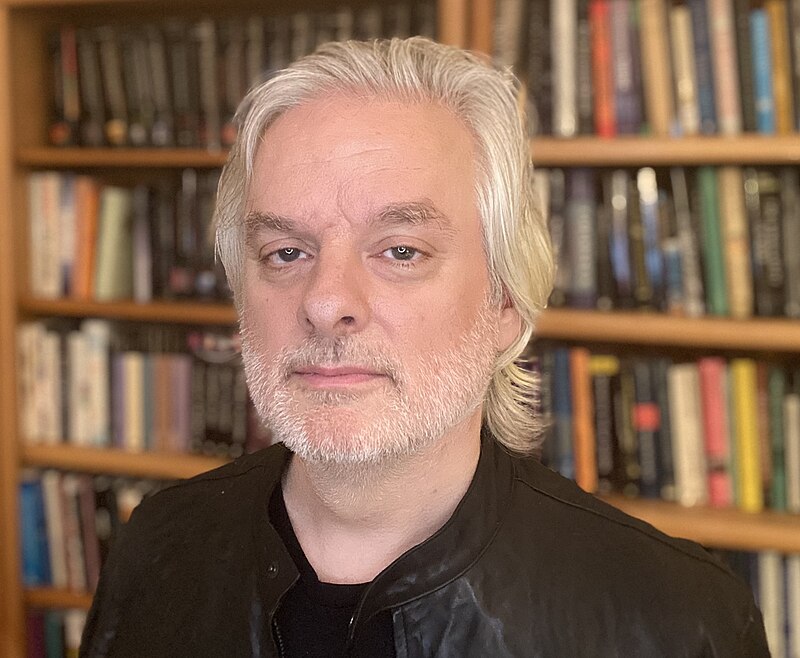
File:David_chalmers.jpg · Wikimedia Commons · See Wikimedia Commons
David Chalmers
Sign in to saveAlso known as David John Chalmers
Australian philosopher and cognitive scientist
OverviewAI-generated
David John Chalmers is an Australian philosopher, university teacher, and academic born in 1966. He works in the fields of philosophy and philosophy of mind, and identifies with atheism. Chalmers has been employed by New York University, the Australian National University, and the University of Arizona. He is a member of the American Academy of Arts and Sciences, where he holds the title of Fellow, and he received the Jean Nicod Prize and the Rhodes Scholarship.
Chalmers was educated at Lincoln College, the University of Adelaide, and Indiana University Bloomington. His doctoral advisor was Douglas Hofstadter, who also influenced his work. Other intellectual influences include Bertrand Russell. In addition to his academic career, he participated in the International Mathematical Olympiad. He speaks English and has authored works such as *Fluid Concepts And Creative Analogies*.
Synthesized by Vinony from 24 facts across 4 sources: Wikidata, Open Library, TMDb, Vinony collections. Generated from structured data (not the Wikipedia text) and checked against those facts — may still contain errors.
Person · Open Library
- Works
- 14
Top works
- Butterflies and Blossoms Vol. 2
- Doodle Book : A Notebook
- Autograph Book Grade 1
- Relaxing Patterns
- Fluid Concepts And Creative Analogies
via Open Library + Wikidata
Film & TV
Known for
- Chasing Utopia2026
- The Alien Perspective2025
- Cyberworld - The future is now — Self2023
- Flesh Computer — Himself2014
- The Singularity — Himself2012
- The Hard Problem: The Science Behind the Fiction — Self2004
via TMDB
Key facts
- Born
- David John Chalmers , ( 1966-04-20 ) 20 April 1966 (age 60) , Sydney , New South Wales , Australia
- Alma mater
- University of Adelaide , ( BSc , 1986), University of Oxford (1987–1988), Indiana University Bloomington ( PhD , 1993)
- Thesis
- Toward a Theory of Consciousness (1993)
- Doctoral advisor
- Douglas Hofstadter
- Era
- Contemporary philosophy
- Region
- Western philosophy
- School or tradition
- Analytic
- Institutions
- New York University
- Main interests
- Philosophy of mind , Consciousness , Philosophy of language
- Notable ideas
- Hard problem of consciousness , extended mind , two-dimensional semantics , naturalistic dualism , philosophical zombie , further facts
via Wikipedia infobox
Wikidata facts
- Instance of
- human
- Given name
- John
- Gender
- male
- Citizenship
- Australia
- Place of birth
- Australia
- Occupation
- academic
- Educated at
- Indiana University Bloomington
- Employer
- University of Arizona
- Languages spoken
- English language
- Religion
- atheism
- Participant in
- International Mathematical Olympiad
- Field of work
- philosophy of mind
- Movement
- atheism
- Official website
- consc.net
- Image
- David chalmers.jpg
Show 6 more facts
- Commons category
- David Chalmers
- date of birth
- 1966-04-20
- name in native language
- David John Chalmers
- influenced by
- Douglas Hofstadter
- maintained by WikiProject
- WikiProject Mathematics
via Wikidata · CC0
~18 min read
Encyclopedic overview
David John Chalmers (/ˈtʃɑːmərz/; born 20 April 1966) is an Australian philosopher and cognitive scientist, specializing in philosophy of mind and philosophy of language. He is a professor of philosophy and neural science at New York University (NYU), as well as co-director of NYU's Center for Mind, Brain and Consciousness (along with Ned Block). In 2006, he was elected a fellow of the Australian Academy of the Humanities. In 2013, he was elected as a fellow of the American Academy of Arts and Sciences.
Chalmers is best known for formulating the hard problem of consciousness, and for popularizing the philosophical zombie thought experiment.
Excerpted from Wikipedia’s “David Chalmers” article, available under the CC BY-SA 4.0 licence.