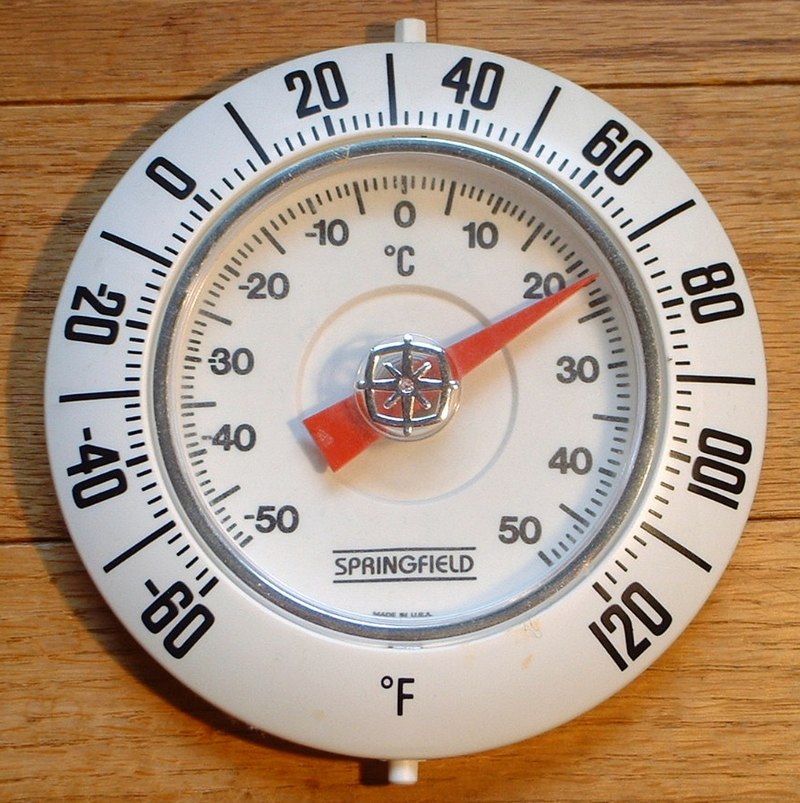
File:Raumthermometer_Fahrenheit+Celsius.jpg · Wikimedia Commons · See Wikimedia Commons
degree Fahrenheit
Sign in to saveAlso known as Fahrenheit, °F
The Fahrenheit scale () is a temperature scale based on one proposed in 1724 by the physicist Daniel Gabriel Fahrenheit (1686–1736). It uses the degree Fahrenheit (symbol: °F) as the unit. Several accounts of how he originally defined his scale exist, but the original paper suggests the lower defining point, 0 °F, was established as the freezing temperature of a solution of brine made from a mixture of water, ice, and ammonium chloride (a salt). The other limit established was his best estimate of the average human body temperature, originally set at 90 °F, then 96 °F (about 2.6
A degree Fahrenheit is a unit of temperature measurement based on a scale created by physicist Daniel Gabriel Fahrenheit in 1724, which originally used the freezing point of a salt-water solution as its zero point and human body temperature as its upper reference. This scale matters because it became one of the primary ways people measure and communicate temperature in everyday life, particularly in countries like the United States.
AI-generated from the Wikipedia summary — may contain errors.
Key facts
- Unit.name
- Fahrenheit
- Unit.image
- Raumthermometer Fahrenheit+Celsius.jpg
- Unit.caption
- Thermometer with Fahrenheit (marked on outer bezel) and Celsius (marked on inner dial) degree units
- Unit.standard
- Imperial/US customary
- Unit.quantity
- Temperature
- Unit.symbol
- °F
- Unit.namedafter
- Daniel Gabriel Fahrenheit
- Unit.convertfromx
- yes
- Unit.units1
- Kelvin
- Unit.inunits1
- ( + 459.67) K
- Unit.units2
- Celsius
- Unit.inunits2
- ( − 32) °C
- Unit.units3
- Rankine scale
- Unit.inunits3
- + 459.67 °Ra
via Wikipedia infobox
Wikidata facts
- Instance of
- unit of thermodynamic temperature
- Named after
- Daniel Gabriel Fahrenheit
- Said to be same as
- degree Rankine
Show 6 more facts
- unit symbol
- °F
- discoverer or inventor
- Daniel Gabriel Fahrenheit
- Wikidata SPARQL query equivalent
- wd:Q42289 p:P2370/psn:P2370 [wikibase:quantityAmount ?source; wikibase:quantityUnit ?base]. ?item p:P2370/psn:P2370 [wikibase:quantityAmount ?target; wikibase:quantityUnit ?base]. BIND(?source / ?target as ?value)
- Unicode character
- ℉
- Commons category
- Fahrenheit temperature
- on focus list of Wikimedia project
- Wikipedia:Vital articles/Level/4
Sources (1)
via Wikidata · CC0
~11 min read
Encyclopedic overview
15 sectionsContents
- Definition and conversion
- Conversion (specific temperature point)
- Conversion (temperature difference or interval)
- History
- Usage
- General
- United States
- Canada
- European Union
- United Kingdom
- Unicode representation of symbol
- See also
- Notes
- References
- External links
The Fahrenheit scale () is a temperature scale based on one proposed in 1724 by the physicist Daniel Gabriel Fahrenheit (1686–1736). It uses the degree Fahrenheit (symbol: °F) as the unit. Several accounts of how he originally defined his scale exist, but the original paper suggests the lower defining point, 0 °F, was established as the freezing temperature of a solution of brine made from a mixture of water, ice, and ammonium chloride (a salt). The other limit established was his best estimate of the average human body temperature, originally set at 90 °F, then 96 °F (about 2.6 °F less than the modern value due to a later redefinition of the scale).
For much of the 20th century, the Fahrenheit scale was defined by two fixed points with a 180 °F separation: the temperature at which pure water freezes was defined as 32 °F and the boiling point of water was defined to be 212 °F, both at sea level and under standard atmospheric pressure. It is now formally defined using the Kelvin scale.
Excerpted from Wikipedia’s “degree Fahrenheit” article, available under the CC BY-SA 4.0 licence.
Gallery (7)
Available in 95 languages
- Español
- Français
- Deutsch
- 中文
- 日本語
- Русский
- Português
- Italiano
- العربية
- हिन्दी
- Afrikaans
- Aragonese
- Armenian
- Assamese
- Asturian
- azb
- Azerbaijani
- Bahasa Indonesia
Show 76 more
- Bangla
- Basque
- be_x_old
- Belarusian
- Bikol
- Bulgarian
- Burmese
- Catalan
- Central Kurdish
- Cherokee
- Croatian
- Czech
- Danish
- Esperanto
- Estonian
- Faroese
- Filipino
- Finnish
- Galician
- Georgian
- Greek
- Haitian Creole
- Hebrew
- Hungarian
- Icelandic
- Ido
- Interlingua
- Jamaican Creole English
- Kannada
- Kazakh
- Kurdish
- Latvian
- Limburgish
- Lithuanian
- Low German
- Luxembourgish
- Macedonian
- Malay
- Malayalam
- Marathi
- Mongolian
- Nederlands
- Northern Frisian
- Norwegian
- Norwegian Nynorsk
- Occitan
- Piedmontese
- Polski
- Punjabi
- Romanian
- Scots
- Serbian
- Serbian (Latin)
- Sicilian
- simple
- Slovak
- Slovenian
- Somali
- Svenska
- Swahili
- Tamil
- Telugu
- Tiếng Việt
- Türkçe
- Ukrainian
- Urdu
- Uzbek
- Waray
- Western Frisian
- Western Panjabi
- Wu Chinese
- Yiddish
- zh_yue
- فارسی
- ไทย
- 한국어
via Wikidata sitelinks · CC0