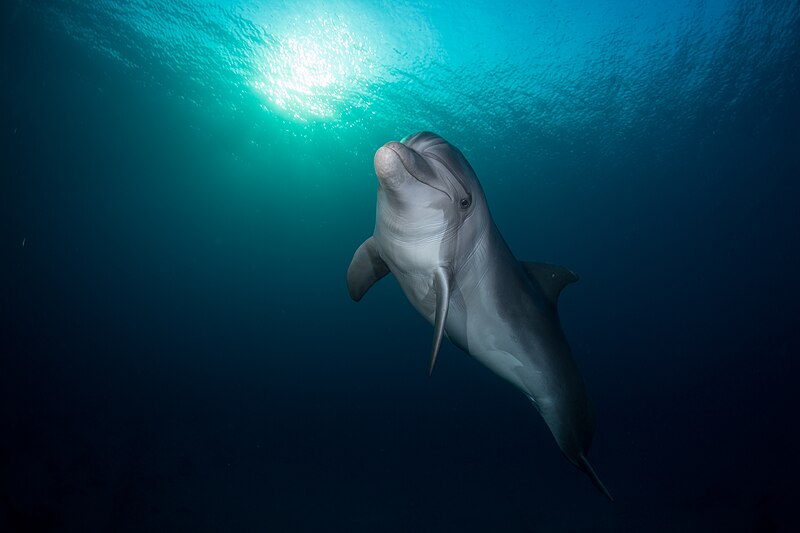
File:Eilat_Dolphin_Reef_(3).jpg · Wikimedia Commons · See Wikimedia Commons
Delphinidae
Sign in to saveAlso known as dolphin, dolphins, oceanic dolphin, oceanic dolphins
family of marine mammals
OverviewAI-generated
Delphinidae is a family of marine mammals within the order Cetacea, class Mammalia, and phylum Chordata. The taxon, commonly known as ocean dolphins, was described by Gray in 1821 and is currently accepted. Its parent taxa include Delphinoidea and Odontoceti. The family originated approximately 30 million years ago and inhabits marine, brackish, and freshwater environments.
Members of this family primarily consume fish and Teuthida. The type genus for the family is Delphinus. Records of Delphinidae are held by institutions such as the USNM, with occurrences documented in the United States. The taxon is referenced by 616 other encyclopedia articles and features in the Wikipedia Vital Articles project.
Synthesized by Vinony from 37 facts across 6 sources: Wikidata, GBIF, Gbif Occ, WoRMS, iDigBio, Vinony graph. Generated from structured data (not the Wikipedia text) and checked against those facts — may still contain errors.
Species
ocean dolphins
Delphinidae
FAMILY
- KingdomAnimalia
- PhylumChordata
- ClassMammalia
- OrderCetacea
- FamilyDelphinidae
Dieser Artikel behandelt die Meerestiere. Siehe auch: Delphine bzw. Delfin. Die Delfine oder Delphine (Delphinidae) gehören zu den Zahnwalen (Odontoceti) und sind somit Säugetiere (Mammalia), die im Wasser leben (Meeressäuger). Delfine sind die vielfältigste und mit rund 40 Arten größte Familie der Wale (Cetacea). Sie sind in allen Meeren verbreitet, einige Arten kommen auch in Flüssen vor.
via GBIF
Museum specimens
- Specimen records
- 2,471
- With media
- 81
- Family
- Delphinidae
- Collections
- USNM
- Recorded in
- United States
Wikidata facts
- Instance of
- taxon
- Parent taxon
- Odontoceti
- Image
- PacificWhiteSidedDolphine.jpg
Show 9 more facts
- taxon rank
- family
- taxon name
- Delphinidae
- Commons category
- Delphinidae
- topic's main category
- Category:Oceanic dolphins
- main food source
- Teuthida
- start time
- 30000000-0
- taxon common name
- delfini
- on focus list of Wikimedia project
- Wikipedia:Vital articles/Level/4
- taxonomic type
- Delphinus
via Wikidata · CC0
~26 min read
Encyclopedic overview
Oceanic dolphins or Delphinidae are a widely distributed family of dolphins that live in the sea. Close to forty extant species are recognised. They include several big species whose common names contain "whale" rather than "dolphin", such as the Globicephalinae (round-headed whales, which include the false killer whale and pilot whale). Delphinidae is a family within the superfamily Delphinoidea, which also includes the porpoises (Phocoenidae) and the Monodontidae (beluga whale and narwhal). River dolphins are a grouping of at least three cetacean superfamilies which form a sister group to Delphinoidea.
Oceanic dolphins range in size from the 1.7-metre-long (5 ft 7 in) and 50-kilogram (110-pound) Maui's dolphin to the 9.4-metre (31 ft) and 10-metric-ton (11-short-ton) orca, the largest known dolphin. Several species exhibit sexual dimorphism; the males are larger than females. They have streamlined muscular bodies and two limbs that are modified into flippers. Though not quite as flexible as seals, some dolphins can travel at speeds 29 km/h (18 mph) for short distances. Most delphinids primarily eat fish, along with a smaller number of squid and small crustaceans, but some species specialise in eating squid, or, in the case of the orca, also eat marine mammals and birds. All, however, are purely carnivorous. They typically have between 100 and 200 teeth, although a few species have considerably fewer. Delphinids travel in large pods, which may number a thousand individuals in some species. Each pod forages over a range of tens to hundreds of square kilometres. Some pods have a loose social structure, with individuals frequently joining or leaving, but others seem to be more permanent, perhaps dominated by a male and a harem of females. Individuals communicate by sound, producing low-frequency whistles, and also produce high-frequency broadband clicks of 80–220 kHz, which are primarily used for echolocation. Gestation lasts from 10 to 18 months, and results in the birth of a single calf. Some species are well adapted for diving to great depths. They have a layer of fat, or blubber, under the skin to keep warm in the cold water.
Excerpted from Wikipedia’s “Delphinidae” article, available under the CC BY-SA 4.0 licence.
Gallery (17)
Available in 77 languages
- Español
- Français
- Deutsch
- 中文
- 日本語
- Русский
- Italiano
- العربية
- Albanian
- Armenian
- Asturian
- Bahasa Indonesia
- Balinese
- Bangla
- Basque
- be_x_old
- Breton
- Bulgarian
Show 58 more
- Buriat
- Catalan
- Cebuano
- Chechen
- Chuvash
- Corsican
- Croatian
- Czech
- Danish
- Egyptian Arabic
- eml
- Esperanto
- Estonian
- Filipino
- Finnish
- Galician
- Georgian
- Guarani
- Hebrew
- Hungarian
- Icelandic
- Interlingua
- Kotava
- Kyrgyz
- Latin
- Latvian
- Limburgish
- Lithuanian
- Navajo
- nds_nl
- Nederlands
- Northern Frisian
- Norwegian
- Norwegian Nynorsk
- Occitan
- Ossetic
- Polski
- Romanian
- Saterland Frisian
- Serbian
- Serbian (Latin)
- Sicilian
- simple
- Slovak
- Svenska
- Tamil
- Tatar
- Tiếng Việt
- Türkçe
- Ukrainian
- Upper Sorbian
- Waray
- Wu Chinese
- zh_min_nan
- zh_yue
- فارسی
- ไทย
- 한국어
via Wikidata sitelinks · CC0