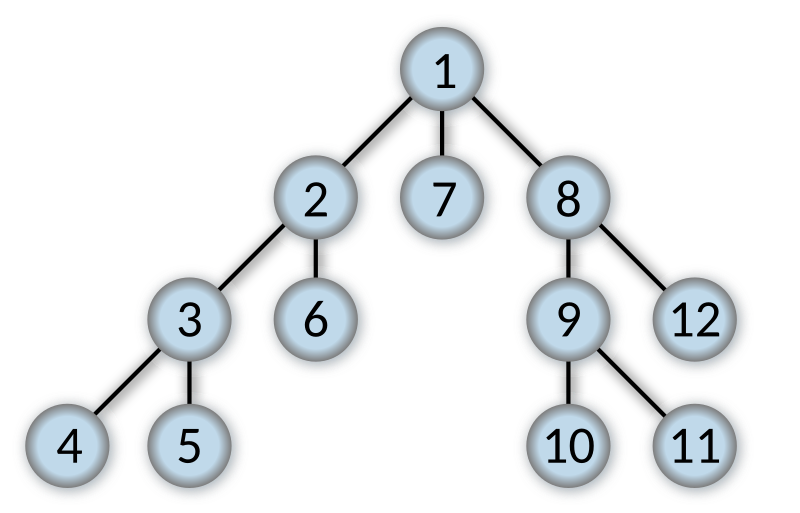
File:Depth-first-tree.svg · Wikimedia Commons · See Wikimedia Commons
depth-first search
Sign in to saveAlso known as DFS, depth-first traversal, depth first search
algorithm for traversing or searching tree or graph data structures
Key facts
- Class
- Search algorithm
- Data structure
- Graph
- Worst case performance
- O ( | V | + | E | ) {\displaystyle O(|V|+|E|)} for explicit graphs traversed without repetition, O ( b d ) {\displaystyle O(b^{d})} for implicit graphs with branching factor b searched to depth d
- Worst case space complexity
- O ( | V | ) {\displaystyle O(|V|)} if entire graph is traversed without repetition, O(longest path length searched) = O ( b d ) {\displaystyle O(bd)} for implicit graphs without elimination of duplicate nodes
- Optimal
- no (does not generally find shortest paths)
via Wikipedia infobox
Described at
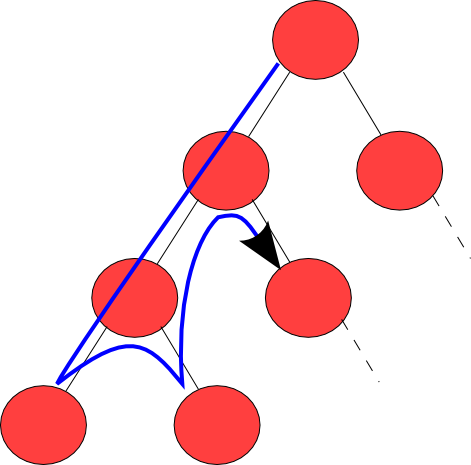
Depth first search - Wikimedia Commons
commons.wikimedia.org →Link to a page describing this subject · 937 chars · not written by Vinony
Wikidata facts
- Subclass of
- graph traversal
- Image
- Depth-first-tree.svg
Show 7 more facts
- Commons category
- Depth-first search
- uses
- LIFO
- short name
- DFS
- maintained by WikiProject
- WikiProject Mathematics
- used by
- intelligent agent
- Commons gallery
- Depth first search
- described at URL
- commons.wikimedia.org/wiki/Depth_first_search
Sources (2)
via Wikidata · CC0
~12 min read
Encyclopedic overview
Depth-first search (DFS) is an algorithm for traversing or searching tree or graph data structures. The algorithm starts at the root node (selecting some arbitrary node as the root node in the case of a graph) and explores as far as possible along each branch before backtracking. Extra memory, usually a stack, is needed to keep track of the nodes discovered so far along a specified branch which helps in backtracking of the graph.
A version of depth-first search was investigated in the 19th century by French mathematician Charles Pierre Trémaux as a strategy for solving mazes.
Excerpted from Wikipedia’s “depth-first search” article, available under the CC BY-SA 4.0 licence.