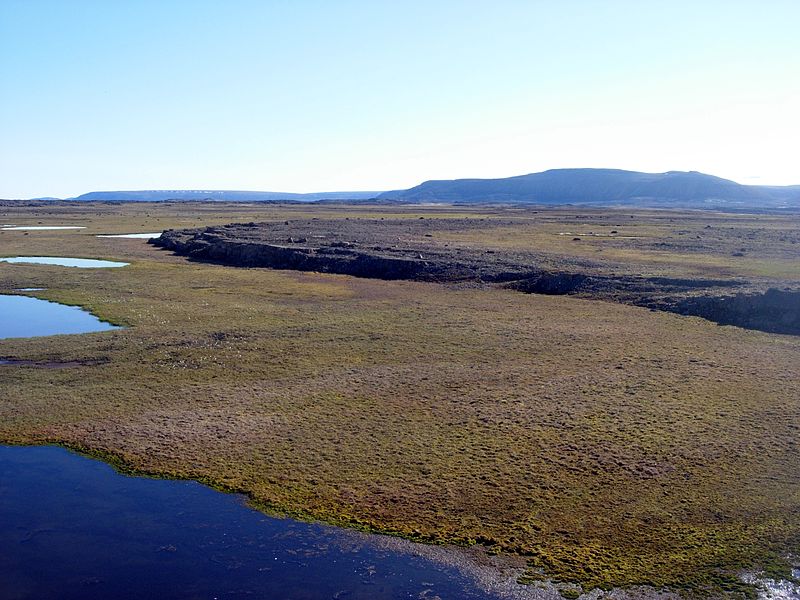
File:Truelove_Lowlands_Devon_Island.jpg · Wikimedia Commons · See Wikimedia Commons
Devon Island is a large, uninhabited island located in northern Canada within the Nunavut territory, situated in the Canadian Arctic Archipelago. It matters because it serves as an important site for scientific research, including Arctic environmental studies and astrobiology experiments that simulate conditions on other planets.
AI-generated from the Wikipedia summary — may contain errors.
Wikidata facts
- Instance of
- uninhabited island
- Part of
- Canadian Arctic Archipelago
- Country
- Canada
- Located in
- Nunavut
- Continent
- North America
- Population
- 0
- Area
- 55247
- Elevation
- 1920
- Body of water
- Baffin Bay
- Image
- Truelove Lowlands Devon Island.jpg
- Length
- 524
Show 3 more facts
- Commons category
- Devon Island
- located in/on physical feature
- Qikiqtaaluk Region
- time of discovery or invention
- 1616-00-00
Sources (2)
via Wikidata · CC0
~7 min read
Encyclopedic overview
Devon Island (Inuktitut: ᑕᓪᓗᕈᑎᑦ, Tallurutit) is an island in Canada and the largest uninhabited island (no permanent human residents) in the world. It is located in Baffin Bay, Qikiqtaaluk Region, Nunavut, Canada. It is one of the largest members of the Arctic Archipelago, the second-largest of the Queen Elizabeth Islands, Canada's sixth-largest island, and the 27th-largest island in the world. It has an area of 55,247 km (21,331 sq mi) (slightly smaller than Croatia). The bedrock is Precambrian gneiss and Paleozoic siltstones and shales. The highest point is the Devon Ice Cap at 1,920 m (6,300 ft) which is part of the Arctic Cordillera. Devon Island contains several small mountain ranges, such as the Treuter Mountains, Haddington Range, and Cunningham Mountains, as well as the Haughton impact crater. The notable similarity of its surface to that of Mars has attracted interest from scientists.
History and settlement
Excerpted from Wikipedia’s “Devon Island” article, available under the CC BY-SA 4.0 licence.
Gallery (5)
On the map
2 mapped locations
Available in 66 languages
- Español
- Français
- Deutsch
- 中文
- 日本語
- Русский
- Português
- Italiano
- العربية
- Afrikaans
- Armenian
- Asturian
- Azerbaijani
- Bahasa Indonesia
- Basque
- be_x_old
- Belarusian
- Breton
Show 47 more
- Bulgarian
- Catalan
- Cebuano
- Chuvash
- Croatian
- Czech
- Danish
- Egyptian Arabic
- Esperanto
- Estonian
- Finnish
- Galician
- Georgian
- Greek
- Hebrew
- Hungarian
- Icelandic
- Interlingua
- Irish
- Kazakh
- Latvian
- Lithuanian
- Malayalam
- Nederlands
- Norwegian
- Norwegian Nynorsk
- Polski
- Romanian
- Scottish Gaelic
- Serbian
- simple
- Slovenian
- Svenska
- Swahili
- Tatar
- Tiếng Việt
- Türkçe
- Ukrainian
- Urdu
- Waray
- Welsh
- Western Panjabi
- Wu Chinese
- zh_yue
- فارسی
- ไทย
- 한국어
via Wikidata sitelinks · CC0