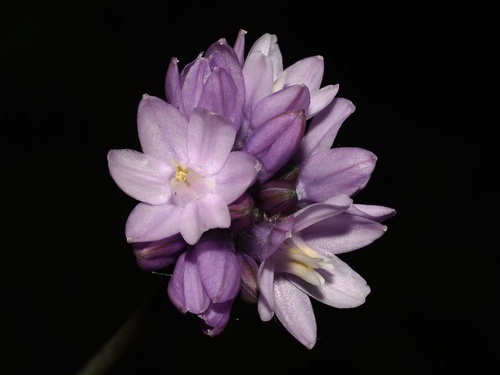
(c) nathantay, some rights reserved (CC BY-NC) · cc-by-nc
Dichelostemma capitatum
Sign in to saveDipterostemon is a monotypic genus of flowering plants in the family Asparagaceae. Its only species is Dipterostemon capitatus, synonym Dichelostemma capitatum, known by the common names blue dicks, wild hyacinth, purplehead and brodiaea (alternately spelled brodiea and brodeia), native to the Western United States (particularly Arizona, California, Oregon, Utah, and New Mexico) and northwest Mexico.
Species
blue dicks
SPECIES
- KingdomPlantae
- PhylumTracheophyta
- ClassLiliopsida
- OrderAsparagales
- FamilyAsparagaceae
via GBIF
Museum specimens
- Specimen records
- 1,553
- With media
- 1,164
- Family
- Asparagaceae
- Collections
- UTEP, DCBS-DICTUS-USON, RSA, IBUNAM, NEON, CAS
- Recorded in
- United States, Mexico
Wikidata facts
- Instance of
- taxon
- Parent taxon
- Dichelostemma
- Image
- Dichelostemma capitatum 2003-02-04.jpg
Show 7 more facts
- Commons category
- Dichelostemma capitatum
- taxon name
- Dichelostemma capitatum
- taxon rank
- species
- Commons gallery
- Dichelostemma capitatum
- taxon common name
- 头花蓝壶韭
- short name
- D. capitatum
Sources (1)
via Wikidata · CC0
~7 min read
Encyclopedic overview
8 sectionsContents
- Description
- Taxonomy
- Subspecies
- Uses
- Management
- Propagation
- References
- External links
Dipterostemon is a monotypic genus of flowering plants in the family Asparagaceae. Its only species is Dipterostemon capitatus, synonym Dichelostemma capitatum, known by the common names blue dicks, wild hyacinth, purplehead and brodiaea (alternately spelled brodiea and brodeia), native to the Western United States (particularly Arizona, California, Oregon, Utah, and New Mexico) and northwest Mexico.
==Description== thumb|Dipterostemon capitatus subsp. capitatus is a variable ecotype. This was photographed from the northern Sierra Nevadas Dipterostemon capitatus is an herbaceous perennial growing from an underground corm to a height of as much as 60 cm. It has 2–3 leaves which are 10–40 cm long. The inflorescence is head- or umbel-like, and dense. It usually contains 2 to 15 flowers, which have a blue, blue-purple, pink-purple, or white perianth. The flower tube is 3–12 mm and is narrowly cylindrical to campanulate. Flowers have six fertile stamens, deeply notched, lanceolate, white, angled inward, slightly reflexed at tip, with outer filaments wider at the base. It has a twisted and fleshy peduncle, a set of membranous, petal-like stamen appendages around the anthers, and angular black seeds. It reproduces from seed and vegetative means in the form of cormlets. The cormlets are attached to the parent corm by stolons and are sessile, produced in the axils of the old leaf bases on the mature corm. Plants thrive in open disturbed environments, and are a common post-fire succession species in chaparral. Flowering peaks in March.
Excerpted from Wikipedia’s “Dichelostemma capitatum” article, available under the CC BY-SA 4.0 licence.