Jimenez, Maria-Luisa;Cardiel, Carlos Palacios;Chamé-Vázquez, David
Diguetia
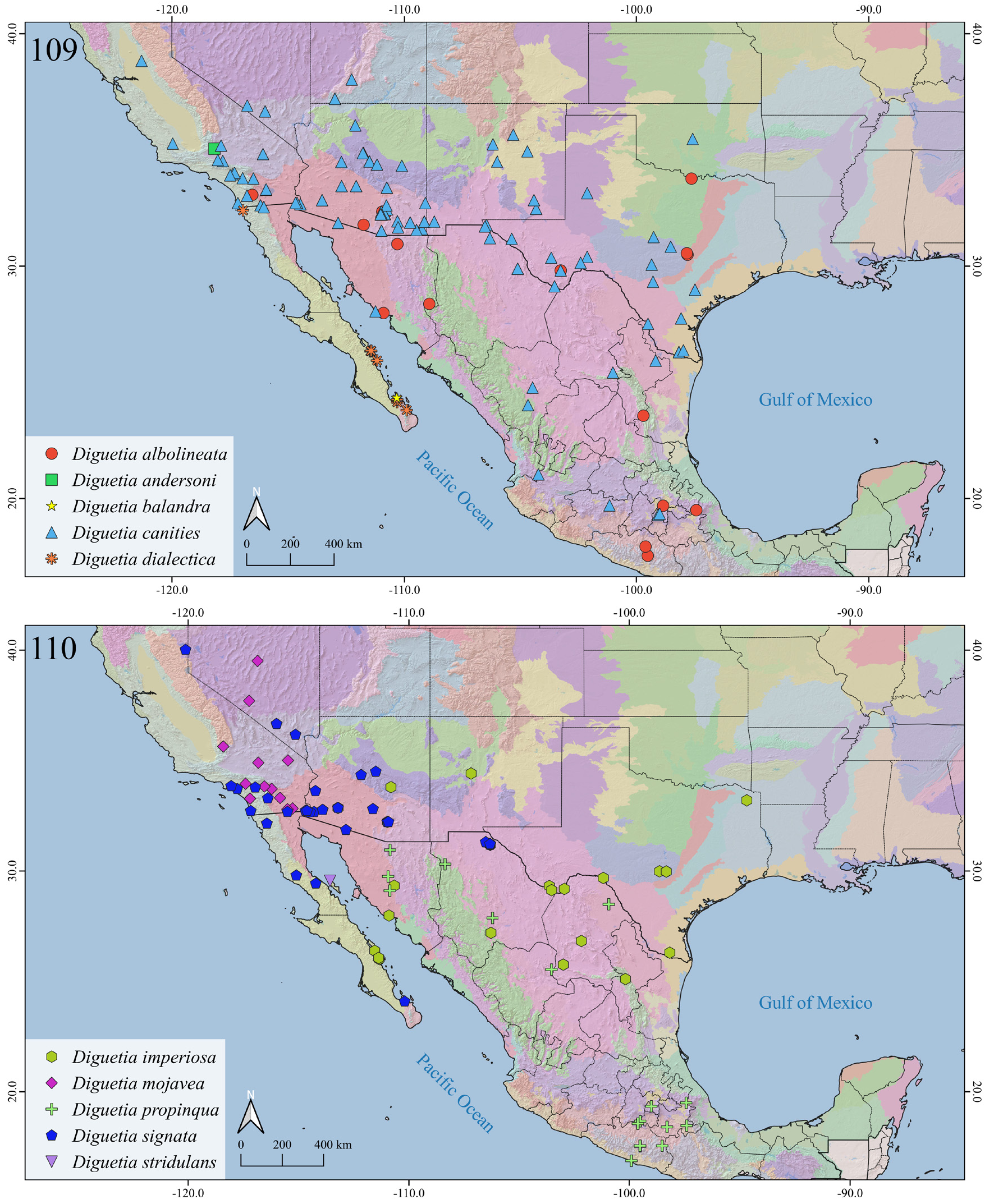
Sign in to saveDiguetia is a genus of coneweb spiders that was first described by Eugène Simon in 1895. Members of this genus are six-eyed spiders that are either white or patterned. They are common in the southwestern United States and Mexico, and one species is found in Argentina. In the United States, species have been found in Arizona, California, Nevada, New Mexico, and Texas. These spiders build a tubular retreat at the tip of their tent-like webs. Once an insect is caught in the web, the spider bites it and injects venom to stop its prey from moving, later wrapping it in silk. Both males and females u
Species
GENUS
- KingdomAnimalia
- PhylumArthropoda
- ClassArachnida
- OrderAraneae
- FamilyDiguetidae
via GBIF
Museum specimens
- Specimen records
- 23
- With media
- 1
- Family
- Diguetidae
- Collections
- CHAS, NMSU, MCZ, SDNHM, UNM, WCU
- Recorded in
- United States, Peru, Mexico
Wikidata facts
- Instance of
- taxon
- Parent taxon
- Coneweb spider
- Image
- Diguetia canities.jpg
Show 5 more facts
- Commons category
- Diguetia
- taxon name
- Diguetia
- taxon rank
- genus
- topic's main category
- Category:Diguetia
- taxonomic type
- Diguetia canities
Sources (1)
via Wikidata · CC0
~5 min read
Encyclopedic overview
6 sectionsContents
- Identification
- Habitat and diet
- Reproduction
- Species
- References
- External links
Diguetia is a genus of coneweb spiders that was first described by Eugène Simon in 1895. Members of this genus are six-eyed spiders that are either white or patterned. They are common in the southwestern United States and Mexico, and one species is found in Argentina. In the United States, species have been found in Arizona, California, Nevada, New Mexico, and Texas. These spiders build a tubular retreat at the tip of their tent-like webs. Once an insect is caught in the web, the spider bites it and injects venom to stop its prey from moving, later wrapping it in silk. Both males and females use stridulation while mating, with females also stridulating when harassed. Two species of jumping spiders feed on its eggs. There are eleven Diguetia species.
==Identification== The species in the genus are haplogynes that have flat oval carapaces and six eyes which are arranged into three groups of two, known as dyads. The abdomen is either white or has patterns, with some species having bands on their legs. Diguetia species have three tarsal claws. Although all spiders may have such features, only spiders of this genus have a combination of those features.
Excerpted from Wikipedia’s “Diguetia” article, available under the CC BY-SA 4.0 licence.