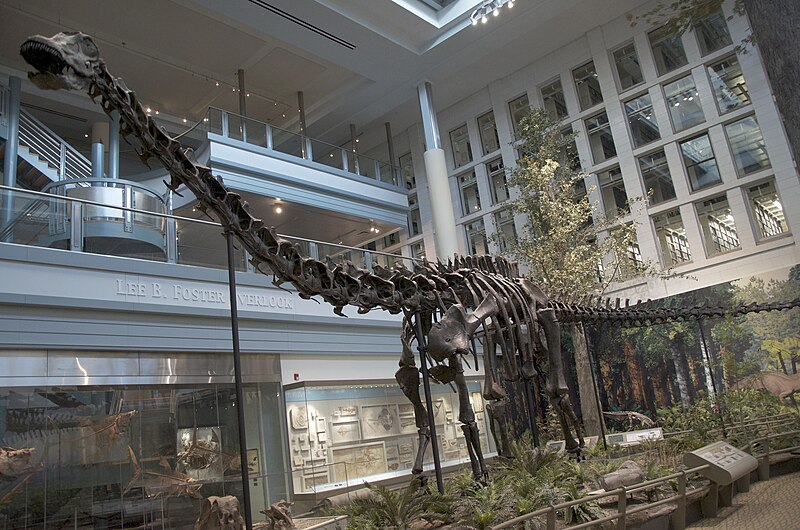
File:CM_Diplodocus.jpg · Wikimedia Commons · See Wikimedia Commons
Diplodocus
Sign in to saveDiplodocus (, , or ) is an extinct genus of diplodocid sauropod dinosaurs known from the Late Jurassic of North America. The first fossils of Diplodocus were discovered in 1877 by S. W. Williston. The generic name, coined by Othniel Charles Marsh in 1878, is a Neo-Latin term derived from Greek διπλός (diplos) "double" and δοκός (dokos) "beam", in reference to the double-beamed chevron bones located in the underside of the tail, which were then considered unique.
Diplodocus is an extinct long-necked dinosaur that lived during the Late Jurassic period in North America, first discovered in 1877. The dinosaur's name refers to the distinctive double-beamed bones found underneath its tail, a feature that scientists at the time thought was unique to this genus.
AI-generated from the Wikipedia summary — may contain errors.
Wikidata facts
- Parent taxon
- Diplodocinae
- Mass
- 113
- Image
- SeismosaurusDB.jpg
- Length
- 26.0
Show 14 more facts
- different from
- Diplocaulus
- Unicode character
- 🦕
- taxon name
- Diplodocus
- Commons category
- Diplodocus
- taxon rank
- genus
- Commons gallery
- Diplodocus
- taxon common name
- 梁龍
- start time
- 154000000-
- end time
- 152000000-
- location of discovery
- United States
- on focus list of Wikimedia project
- Wikipedia:Vital articles/Level/4
- described by source
- Encyclopædia Britannica 11th edition
- time period
- Late Jurassic
- main food source
- herbivore
Sources (3)
via Wikidata · CC0
~44 min read
Encyclopedic overview
21 sectionsContents
- Description
- Postcranial skeleton
- Skin impressions
- Discovery and history
- Bone Wars and ''Diplodocus longus''
- Second Dinosaur Rush and ''Diplodocus carnegii''
- Dinosaur National Monument
- Later discoveries and ''D. hallorum''
- Classification and species
- Phylogeny
- Valid species
- ''Nomina dubia'' (doubtful species)
- Formerly assigned species
- Paleobiology
- Posture
- Diet and feeding
- Reproduction and growth
- Paleoenvironment
- Cultural significance
- References
- External links
Diplodocus (, , or ) is an extinct genus of diplodocid sauropod dinosaurs known from the Late Jurassic of North America. The first fossils of Diplodocus were discovered in 1877 by S. W. Williston. The generic name, coined by Othniel Charles Marsh in 1878, is a Neo-Latin term derived from Greek διπλός (diplos) "double" and δοκός (dokos) "beam", in reference to the double-beamed chevron bones located in the underside of the tail, which were then considered unique.
The genus lived in what is now mid-western North America, at the end of the Jurassic period. It is one of the more common dinosaur fossils found in the middle to upper Morrison Formation, with most specimens being found in rocks dated between about 151.88 and 149.1 million years ago, during the latest Kimmeridgian Age, although it may have made it into the Tithonian, with at least one specimen (AMNH FR 223) being potentially from among the youngest deposits of the formation. The Morrison Formation records an environment and time dominated by gigantic sauropod dinosaurs, such as Apatosaurus, Barosaurus, Brachiosaurus, Brontosaurus, and Camarasaurus. Its great size may have been a deterrent to the predators Allosaurus and Ceratosaurus: their remains have been found in the same strata, which suggests that they coexisted with Diplodocus.
Excerpted from Wikipedia’s “Diplodocus” article, available under the CC BY-SA 4.0 licence.
Gallery (32)
Available in 75 languages
- Español
- Français
- Deutsch
- 中文
- 日本語
- Русский
- Português
- Italiano
- العربية
- Afrikaans
- Aragonese
- Armenian
- Asturian
- Azerbaijani
- Bahasa Indonesia
- Balinese
- Bangla
- Basque
Show 56 more
- Belarusian
- Breton
- Bulgarian
- Burmese
- Catalan
- Cebuano
- Central Kurdish
- Croatian
- Czech
- Danish
- Esperanto
- Estonian
- Filipino
- Finnish
- Galician
- Georgian
- Greek
- Hebrew
- Hungarian
- Irish
- Javanese
- Kazakh
- Kyrgyz
- Latin
- Latvian
- Lithuanian
- Macedonian
- Malay
- Malayalam
- Nederlands
- Norwegian
- Norwegian Nynorsk
- Occitan
- Piedmontese
- Polski
- Romanian
- Scots
- Serbian
- Serbian (Latin)
- simple
- Slovak
- Slovenian
- Svenska
- Tamil
- Tiếng Việt
- Türkçe
- Ukrainian
- Uzbek
- Waray
- Welsh
- Western Panjabi
- Wu Chinese
- zh_yue
- فارسی
- ไทย
- 한국어
via Wikidata sitelinks · CC0