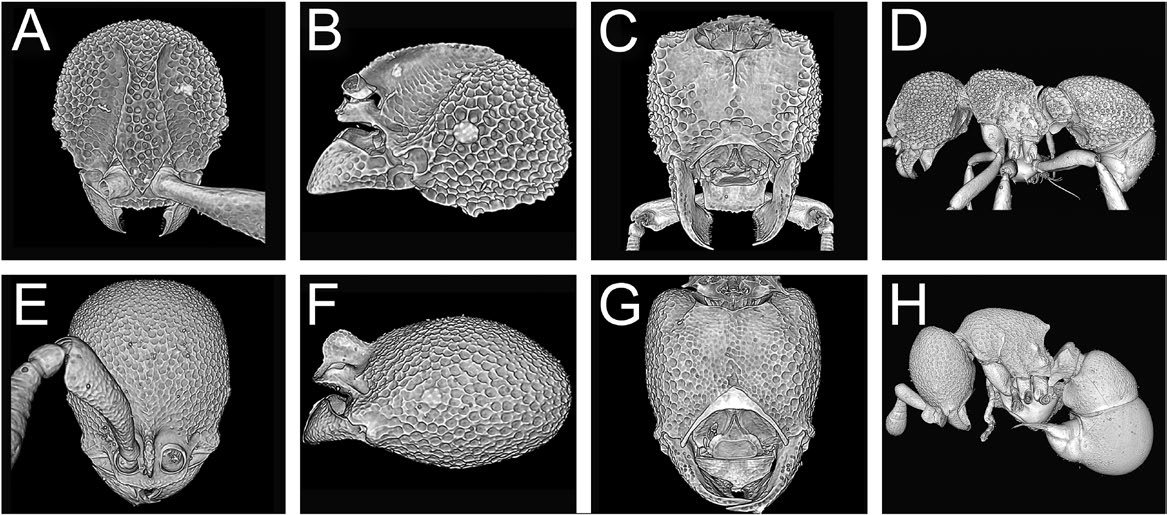
Hita-Garcia, Francisco;Lieberman, Ziv;Audisio, Tracy L.;Liu, Cong;Economo, Evan P.
Discothyrea
Sign in to saveDiscothyrea is a genus of small ants in the subfamily Proceratiinae. The genus is distributed in the tropics and subtropics throughout the world, where they usually nest in rotten wood, in the leaf litter, or under stones. Little is known about their biology, but ants in this genus are thought to be specialist predators of arthropod eggs and have been observed storing eggs in their nests (probably spider eggs).
Species
GENUS
- KingdomAnimalia
- PhylumArthropoda
- ClassInsecta
- OrderHymenoptera
- FamilyFormicidae
Discothyrea Roger , 1863: 176. Type species: Discothyrea testacea Roger , 1863, by monotypy. Pseudosysphincta Arnold , 1916: 161. Type species: Pseudosysphincta poweri Arnold , 1916 [synonymised by Brown 1958]. Prodiscothyrea Wheeler , 1916: 33. Type species: Prodiscothyrea velutina Wheeler , 1916 [synonymised by Brown 1958]. Pseudosphincta Wheeler , 1922: 645, 762 [variant spelling of Pseudosysphincta ]. General diagnosis. Small stocky ants, notable for the exaggerated enlargement of the apical antennal segment. The antennae are 6-12 segmented. Mandibles edentate and overhung by a projecting clypeus. Alitrunk is short and sutureless dorsally (Brown 1958; Bolton 1994).
via GBIF
Museum specimens
- Specimen records
- 280
- With media
- 11
- Family
- Formicidae
- Collections
- UQROO, CAS, USNM, CSIRO, NMV
- Recorded in
- Mexico, Brazil, Samoa, China, Papua New Guinea, Colombia, South Africa, Madagascar
Wikidata facts
- Instance of
- taxon
- Parent taxon
- Formicidae
- Image
- Discothyrea testacea casent0006058 profile 1.jpg
Show 4 more facts
- Commons category
- Discothyrea
- taxon name
- Discothyrea
- taxon rank
- genus
- topic's main category
- Category:Discothyrea
Sources (1)
via Wikidata · CC0
~3 min read
Encyclopedic overview
3 sectionsContents
- Species
- References
- External links
Discothyrea is a genus of small ants in the subfamily Proceratiinae. The genus is distributed in the tropics and subtropics throughout the world, where they usually nest in rotten wood, in the leaf litter, or under stones. Little is known about their biology, but ants in this genus are thought to be specialist predators of arthropod eggs and have been observed storing eggs in their nests (probably spider eggs).
Two fossil species, D. gigas and D. maya, are known from Dominican and Mexican amber.
Excerpted from Wikipedia’s “Discothyrea” article, available under the CC BY-SA 4.0 licence.
Gallery (3)
Available in 11 languages
via Wikidata sitelinks · CC0