
File:STS-133_Space_Shuttle_Discovery_after_undocking_3_(cropped).jpg · Wikimedia Commons · See Wikimedia Commons
Discovery
Sign in to saveAlso known as OV-103, Space Shuttle Discovery, OV103, Orbital Vehicle 103, Discovery Space Shuttle
transbordador espacial de la NASA
Space Shuttle Discovery is a reusable spacecraft that was part of NASA's Space Shuttle program, designed to carry astronauts and cargo to orbit and back to Earth. It matters because it was used for numerous important missions including deploying satellites, conducting scientific research, and helping to construct and resupply the International Space Station.
AI-generated from the Wikipedia summary — may contain errors.
Described at
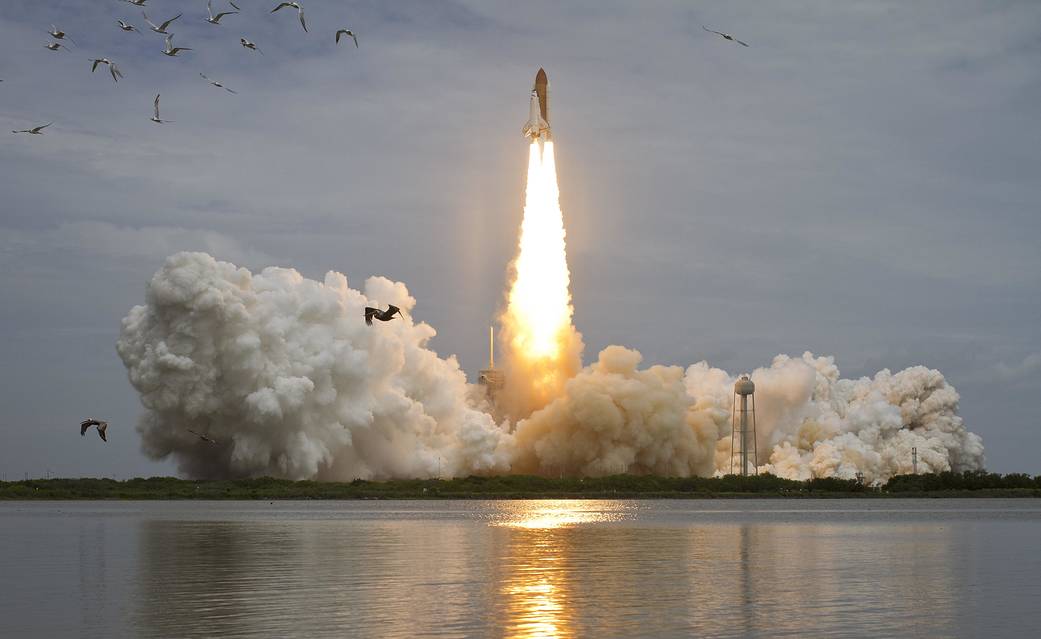
Space Shuttle - NASA
NASA’s shuttle fleet achieved numerous firsts and opened up space to more people than ever before during the Space Shuttle Program’s 30 years of missions.
nasa.gov →NASA’s shuttle fleet achieved numerous firsts and opened up space to more people than ever before during the Space Shuttle Program’s 30 years of missions. From the first launch on April 12, 1981 to the final landing on July 21, 2011, NASA's space shuttle fleet flew 135 missions, helped construct the International Space Station and inspired generations. An idea born in unsettled times becomes a feat of engineering excellence. The most complex machine ever built to bring humans to and from space and eventually construct the next stop on the road to space exploration. Second test flight of the Space Shuttle to demonstrate safe re-launch and safe return of the orbiter and crew. The first operational mission of the Shuttle, which deployed two commercial satellites. STS-6 was the maiden flight of Challenger. STS-6 deployed the first Tracking and Data Relay Satellite (TDRS-1) into orbit. STS-7 carried Sally Ride, the first American woman to fly in space. STS-8 carried Guion Bluford who became the first African-American to fly in space. INSAT-1B, a multipurpose satellite for India which… STS-9 carried the first Spacelab mission and the first astronaut to represent the European Space Agency. On this mission the first untethered space walks were carried out by McCandless and Stewart, using the manned maneuvering unit. The primary payload of the mission was the Long Duration Exposure Facility (LDEF). First flight of Space Shuttle Discovery. The primary payloads for the mission were three commercial communications satellites – SBS-4 for… Explore chronologies, publications, oral histories and more to dig into the details of the history of NASA's Space Shuttle Program.
Excerpt from a page describing this subject · 40,000 chars · not written by Vinony
Wikidata facts
- Instance of
- exhibit
- Named after
- HMS Discovery
- Country
- United States
- Located in
- Chantilly
- Owned by
- Smithsonian Institution
- Operator
- NASA
- Country of origin
- United States
- Collection
- National Air and Space Museum
- Duration
- 31532719
- Mass
- 73176.5
- Manufacturer
- Rockwell International
- Image
- STS-133 Space Shuttle Discovery after undocking 3 (cropped).jpg
- Height
- 17.768
- Length
- 38.03
Show 9 more facts
- Commons category
- Space Shuttle Discovery
- event distance
- 238539663
- different from
- Discovery
- serial number
- OV-103
- orbits completed
- 5830
- wingspan
- 24.314
- first flight
- 1984-08-30
- location of creation
- Air Force Plant 42
Sources (10)
via Wikidata · CC0
Article · Español
El transbordador espacial Discovery (designación NASA: OV-103) es una de las tres naves que permanecieron en la flota de transbordadores espaciales de la NASA, junto con el Atlantis y el Endeavour. El Discovery era el orbitador más antiguo que continuaba en servicio y realizó variadas misiones de investigación y montaje de satélites, así como también misiones de construcción de la Estación Espacial Internacional (ISS). El nombre de la nave proviene del barco de exploración , que acompañó al HMS Resolution de James Cook en su tercer y último viaje. Otras embarcaciones comparten el mismo nombre, como la Discovery de Henry Hudson que entre 1610 y 1611 buscó el paso del Noroeste; y el RRS Discovery de Scott y Shackleton que se utilizó en sus viajes a la Antártida de 1901-1904. Además, el transbordador comparte nombre con la nave de ficción Discovery One de la película 2001: A Space Odyssey. El Discovery fue el transbordador encargado de lanzar el telescopio espacial Hubble. La segunda y tercera misión de servicios al Hubble también fueron realizadas por el Discovery. También puso en órbita la sonda Ulysses y tres satélites TDRS. El Discovery ha sido escogido en dos ocasiones como el orbitador para regresar al espacio, la primera en 1988 como regreso tras el accidente del transbordador Challenger en 1986 y, posteriormente, en un regreso doble en julio de 2005 y julio de 2006 tras el accidente del transbordador Columbia de 2003. El transbordador también ha transportado al astronauta John Glenn, del Programa Mercury, que en ese momento contaba con 77 años, convirtiéndose en la persona con mayor edad en el espacio.
Abstract from DBpedia / Wikipedia · CC BY-SA