Official website (https://www.thedoldergrand.com/)
Official website
The Dolder Grand - 5 Sterne Hotel Zürich mit Spa & Wellness
Das 5 Sterne Hotel ist ein City Resort der Extraklasse mit Spa – nur wenige Minuten von der Innenstadt entfernt. Besuchen Sie unsere Website.
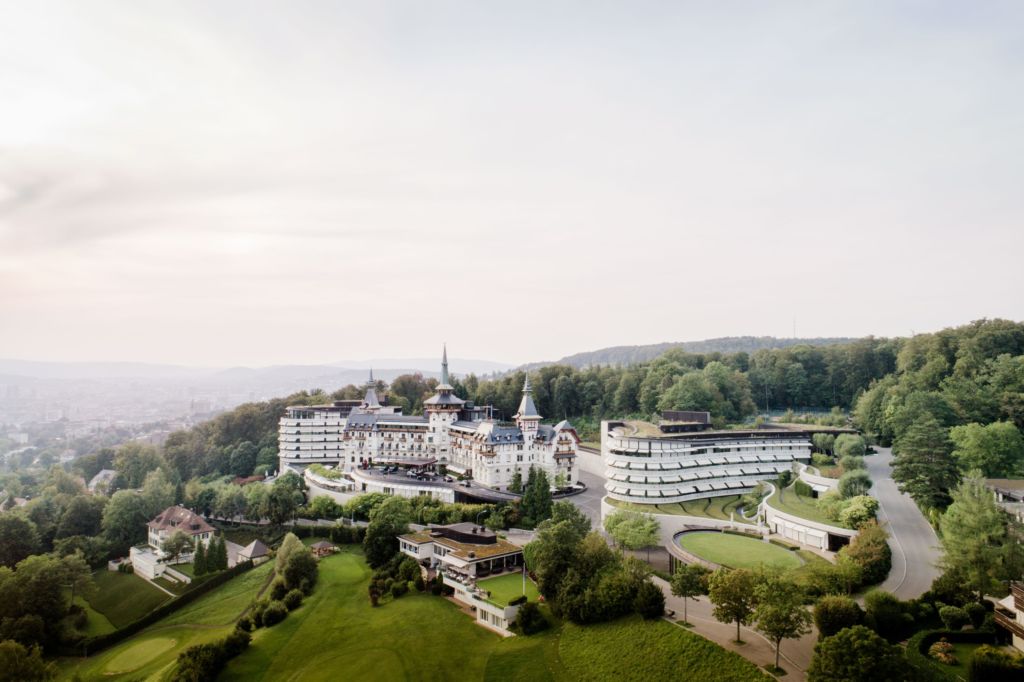
thedoldergrand.com →Since 1899, the Dolder Grand in Zurich has been synonymous with exceptional hospitality. What began as a ‘Sanatorium and Wildlife Park’ amidst stunning natural surroundings, complete with a funicular connection to the city, has evolved into a luxurious city resort offering exquisite cuisine, a renowned art collection, and an impressive spa. Architects from various eras, spanning the Belle Époque to high-tech architecture, have left their mark on the grand hotel. International guests have shaped the history of our establishment, while the Dolder Grand’s deep connection to Zurich continues to highlight our roots. We invite you to embark on a journey through time at the Dolder Grand, which will continue to embody visionary luxury hospitality for the next 125 years. To host foreign guests wanting to stay permanently in Zurich after the First World War, the Hotel switched from seasonal operations to year-round opening from 1915 onwards. By 1924, all guest accommodation received running water or private bathrooms, a staff wing was added, and the main entrance on the lake-facing side made way for the “Rotonde”, a semi-circular restaurant with magnificent views of the lake and the mountain landscape. Over the next few decades, the Rotonde would be “the” meeting point for Hotel guests and Zurich residents. At this time, the Dolder golf course , which was set up in 1907 on the south slope of the Adlisberg, was one of the popular leisure activities, in addition to tennis, enjoyed by the discerning guests at the upscale Hotel. Numerous advertisements in national and international newspapers as well as in travel brochures attracted American physicians, English lawyers and professional golfers from around the world to tee off on the south slope of the Adlisberg in a picturesque setting just below the Hotel. In 1931, this was followed by the Dolder Kunsteisbahn (open-air ice-skating rink), created by the architects Witzig and Begert. At the time, it was Europe’s largest and most state-of-the-art ice rink, and the first in Switzerland to have the technical machinery and infrastructure for freezing water. In no time at all, the ice rink developed into the city’s most popular leisure facility. Professional competitions such as the World Figure-Skating Championships in February drew additional crowds. Even in the present day, the Kunsteisbahn (open-air ice-skating rink), run in a public-private partnership with the city of Zurich, spans an area of 6,000 square metres and offers a varied, atmospheric way for ice-skating enthusiasts young and old to indulge in winter fun. In 1934, the Dolder wave pool was created nearby, in the midst of beautiful beech and fir forests. The vision behind this was stated in the Swiss Bauzeitung of that same year: “the realisation that bathing in crystal-clear basin water, kept at a constant temperature, and artificial waves is preferred by many to bathing in the lake.” The project was spearheaded by architect Emil Rein in the modernist architectural style of the time, which focused on functionality and practicality with clean lines and geometric shapes. The pool, which was designed as the first family-run outdoor pool and garden pool in the city of Zurich, was beloved by visitors and the press. Visitors saw it as a place of “exercise hygiene in ozone-rich mountain air”, praising the combination of entrepreneurial foresight, technical progress and dedication to public health. In addition to the range of sporting activities available, there was also entertainment on offer, such as fashion shows, dance events and championships for local and national swimming associations. The collapse of international tourism during the war years had a severe impact on the Grand Hotel. Although it even had managed to remain in the black during the First World War as a place of refuge for emigrants, its prime clientele stayed away this time. In 1940, only a dozen guests stayed at the Hotel, the most loyal among them resident there
Read more on their site →Excerpt from the official site · 7,415 chars · not written by Vinony
Wikidata facts
- Instance of
- hotel
- Country
- Switzerland
- Located in
- Zurich
- Location
- Hottingen
- Sport
- golf
- Official website
- www.thedoldergrand.com
- Image
- Dolder Grand Zürich 2019.jpg
Show 5 more facts
- Commons category
- Grand Hotel Dolder
- inception
- 1893-00-00
- street address
- Kurhausstrasse 65, 8032 Zürich
- member of
- The Leading Hotels of the World
- postal code
- 8032
Sources (2)
via Wikidata · CC0
Gallery (2)
On the map
Available in 10 languages
via Wikidata sitelinks · CC0