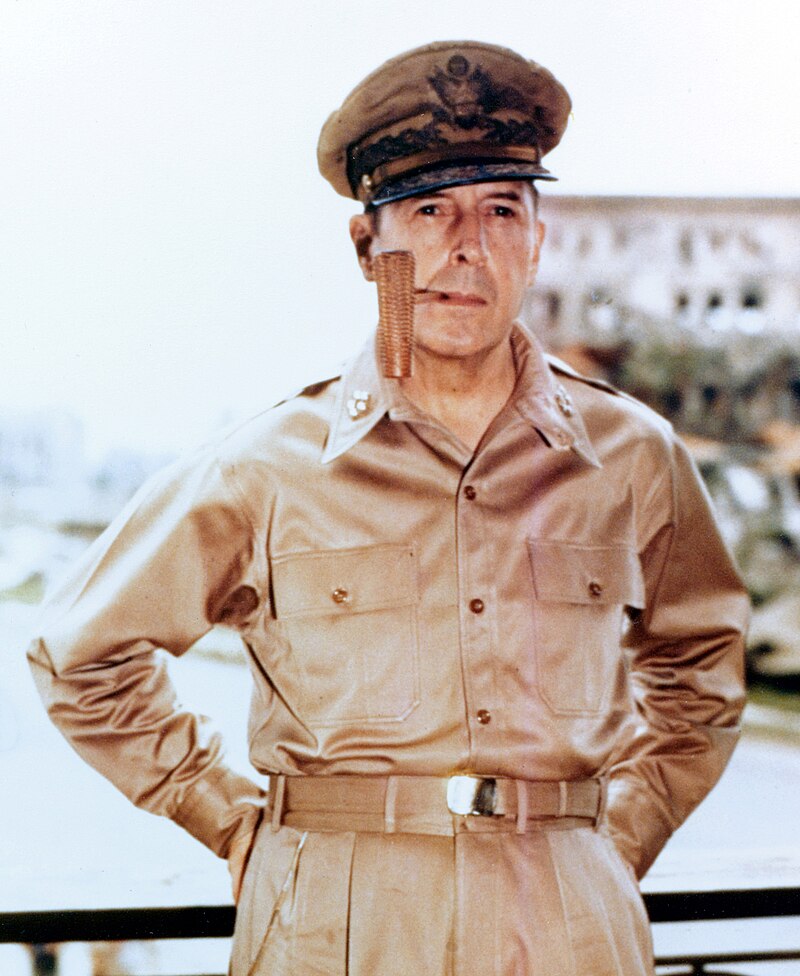
File:MacArthur_Manila_(cropped2).jpg · Wikimedia Commons · See Wikimedia Commons
Douglas MacArthur
Sign in to saveAlso known as General Douglas MacArthur, General MacArthur, D. MacArthur, MacArthur
United States Army general in WWI, WWII and Korea (1880–1964)
Douglas MacArthur was a prominent U.S. Army general who played major roles in three of the twentieth century's largest military conflicts: World War I, World War II, and the Korean War. His career and strategic decisions during these conflicts significantly influenced American military history and foreign policy, making him one of the most consequential military figures of his era.
AI-generated from the Wikipedia summary — may contain errors.
Film & TV
Little Rock, Arkansas, USA
Douglas MacArthur (26 January 1880 – 5 April 1964) was an American five-star general and Field Marshal of the Philippine Army. He was Chief of Staff of the United States Army during the 1930s and played a prominent role in the Pacific theater during World War II. He received the Medal of Honor for his service in the Philippines Campaign, which made him and his father Arthur MacArthur, Jr., the…
Known for
- Kamikaze: An Untold History — Archive2025
- Beyond Utopia — Self (archive footage)2023
- Korea, A Hundred Years of War — Self (archive footage)2020
- Korea: The Never-Ending War — Self (archive footage)2019
- The Battle Of Chosin — Himself (archive footage)2016
- Tokyo Trial: Judging Japan — Self (archive footage)2016
- Remember Pearl Harbor — Self (archive footage)2016
- Hundred Years' War in Korea — Himself (archive footage)2012
- World War II in Colour — Self (archive footage)2009
- War Made Easy — Self (archive footage)2007
via TMDB
Wikidata facts
- Instance of
- human
- Given name
- Douglas
- Gender
- male
- Citizenship
- United States
- Place of birth
- Little Rock
- Place of death
- Washington, D.C.
- Spouse
- Louise Cromwell
- Child
- Arthur McArthur IV
- Father
- Arthur MacArthur Jr.
- Sibling
- Arthur MacArthur III
- Position held
- Chief of Staff of the United States Army
- Political party
- Republican Party (United States)
- Languages spoken
- English language
- Participant in
- Korean War
- Conflict
- Battle of Inchon
- Military branch
- United States Army
- Image
- MacArthur Manila (cropped2).jpg
- Significant event
- Douglas MacArthur's escape from the Philippines
Show 16 more facts
- topic has template
- Template:Douglas MacArthur
- allegiance
- United States
- Commons category
- Douglas MacArthur
- date of birth
- 1880-01-26
- date of death
- 1964-04-05
- manner of death
- natural causes
- Commons gallery
- Douglas MacArthur
- topic's main category
- Category:Douglas MacArthur
- cause of death
- kidney failure
- name in native language
- Douglas MacArthur
- writing language
- English language
- start of work period
- 1903-00-00
- on focus list of Wikimedia project
- Wikipedia:Vital articles/Level/4
- end of work period
- 1951-00-00
- Commons Creator page
- Douglas MacArthur
- P12749
- Hippocrepis emerus
Sources (6)
via Wikidata · CC0
~40 min read
Encyclopedic overview
Douglas MacArthur (26 January 1880 – 5 April 1964) was an American general who served as a top commander during World War II and the Korean War, achieving the rank of General of the Army. He served with distinction in World War I; as chief of staff of the United States Army from 1930 to 1935; as Supreme Commander, Southwest Pacific Area, from 1942 to 1945; as Supreme Commander for the Allied Powers overseeing the occupation of Japan from 1945 to 1951; and as head of the United Nations Command in the Korean War from 1950 to 1951. MacArthur was nominated for the Medal of Honor three times, and awarded it for his WWII service in the Philippines. He is one of only five people to hold the rank of General of the Army, and the only person to hold the rank of Field Marshal in the Philippine Army.
MacArthur, a son of Medal of Honor recipient Arthur MacArthur Jr., graduated first in his class from the U.S. Military Academy at West Point in 1903. During the 1914 U.S. occupation of Veracruz, he conducted a reconnaissance mission for which he was nominated for the Medal of Honor. In 1917, he was promoted from major to colonel and became chief of staff of the 42nd (Rainbow) Division. On the Western Front during World War I, he rose to the rank of brigadier general, was again nominated for a Medal of Honor, and was awarded the Distinguished Service Cross twice and the Silver Star seven times. From 1919 to 1922, MacArthur served as Superintendent of the U.S. Military Academy. His next posting was in the Philippines, where in 1924 he was instrumental in quelling the Philippine Scout Mutiny. In 1925, MacArthur became the Army's youngest major general at the age of 45, and in 1930 was appointed Chief of Staff of the U.S. Army. He was involved in the controversial expulsion of the Bonus Army protesters in Washington, D.C., in 1932, and organized the Civilian Conservation Corps. In 1935, MacArthur was appointed Military Advisor to the Commonwealth of the Philippines. He retired from the Army in 1937, but continued as an advisor and as a Field Marshal in the Philippine Army from 1936.
Excerpted from Wikipedia’s “Douglas MacArthur” article, available under the CC BY-SA 4.0 licence.
Gallery (13)
Available in 87 languages
- Español
- Français
- Deutsch
- 中文
- 日本語
- Русский
- Português
- Italiano
- العربية
- Afrikaans
- Albanian
- Aragonese
- Armenian
- Asturian
- Azerbaijani
- Bahasa Indonesia
- Bangla
- Basque
Show 68 more
- Belarusian
- Breton
- Bulgarian
- Burmese
- Catalan
- Central Kurdish
- Croatian
- Czech
- Danish
- Egyptian Arabic
- Esperanto
- Estonian
- Fijian
- Filipino
- Finnish
- Galician
- Gan Chinese
- Georgian
- Greek
- Hebrew
- Hungarian
- Icelandic
- Ido
- Interlingua
- Irish
- Javanese
- Kazakh
- Lao
- Latin
- Latvian
- Lingua Franca Nova
- Lithuanian
- Luxembourgish
- Malagasy
- Malay
- Marathi
- Mingrelian
- Mongolian
- Nederlands
- Norwegian
- Occitan
- Ossetic
- Pashto
- Piedmontese
- Polski
- Romanian
- Scots
- Serbian
- Serbian (Latin)
- simple
- Slovak
- Slovenian
- Svenska
- szy
- Tamil
- Tiếng Việt
- Türkçe
- Ukrainian
- Waray
- Welsh
- Wu Chinese
- Yoruba
- zh_classical
- zh_min_nan
- zh_yue
- فارسی
- ไทย
- 한국어
via Wikidata sitelinks · CC0