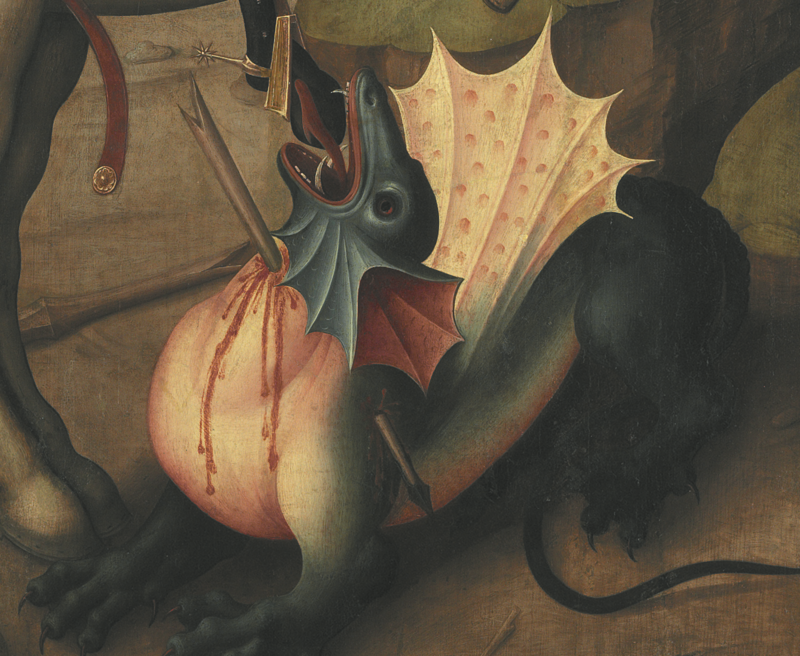
File:St_Catherine,_St_George_and_the_Dragon_(Mästaren_från_Kappenberg)_-_Nationalmuseum_-_18337_(brightened),_draken.png · Wikimedia Commons · See Wikimedia Commons
A dragon is a mythical creature that appears in the folklore of many cultures around the world, typically depicted as a reptilian or serpent-like being with features such as claws, wings, scales, or horns. Dragons are generally portrayed as intelligent creatures capable of controlling natural elements, and their appearance often combines characteristics from reptiles, mammals, and birds.
AI-generated from the Wikipedia summary — may contain errors.
Wikidata facts
- Image
- Friedrich-Johann-Justin-Bertuch Mythical-Creature-Dragon 1806.jpg
Show 10 more facts
- described by source
- Pauly–Wissowa
- Unicode character
- 🐲
- Commons category
- Dragons
- topic's main category
- Category:Dragons
- Commons gallery
- Dragon
- has characteristic
- fire breathing
- P8168
- Lizinska de Mirbel
- on focus list of Wikimedia project
- Wikipedia:Vital articles/Level/4
- indigenous to
- Asia
- topic has template
- Template:Dragons
via Wikidata · CC0
Article · 中文
龍形傳說生物是一种巨大的蛇形传说生物,在世界各地的民间传说中都有出现。而在各地,尽管背景和象徵意義不同,但龍形傳說生物在英文中统一称为“dragon”。它在不同文化中皆可見類似形狀的傳說動物,並出现在各种文学、艺术作品以及建筑、纪念物中。例如在多数情况下,東亞龍是瑞獸,通常寓意吉祥,而西方龍則多表示邪惡。 在基督教流行之前,西方的“dragon”一直是維京人、塞爾特人和撒克遜人的民族象徵,這點和東方龍無異。隨著基督教勢力的壯大,龍和蛇有負面涵義,其在《新約全書》的啟示錄中被描繪為邪惡的“古蛇”、“魔鬼”、“撒旦”,從此西方龍就常與邪惡畫上等號,與東亞的瑞獸完全不一樣。 而在南亞文化圈也有稱為那伽的龍形傳說生物,出現在印度教傳說中,後來被佛教吸收。佛教傳入東亞後,那伽的形象亦與東亞傳統的龍混同,漢傳佛教中亦直接把那伽翻譯為「龍」。
Abstract from DBpedia / Wikipedia · CC BY-SA
Gallery (52)
Available in 130 languages
- Español
- Français
- Deutsch
- 中文
- 日本語
- Русский
- Português
- Italiano
- العربية
- हिन्दी
- Abkhazian
- Adyghe
- Afrikaans
- Albanian
- Albanian
- Aragonese
- Aramaic
- Armenian
Show 111 more
- Asturian
- azb
- Azerbaijani
- Bahasa Indonesia
- Balinese
- Bangla
- Bashkir
- Basque
- Bavarian
- be_x_old
- Belarusian
- Bhojpuri
- Bikol
- Bosnian
- Breton
- Bulgarian
- Catalan
- Central Dusun
- Central Kurdish
- Chechen
- Cornish
- Crimean Tatar
- Croatian
- Czech
- Danish
- Esperanto
- Estonian
- Faroese
- Filipino
- Finnish
- fiu_vro
- Galician
- Georgian
- Gilaki
- Greek
- Guarani
- Hausa
- Hebrew
- Hungarian
- Icelandic
- Ido
- Ingush
- Interlingua
- Kannada
- Kashmiri
- Kazakh
- Kurdish
- Kyrgyz
- Latin
- Latvian
- Lingua Franca Nova
- Lithuanian
- lld
- Lombard
- Luxembourgish
- Macedonian
- Madurese
- Malagasy
- Malay
- Malayalam
- Manipuri
- Mazanderani
- Neapolitan
- Nederlands
- Nepali
- Norwegian
- Norwegian Nynorsk
- Novial
- nrm
- Occitan
- Old English
- Oromo
- Ossetic
- Pashto
- Polski
- Punjabi
- Quechua
- Romanian
- Sardinian
- Scots
- Serbian
- Serbian (Latin)
- Silesian
- simple
- Sindhi
- Slovak
- Slovenian
- Standard Moroccan Tamazight
- Svenska
- Tajik
- Talysh
- Tamil
- Tatar
- Telugu
- Tiếng Việt
- Toki Pona
- Türkçe
- Ukrainian
- Urdu
- Uzbek
- Waray
- Welsh
- Western Frisian
- Western Panjabi
- Wu Chinese
- Yiddish
- zh_yue
- Zulu
- فارسی
- ไทย
- 한국어
via Wikidata sitelinks · CC0