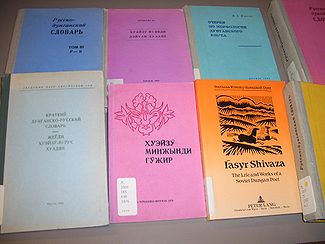
File:Dungan-books-2450.jpg · Wikimedia Commons · See Wikimedia Commons
Dungan
Sign in to saveAlso known as Dungan language
divergent variety of Central Plains Mandarin spoken in Central Asia
Dungan is a variety of Mandarin Chinese that developed among communities in Central Asia and differs noticeably from the Mandarin spoken in China's Central Plains region. It matters because it represents a distinct linguistic branch that reflects the unique history and cultural development of Chinese-speaking populations outside of mainland China.
AI-generated from the Wikipedia summary — may contain errors.
Key facts
- Pronunciation
- [ xwɛ̌jt͡sû ʝŷʝɛ̃̌ ]
- Native to
- Central Asia
- Region
- Chu Valley ( Kyrgyzstan , Kazakhstan ), Altai Krai , Saratov Oblast (Rovensky District) ( Russia ), Fergana Valley ( Uzbekistan )
- Ethnicity
- Dungan
- Native speakers
- 145,000 (2009–2021)
- Language family
- Sino-Tibetan Sinitic Chinese Mandarin Central Plains Mandarin Dungan
- Writing system
- Cyrillic (official), Chinese characters (obsolete), Xiao'erjing (obsolete), Latin (historical)
- Iso 639 3
- dng
- Glottolog
- dung1253
- Elp
- Dungan
via Wikipedia infobox
Wikidata facts
- Instance of
- varieties of Chinese
- Subclass of
- Central Plains Mandarin
- Country
- Kyrgyzstan
Show 6 more facts
- writing system
- Cyrillic script
- number of speakers, writers, or signers
- 41400
- topic's main category
- Category:Dungan language
- indigenous to
- Jambyl Region
- Commons category
- Dungan language
via Wikidata · CC0
~16 min read
Encyclopedic overview
Dunganese name DunganХуэйзў йүян Xiao'erjingخُوِزُو یُوِیًا Hanzi回族語言 (Huízú yǔyán; Hui-tsu yü-yen) Uyghur name Uyghur تۇڭگان تىلى Russian name RussianДунганский язык RomanizationDunganskij jazyk Kyrgyz name KyrgyzДунган тили دۇنعان تىلى Dungan tili Kazakh name KazakhДүнген тілі دۇنگەن تىلى Düngen tılı
Dungan (/ˈdʊŋ.ɡɑːn/ or /ˈdʌŋ.ɡən/) is a Sinitic language spoken primarily in the Chu Valley of southeastern Kazakhstan and northern Kyrgyzstan. It is the native language of the Dungan people, a Hui subgroup that fled Qing China in the 19th century. It evolved from the Central Plains Mandarin varieties spoken in Gansu and Shaanxi. It is the only Sino-Tibetan language to be officially written in the Cyrillic script. In addition, the Dungan language contains loanwords and archaisms not found in other modern varieties of Mandarin.
Excerpted from Wikipedia’s “Dungan” article, available under the CC BY-SA 4.0 licence.