File:Plasma_globe_60th.jpg · Wikimedia Commons · See Wikimedia Commons
electromagnetic interaction
Sign in to saveAlso known as electromagnetism, EM interaction
the fundamental interaction that occurs between electrically charged particles
Electromagnetic interaction is the fundamental force that occurs between electrically charged particles, causing them to attract or repel each other depending on whether their charges are opposite or the same. This interaction matters because it's responsible for holding atoms together, enabling chemical reactions, and powering nearly all the technology and natural phenomena we encounter in everyday life.
AI-generated from the Wikipedia summary — may contain errors.
Wikidata facts
- Instance of
- fundamental interaction
- Subclass of
- electroweak interaction
- Image
- Feynmann Diagram Coulomb.svg
Show 3 more facts
- different from
- electromagnetism
- on focus list of Wikimedia project
- Wikipedia:Vital articles/Level/4
- studied by
- electromagnetism
Sources (1)
via Wikidata · CC0
~19 min read
Encyclopedic overview
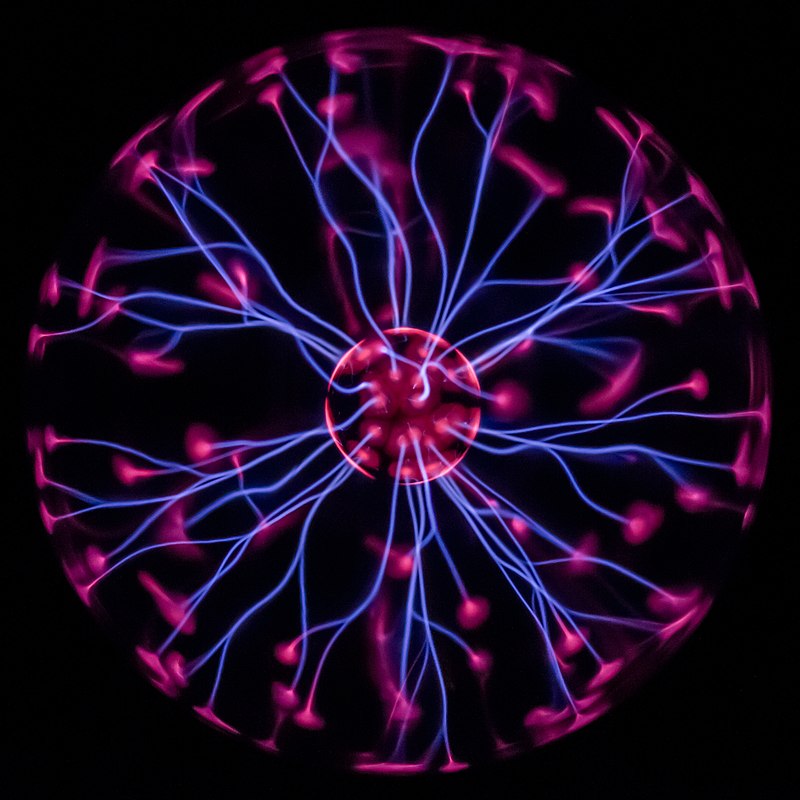
Electromagnetic interactions are responsible for the glowing filaments in this plasma globe.
In physics, electromagnetism is an interaction that occurs between particles with electric charge via electromagnetic fields. The electromagnetic force is one of the four fundamental forces of nature. It is the dominant force in the interactions of atoms and molecules. Electromagnetism can be thought of as a combination of electrostatics and magnetism, which are distinct but closely intertwined phenomena. Electromagnetic forces occur between any two charged particles. Electric forces cause an attraction between particles with opposite charges and repulsion between particles with the same charge, while magnetism is an interaction that occurs between charged particles in relative motion. These two forces are described in terms of electromagnetic fields. Macroscopic charged objects are described in terms of Coulomb's law for electricity and Ampère's force law for magnetism; the Lorentz force describes microscopic charged particles.
Excerpted from Wikipedia’s “electromagnetic interaction” article, available under the CC BY-SA 4.0 licence.
Gallery (4)
Available in 80 languages
- Español
- Français
- Deutsch
- 中文
- 日本語
- Русский
- Português
- Italiano
- العربية
- Afrikaans
- Albanian
- Aragonese
- Asturian
- Bahasa Indonesia
- Bangla
- Bashkir
- Basque
- bat_smg
Show 61 more
- be_x_old
- Belarusian
- Bosnian
- Bulgarian
- Catalan
- Chuvash
- Croatian
- Czech
- Danish
- Egyptian Arabic
- Esperanto
- Estonian
- Fiji Hindi
- Finnish
- Galician
- Greek
- Hebrew
- Icelandic
- Ido
- Javanese
- Kazakh
- Latin
- Latvian
- Limburgish
- Lithuanian
- Low German
- Malay
- Malayalam
- Mongolian
- Nederlands
- Northern Frisian
- Norwegian
- Norwegian Nynorsk
- Occitan
- Piedmontese
- Polski
- Romanian
- Serbian
- Serbian (Latin)
- Sindhi
- Slovak
- Slovenian
- Svenska
- Swahili
- Tamil
- Tatar
- Telugu
- Tiếng Việt
- Türkçe
- Tuvinian
- Ukrainian
- Veps
- Waray
- Welsh
- Wu Chinese
- Yiddish
- zh_min_nan
- zh_yue
- فارسی
- ไทย
- 한국어
via Wikidata sitelinks · CC0