Encyclopedia of Life · EOL (see source)
Engystomops
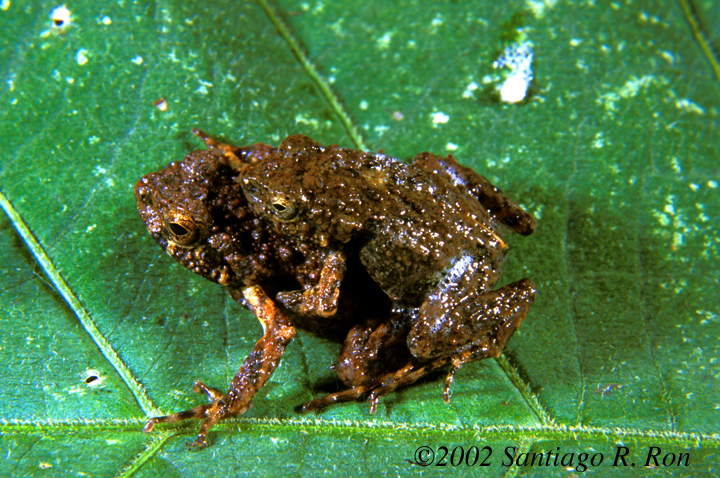
Sign in to saveEngystomops is a genus of frogs in the family Leptodactylidae. They are commonly known as foam frogs or túngara frogs, though the latter name most commonly refers to Engystomops pustulosus. They are native to the Americas from southern Mexico south to the Amazon Basin.
Species
GENUS
- KingdomAnimalia
- PhylumChordata
- ClassAmphibia
- OrderAnura
- FamilyLeptodactylidae
Engystomops pustulosus bei der Paarung Engystomops ist eine 2006 wieder errichtete Gattung der Frösche. Sie wurde aus der Gattung Physalaemus ausgegliedert und umfasst eine Reihe von süd- und mittelamerikanischen Arten, darunter den häufigen und weit verbreiteten Tungara-Frosch (Engystomops pustulosus). Inhaltsverzeichnis 1 Merkmale 2 Verbreitung 3 Lebensweise 4 Systematik und Taxonomie 5 Arten 6 Einzelnachweise 7 Literatur 8 Weblinks Merkmale Die Frösche der Gattung Engystomops werden 15 bis 38,6 Millimeter lang. Die Rückenhaut ist warzig. Die Frösche sind unauffällig braun gefärbt. Über dem Gehörorgan ist das Tympanum sichtbar. Verbreitung Das Verbreitungsgebiet dieser Froschgattung reicht vom Süden Mexikos über Mittelamerika bis in die nördlichen Staaten Südamerikas einschließlich Perus und Ecuadors. Die Gattung umfasst zwei Kladen, die durch die Anden biogeographisch voneinander getrennt werden. Die beiden Kladen wurden in zwei ranglosen Artengruppen zusammengefasst. Die Klade Edentulus besteht aus Engystomops petersi und Engystomops pustulosus sowie Engystomops freibergi und kommt östlich der Anden im Norden Südamerikas und im Amazonasbecken vor. Die Klade Duovox besteht aus d
via GBIF
Wikidata facts
- Instance of
- taxon
- Parent taxon
- Leiuperidae
- Image
- Engystomops petersi 2.jpg
Show 5 more facts
- taxon rank
- genus
- taxon name
- Engystomops
- Commons category
- Engystomops
- topic's main category
- Category:Engystomops
- taxon common name
- Dwarf Frogs
Sources (1)
via Wikidata · CC0
~2 min read
Encyclopedic overview
2 sectionsContents
- Description
- References
Engystomops is a genus of frogs in the family Leptodactylidae. They are commonly known as foam frogs or túngara frogs, though the latter name most commonly refers to Engystomops pustulosus. They are native to the Americas from southern Mexico south to the Amazon Basin.
This genus was maintained on its own until 1970, when it was merged into Physalaemus, a genus of similar frogs. As studies progressed, there was increasing evidence that Physalaemus was not a monophyletic group; it was made up of several groups. One of those groups consisted of several frogs more closely related to each other than to the rest of the Physalaemus, and they were represented by P. pustulosus, now Engystomops pustulosus. This group was split off in 2005 on the basis of characters such as basic morphology and vocalizations, as well as allozyme and other genetic analysis. The group was given the revalidated name Engystomops. It included two newly described species.
Excerpted from Wikipedia’s “Engystomops” article, available under the CC BY-SA 4.0 licence.
Available in 16 languages
- Español
- Français
- Deutsch
- Русский
- Português
- Basque
- Cebuano
- Egyptian Arabic
- Hungarian
- Navajo
- Nederlands
- Polski
- Svenska
- Tiếng Việt
- Waray
via Wikidata sitelinks · CC0