Epifagus · Kew POWO · Kew Plants of the World Online
Epifagus
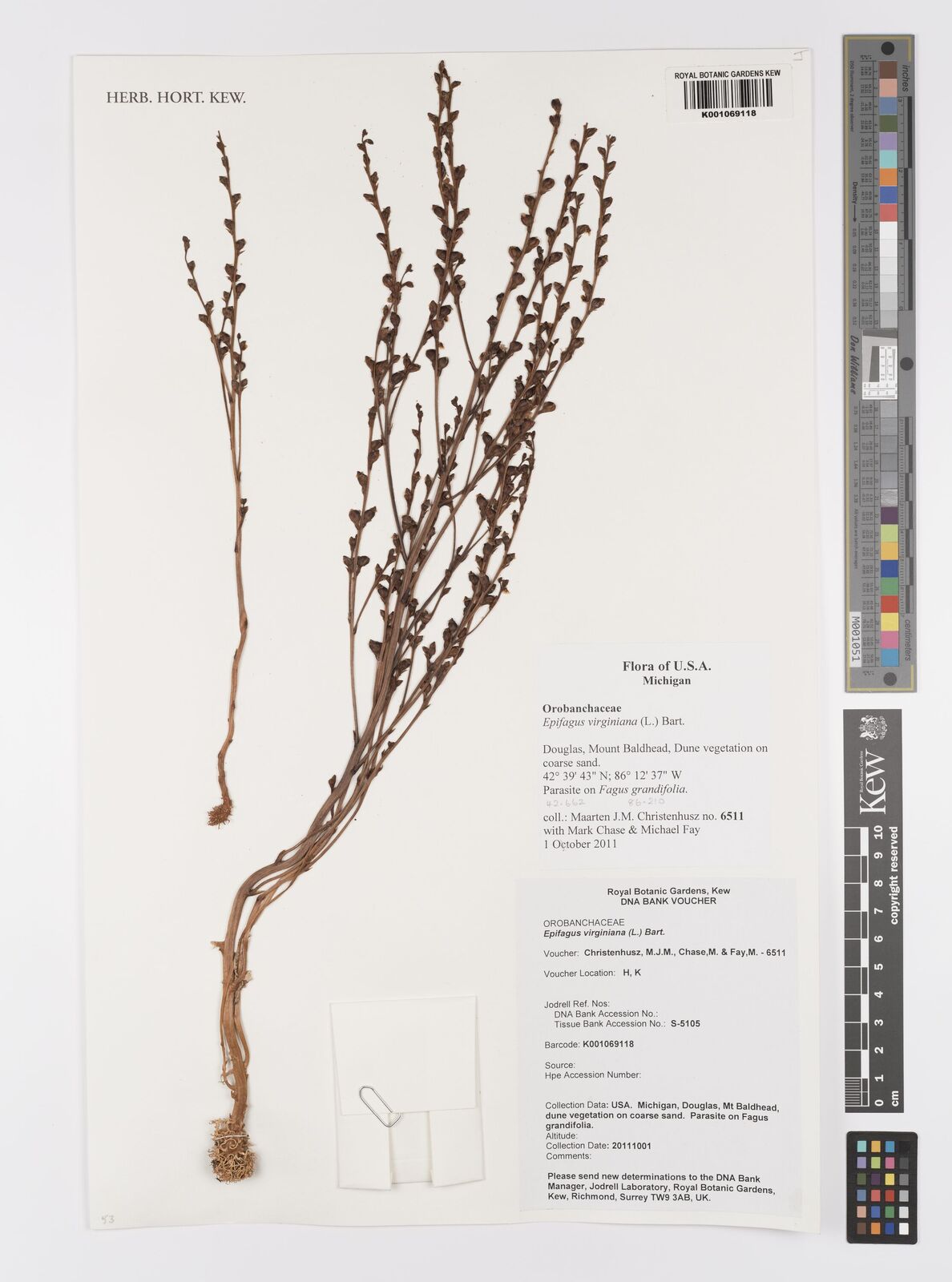
Sign in to saveEpifagus virginiana, commonly called beech drops (or beech-drops or beechdrops), is an obligate parasitic plant which grows and subsists on the roots of American beech. It is a member of the family Orobanchaceae. The genus Epifagus is monotypic—containing only E. virginiana. The name Epifagus derives from Greek "epi" meaning "on" or "upon", and "Fagus" which is the genus name of beech.
Species
GENUS
- KingdomPlantae
- PhylumTracheophyta
- ClassMagnoliopsida
- OrderLamiales
- FamilyOrobanchaceae
via GBIF · Kew POWO
Museum specimens
- Specimen records
- 149
- With media
- 144
- Family
- Orobanchaceae
- Collections
- IEA-UAT, ANSP, MO, MSC, OSW, DOV
- Recorded in
- Mexico, United States
Wikidata facts
- Instance of
- taxon
- Parent taxon
- Orobanchaceae
- Image
- Epifagus virginiana.jpg
Show 6 more facts
- taxon name
- Epifagus
- taxon rank
- genus
- topic's main category
- Category:Epifagus
- taxon common name
- beechdrops
- Commons category
- Epifagus
Sources (1)
via Wikidata · CC0
~4 min read
Encyclopedic overview
5 sectionsContents
- Description
- Host and symptoms
- Life cycle
- Environment
- References
Epifagus virginiana, commonly called beech drops (or beech-drops or beechdrops), is an obligate parasitic plant which grows and subsists on the roots of American beech. It is a member of the family Orobanchaceae. The genus Epifagus is monotypic—containing only E. virginiana. The name Epifagus derives from Greek "epi" meaning "on" or "upon", and "Fagus" which is the genus name of beech.
==Description== Beechdrops is a parasitic plant native to eastern North America. It entirely lacks chlorophyll and produces many brown stems up to 30 cm tall on which it bears small white and purple flowers that appear in July through October. The flowers have tubular, zygomorphic corollas ~8mm long containing a single style and four stamens. The dried flower stalks will persist throughout the winter. The flowers on the lower parts of the plant are cleistogamous (self-pollinating), while the tops of the stems have chasmogamous (cross-pollinating) flowers, which may be sterile.
Excerpted from Wikipedia’s “Epifagus” article, available under the CC BY-SA 4.0 licence.