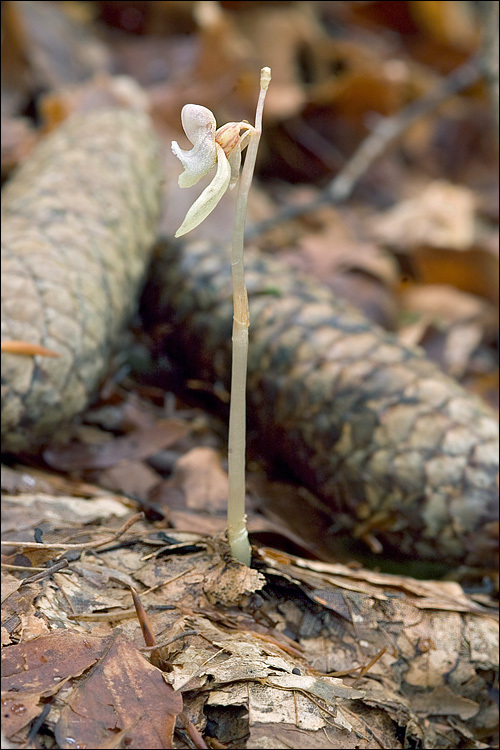
Encyclopedia of Life · EOL (see source)
OverviewAI-generated
Epipogium aphyllum is a species of plant in the family Orchidaceae. It belongs to the genus Epipogium and is classified within the order Asparagales, class Liliopsida, and phylum Tracheophyta. The species is known by several common names, including Ghost orchid, Blattloser Widerbart, and Lehitu pisikäpp. It has been cited as a medicinal plant.
The taxon range includes China, Xinjiang, and the Tibet Autonomous Region. According to the Encyclopedia of Life, its distribution also extends to Europe, Western Asia, the Himalayas (from Kashmir to Bhutan), Tibet, Siberia, and Japan. The species holds a regional conservation status of Near Threatened.
Records for this taxon are held by various institutions, including CAS, RSA, MICH, BRIT, and BOUM. These records document occurrences in countries such as France, Germany, Sweden, Austria, and the Czech Republic.
Synthesized by Vinony from 30 facts across 7 sources: Wikidata, GBIF, Encyclopedia of Life, Gbif Occ, Plants of the World, iDigBio, Vinony graph. Generated from structured data (not the Wikipedia text) and checked against those facts — may still contain errors.
Species
SPECIES
- KingdomPlantae
- PhylumTracheophyta
- ClassLiliopsida
- OrderAsparagales
- FamilyOrchidaceae
Europe, W. Asia, Himalaya (Kashmir to Bhutan), Tibet, Siberia, China, Japan.
via GBIF · Kew POWO
Museum specimens
- Specimen records
- 738
- With media
- 392
- Family
- Orchidaceae
- Collections
- CAS, RSA, MICH, BRIT, BOUM, NY
- Recorded in
- France, Germany, Sweden, Austria, Czech Republic, Russia, China, Slovakia
Wikidata facts
- Instance of
- taxon
- Parent taxon
- Epipogium
- Image
- Epipogium aphyllum - Jõhvi- crop.jpg
- Has use
- medicinal plant
Show 9 more facts
- taxon rank
- species
- taxon name
- Epipogium aphyllum
- Commons category
- Epipogium aphyllum
- taxon common name
- Ouniblat-Geeschterorchidee
- Commons gallery
- Epipogium aphyllum
- taxon range
- Tibet Autonomous Region
- short name
- E. aphyllum
- taxon author citation
- C. Y. Yang
- regional conservation status
- Near Threatened
Sources (8)
via Wikidata · CC0
~5 min read
Encyclopedic overview
Epipogium aphyllum, the ghost orchid, is a hardy mycoheterotrophic orchid lacking chlorophyll. In much of its range, it is a rare representative of family Orchidaceae.
It is famous for its unpredictable appearance; in many localities it has been seen just once. It is found in beech, oak, pine, and spruce forests of Europe and Asia, on base-rich soils. It is a rare and critically endangered plant in Britain; it was believed to be extinct throughout much of its former range, although in 2009 and in 2024 it was re-confirmed, where the plants were believed to have become extinct.
Excerpted from Wikipedia’s “Epipogium aphyllum” article, available under the CC BY-SA 4.0 licence.