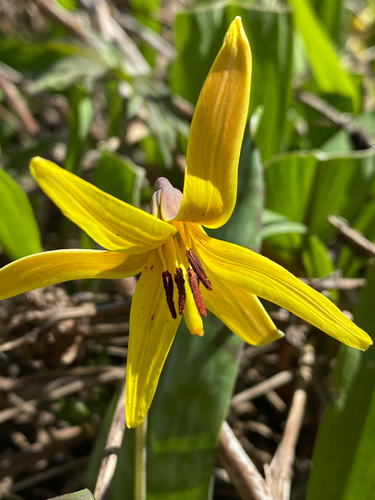
(c) mrdace, some rights reserved (CC BY), uploaded by mrdace · cc-by
Erythronium
Sign in to saveAlso known as fawn lilies
Erythronium, the fawn lily, trout lily, '''dog's-tooth violet or adder's tongue', is a genus of Eurasian and North American plants in the lily family, most closely related to tulips. The name Erythronium derives from Ancient Greek () "red" in Greek, referring to the red flowers of E. dens-canis''. Of all the established species, most live in North America; only six species are found in Europe and Asia.
OverviewAI-generated
Erythronium is a genus of plants within the family Liliaceae. It belongs to the order Liliales, class Liliopsida, and phylum Tracheophyta in the kingdom Plantae. The genus is classified under the subfamily Lilioideae. Common names for this group include kandík, Zahnlilien, Fawn lily, and Koiranhampaat. The fruit type is a capsule.
Records indicate that Erythronium has been introduced to Germany, Great Britain, and Ireland. Occurrence data from various sources, including iDigBio, lists collections from Canada, the United States, and North Korea. Institutions holding records include the University of Alberta Museums, MSC, US, NY, and ENCB-IPN. The genus has been described in the Brockhaus and Efron Encyclopedic Dictionary.
Synthesized by Vinony from 34 facts across 7 sources: Wikidata, GBIF, iNaturalist, Gbif Occ, Plants of the World, iDigBio, Vinony graph. Generated from structured data (not the Wikipedia text) and checked against those facts — may still contain errors.
Species
yellow trout lily
GENUS
- KingdomPlantae
- PhylumTracheophyta
- ClassLiliopsida
- OrderLiliales
- FamilyLiliaceae
猪牙花属(学名:Erythronium)是百合科下的一个属,为多年生草本植物。该属共有25种,分布于北温带。[1] 参考文献 ^ 中国种子植物科属词典. 中国数字植物标本馆. (原始内容存档于2012-04-11). 外部链接 維基物種中有關猪牙花属的數據 这是一篇與植物相關的小作品。你可以通过编辑或修订扩充其内容。 查 论 编 取自“https://zh.wikipedia.org/w/index.php?title=猪牙花属&oldid=45159810” 分类: 百合科 豬牙花屬 隐藏分类: 维基数据有相关图片而本地未添加 WikispeciesLatinName 全部小作品 植物小作品
via GBIF · Kew POWO
Museum specimens
- Specimen records
- 518
- With media
- 409
- Family
- Liliaceae
- Collections
- UNIVERSITY OF ALBERTA MUSEUMS, MSC, US, NY, ENCB-IPN, BUF
- Recorded in
- Canada, United States, North Korea
Wikidata facts
- Instance of
- taxon
- Parent taxon
- Lilioideae
- Image
- Erythronium oregonum 01193.JPG
Show 8 more facts
- taxon rank
- genus
- taxon name
- Erythronium
- topic's main category
- Category:Erythronium
- Commons gallery
- Erythronium
- Commons category
- Erythronium
- taxon common name
- pasji zob
- has fruit type
- capsule
via Wikidata · CC0
~6 min read
Encyclopedic overview
7 sectionsContents
- Taxonomy
- Species
- Formerly included
- Cultivation and uses
- See also
- References
- Bibliography
Erythronium, the fawn lily, trout lily, '''dog's-tooth violet or adder's tongue', is a genus of Eurasian and North American plants in the lily family, most closely related to tulips. The name Erythronium derives from Ancient Greek () "red" in Greek, referring to the red flowers of E. dens-canis. Of all the established species, most live in North America; only six species are found in Europe and Asia.
==Taxonomy== It was published by Carl Linnaeus in 1753 with Erythronium dens-canis as the type species. === Species === Erythronium includes about 20–30 species of hardy spring-flowering perennial plants with long, tooth-like bulbs. Slender stems carry pendent flowers with recurved tepals in shades of cream, yellow, pink and mauve. Species are native to forests and meadows in temperate regions of the Northern Hemisphere.
Excerpted from Wikipedia’s “Erythronium” article, available under the CC BY-SA 4.0 licence.