Also known as sz, Kingdom of Eswatini, Umbuso weSwatini, Swaziland, Kingdom of Swaziland
Stato dell'Africa del Sud
I don't see any context provided for me to base an overview of Eswatini on. Could you please share the context you'd like me to use to write the overview?
AI-generated from the Wikipedia summary — may contain errors.
via Open-Meteo
The Kingdom of Eswatini is one of the last absolute monarchies in the world, one of the smallest countries in Africa and has a well-earned reputation for friendliness in Southern Africa. It also contains several moderately sized game parks and reserves, which are sponsored by the government and are popular tourist destinations.
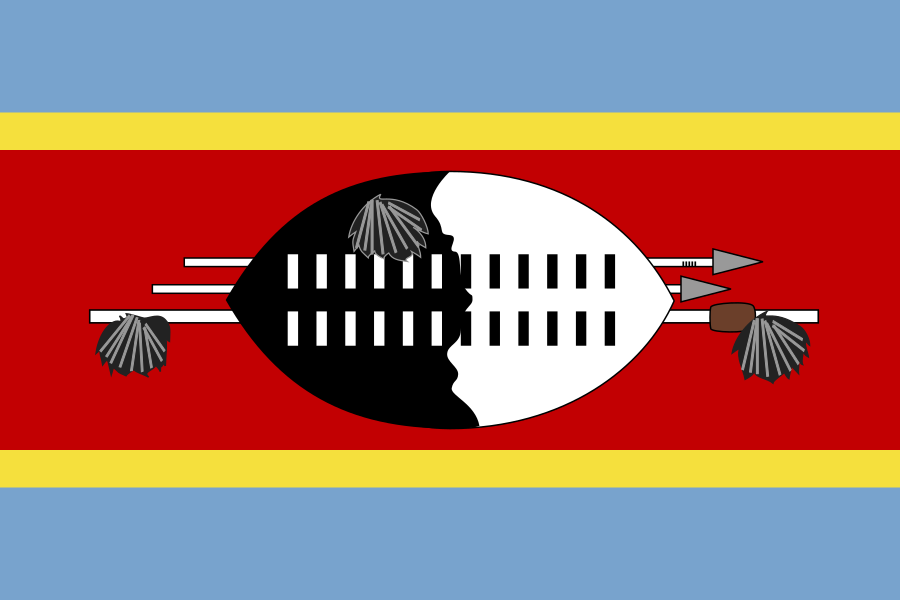
Eswatini is named after Mswati II, who became king in 1839. The royal lineage can be traced back to the Dlamini clan. The population is divided roughly between Nguni, Sotho and Tsonga, the remainder being 3% white. The current king is Mswati III, son of Sobuza II who had about seventy wives. He rules jointly with Indlovukazi, the Queen Mother. The primary symbol of Eswatini is not what the West would typically associate with nationhood, flags or monuments, but the king himself. The relationship between king and people is demonstrated through the incwala, a ceremony lasting several weeks which focuses on traditional rule, unity of the state, primacy of agriculture, sacredness of land, fertility and potency. Mswati's relationship with his people has been made even more unique through the introduction of chastity decrees for the under-18s to combat the rise of AIDS. However, Mswati III broke the rule when he married a 17-year-old girl, his thirteenth wife, in 2005. Mswati III has come under further criticism for attempting to purchase a private plane during a period of persistent drought and famine. Dissent grew so vociferous that the media was banned fr…
thumb|375px|Visa policy of Swaziland/Eswatini Eswatini's visa policy is quite liberal. Citizens of many countries can visit the country without a visa. The government plans to offer visas on arrival in the near future.
thumb|Kombis.
With an area of 6,704 sq mi, the quickest way to get around the country is by car. You can easily cover the whole country in one day this way.
The national parks and reserves are the most important sights in Eswatini, and traditional culture and customs are still alive.
thumb|Making pap Many Western foods are available in Swazi grocery stores, but traditional foods are still common, as is modern convenience food based on traditional ingredients.
eSwatini, ufficialmente Regno di eSwatini (noto fino al 2018 come Swaziland o anche con il nome Ngwane, adottato alla proclamazione dell'indipendenza, meno usato), è uno Stato indipendente dell'Africa meridionale. È una delle tre monarchie dell'Africa, insieme al Marocco e al Lesotho. Si trova sul fianco orientale dei monti dei Draghi e confina con il Mozambico a est e con il Sudafrica a nord, ovest e sud. Non ha sbocco sul mare e dista circa 80 km dall'Oceano Indiano. Estendendosi a un massimo di 200 km da Nord a Sud e 130 km da est a ovest, eSwatini è uno dei paesi più piccoli in Africa. Nonostante ciò, il suo clima e la sua topografia sono molto variati, che vanno dal clima mite e di montagna dell'Alto Veld, a quello caldo e arido del Basso Veld. La popolazione dello stato è composta principalmente dall'etnia Swazi, e la lingua maggiormente utilizzata è lo Swati (chiamato siSwati dai nativi). Gli Swazi stabilirono il loro regno nella seconda metà del diciottesimo secolo sotto il comando di Ngwane III.
Abstract from DBpedia / Wikipedia · CC BY-SA
3 mapped locations
Discovered by embedding cosine similarity (sentence-transformers MiniLM, 384-dim).
via REST Countries
via World Bank Open Data · CC BY 4.0
via Wikimedia Pageviews API
via Wikipedia infobox
via PubMed
via Wikidata · CC0
Maize-based dishes are popular, and mealie or pap (similar to porridge) is a staple. Beans, groundnuts, pumpkin, avocado and sour milk are also common ingredients. Dried and cooked local meats, such as antelope (often called 'wild meat' by locals), are widely available at tourist restaurants.
"Chicken dust" is a cheap local bbq meal; basically chicken grilled in the open served with a salad and mealie. It is popular both with locals and delicious. Take appropriate precautions as it is a street vendor food.
Sweet breads, vegetables and fruits are often available from roadside merchants. If you're craving pasta, imported olive oil, Nestle chocolate, Herbal Essences and Carlsberg, go to the Hub, at Manzini: a huge Spar with everything you could need (at an appropriately inflated price). There are several coffee-shops and restaurants around the Hub, also: be aware that the lavatories are located separately, down the stairs, and you have to pay to use them. Manzini's bustling markets and local shops yield all kinds of interesting foodstuffs, along with the ubiquitous KFC.
Marula (made of fruits from the tree with the same name) is locally brewed during the marula season, fruits ripen between December and March. It may be difficult to find; ask locals as it is home-brewed.
There is a vibrant nightlife in Eswatini ranging from traditional dances to bars and nightclubs. If you're staying in Ezulwini, there are four bars at the Royal Swazi hotel. If you're in the Malkerns area, the House on Fire is extremely popular: local art, local and national DJs, an open-air setting and live acts.
Eswatini is a small country and it is easy to get anywhere in the country during one day.
If you're watching the pennies, head to Veki's Guesthouse or Grifter's Backpackers in Mbabane, which costs around E120 per night for a bunk. It is unclear whether the latter one still exists. If you want to push the boat out, book a room at the Mountain Inn which has outstanding accommodation, facilities and leisure opportunities.
The most sought-after hotels in Eswatini tend to be located in Ezulwini Valley between the two major cities, Mbabane and Manzini. With four bars, a restaurant, a casino, golf, swimming, tennis and 411 rooms and suites, the Royal Sun Swazi epitomises luxury. The Royal Villas, also found in Ezulwini, spread 56 rooms across 14 villas and are extremely luxurious, offering excellent food, atmosphere and leisure facilities. The Ezulwini sun offers excellent facilities, also, at mid-range prices. A budget option is Sundowners Backpackers, private rooms from around E200, dorms from E120 and camping from E70/night.
And, if you're going towards the Mozambique border, you'll find comfortable, well-appointed country clubs at Manananga, Mhlume and Simunye.
thumb|Nhlangano Historically, Eswatini has enjoyed a very low rate of violent crime compared to its neighbors. Indeed, South Africans and Mozambicans love to vacation here because they need not worry about being crime victims while on vacation.
Be cautious in the presence of police. Officers have been known to aggressively apprehend and abuse foreigners for minor offences such as jaywalking or speeding.
Hippopotamuses are found (rarely) in the country's rivers, and are one of the more dangerous animals you are likely to come across. They are actually quite fast animals, as well as being extremely strong and with large, powerful jaws. They often stay submerged in shallow water during the day, but come out at night to graze. They can be unpredictable, territorial and very protective of their young. Do not stand between a hippo and the water.
Crocodiles are a more common danger when swimming in rivers.
Eswatini also has one of the highest numbers of people struck by lightning per capita in the whole world, and it is common to know (or know of) somebody who has been struck by lightning.
Be careful when crossing any of Eswatini's nineteen border gates. It is forbidden to take meat into certain areas, and the soldiers have the right to search both you and your vehicle extensively. It is extremely inadvisable to stray into 'No-Man's Land', a 5 km stretch of territory between Mozambique and Eswatini; several locals have been shot by soldiers guarding the edges of the respective…
Excellent medical care is entirely non-existent in Eswatini; the country has one of the lowest average life expectancies in the world and the healthcare system is poorly funded and maintained. If you fall sick during your stay, it is recommended that you go to neighbouring South Africa, where medical care is generally better.
Eswatini has the highest HIV/AIDS prevalence rate in the world ― 25-26% of Swazi adults aged between 15-49 have HIV/AIDS ― and it appears that the issue has been getting worse and worse since 2002. Take the necessary precautions and don't even think about having unprotected sex! If you happen to find romance here, which is highly unlikely, you and your partner should consider getting an HIV test before taking things further.
There are risks for bilharzia if you frequent infected streams, as well as seasonal risks for malaria in the North-East parts of Eswatini near Mozambique. Be sure to use mosquito nets and repellent where necessary.
Tap water is potable in major cities but may not be in rural areas.
Swazis are very loyal to the king and the royalty; be smart about what is said openly.
Eswatini is also predominantly Christian, and modesty in dress is encouraged. Both Western and traditional clothing is worn. Shorts and sleeveless shirts are usually acceptable. The traditional clothing depends upon the person's gender and age. Adults may wear an outfit called emahiya, which is two large pieces of fabric, one tied to cover one shoulder and hang loosely down over the torso, and the other tied around the waist to form a skirt that reaches below the knees. Various accessories indicate the person's marital and social status. Newborns do not wear clothes, and young children wear only a small skirt.
Swazis adhere strongly to their historical traditions, which are widely practised today. Many who are suffering from an illness will consult a sangoma (traditional healer/diviner) to determine its cause and an inyanga (herbalist) to prescribe a treatment. It is the height of disrespect to be disparaging towards these individuals or to refer to them as witch doctors.
Male homosexuality is criminalized in Eswatini, although in practice the law is not enforced. The law does not explicitly discuss female homosexuality. Even still, LGBTQ+ Swazis face common societal discrimination and even violence. LGBTQ+ travellers should be aware that public acknowledgement of their sexuality may put them in legal or extralegal danger.
Travel guide from Wikivoyage (CC BY-SA 4.0)
via Wikidata sitelinks · CC0